2026-07-14
The History of Borobudur, Told from the Terraces
Borobudur's history read off the stone: begun 778 AD, finished around 825, abandoned for reasons nobody proved, and cleared in 1814 by locals who never forgot.
 By Dewi Lestari, Borobudur temple tour guide since 2022
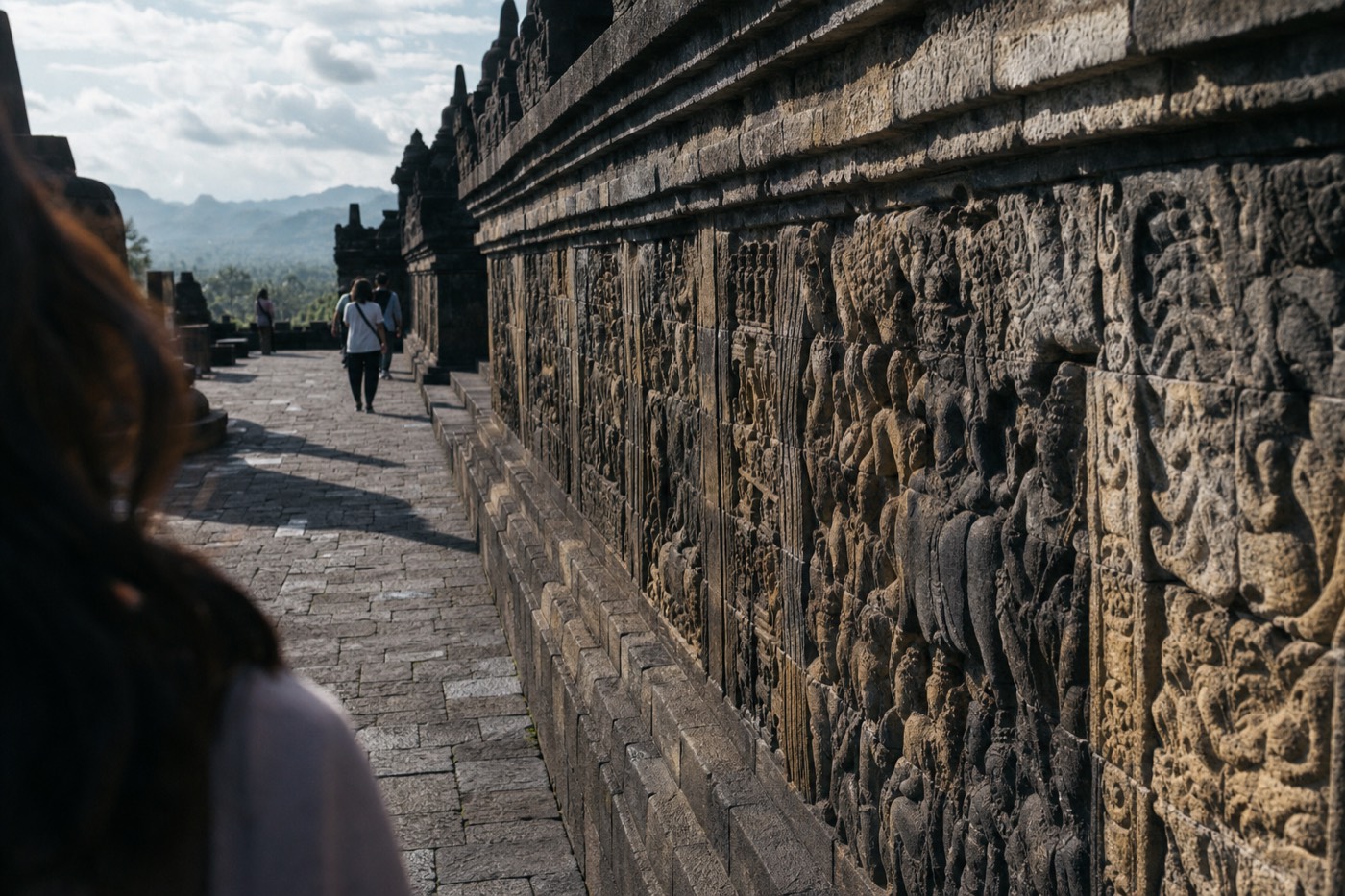
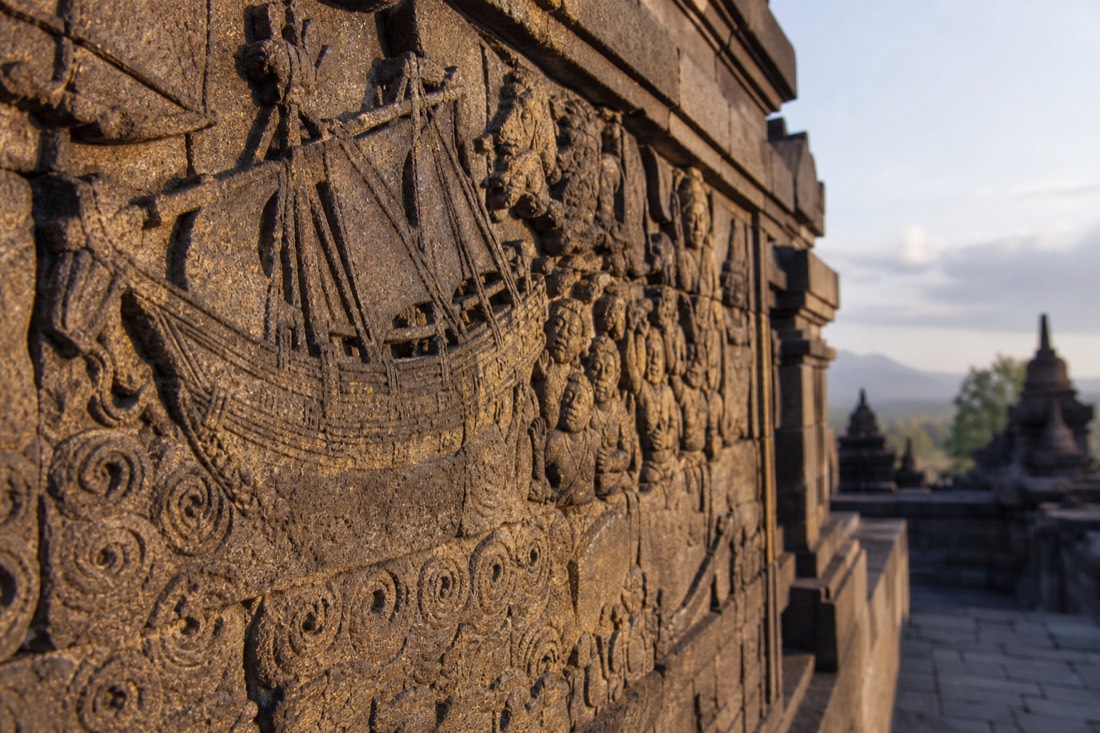
There is a panel at the foot of the eastern stairway that I stop at with every group, and almost nobody has looked at it before I point. It is warm by half past eight, the andesite gives back the heat it took yesterday, and the carving shows a man with a cooking pot. That is it. A pot. Twelve centuries of weather and the pot is still there, and above it, four galleries up and a long walk away, is the thing everyone photographs. Most people meet Borobudur in the wrong order. They arrive at the top and work out afterwards that they missed the story.
I have guided here since 2022, and this is the part of the job I care about most. Not the dates, which you can read anywhere. The way the building itself carries the argument.
When was Borobudur built, and who built it?
Construction began in 778 AD and finished around 825 AD, under the Sailendra dynasty, in the Kedu Plain of Central Java. That is roughly fifty years of work, three or four generations of masons, and it makes Borobudur older than Angkor Wat by some three hundred years and older than most of Europe's great cathedrals.
Fifty years is the number worth sitting with. Nobody who broke ground in 778 saw the main stupa closed. The Sailendras were a Mahayana Buddhist ruling house, and they were building at a moment when Central Java had the surplus, the rice, and the political will to spend half a century on a single religious object.
UNESCO inscribed the site in 1991 as the Borobudur Temple Compounds, a listing that also takes in the smaller temples of Mendut and Pawon a few kilometres east. Those three sit on a line. Whether that alignment was designed as a pilgrimage route is argued about rather than settled, and I would rather tell you it is argued about than sell you a certainty.
What is not argued about is that the same century, in the same region, produced a huge Hindu complex too. I have written about what that overlap means in the Prambanan question, because it is the single most interesting fact about 9th-century Java and it almost never gets told properly.
Why does Borobudur have nine levels?
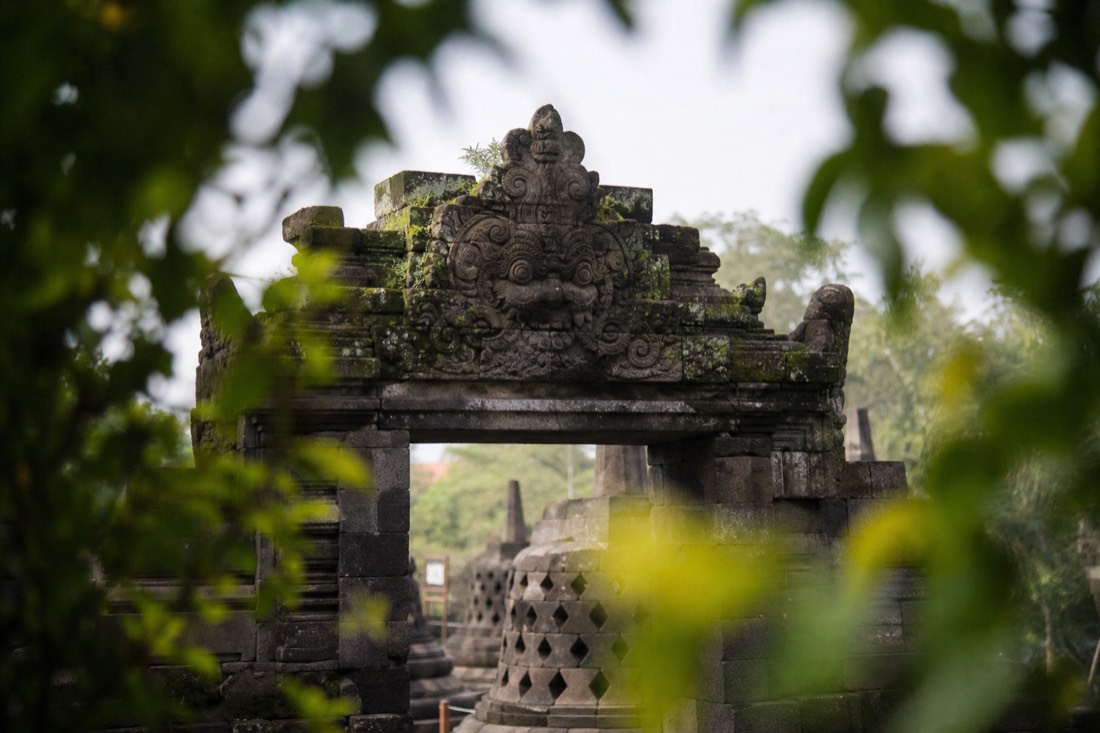
Nine platforms rise from the base: square gallery terraces below, three circular terraces above, and a main stupa about 35 metres above the ground. The shape is a Buddhist cosmology you climb. Square levels are the world of form; the circles above are formlessness; the closed stupa at the summit is what cannot be depicted at all.
Here is a place where honest sources disagree, and I would rather you heard it from me. Everyone counts nine levels. Nobody counts the square ones the same way. Britannica and UNESCO both describe five square terraces sitting on an encased base; the count of six that you will see widely, including in Indonesian material, folds that hidden base in as a square level of its own. It is a counting convention, not a factual dispute. Both descriptions are of the same building.
The three-zone reading, though, is agreed on by UNESCO and Britannica alike, and it is the reason the monument is shaped like this and not like a tower.
| Level | What it is | What you actually see |
|---|---|---|
| The base (kamadhatu) | The realm of desire. Encased by a later stone foot, so mostly hidden | Almost nothing. A small section is exposed; the Karmawibhangga reliefs behind it are covered |
| The square gallery terraces (rupadhatu) | The realm of form. Walled corridors, carved on both sides | 1,460 narrative relief panels, plus Buddha statues in niches along the balustrades |
| The three circular terraces (arupadhatu) | The realm of formlessness. No walls, no corridors, no carving | 72 perforated stupas, each holding a Buddha you can half-see through the stone |
| The main stupa | The summit, about 35 m above the base | A single sealed dome. Nothing to look at, which is the point |
Walk it and the architecture does something no diagram conveys. The galleries are narrow and high-walled, so for an hour you can see only carved stone and a strip of sky. Then you step onto the first circular terrace and the walls simply stop. The Kedu Plain opens out, Merapi sits on the horizon, and the carving ends. The building spends four galleries showing you every story it has, and then, at the top, shows you nothing. Whatever you believe, that is an extraordinary piece of design.
What do Borobudur's relief panels actually tell you?
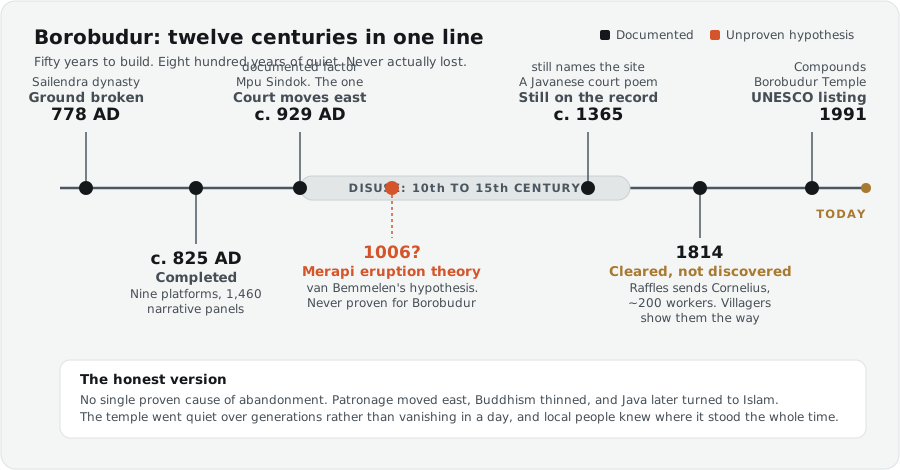
The six gallery terraces carry 1,460 narrative relief panels, meant to be read clockwise and upward, starting at the eastern stairway. They are a sequence, not decoration. Walked in order they run from ordinary human appetite at the bottom to a bodhisattva's path at the top, which is the same journey your legs are making.
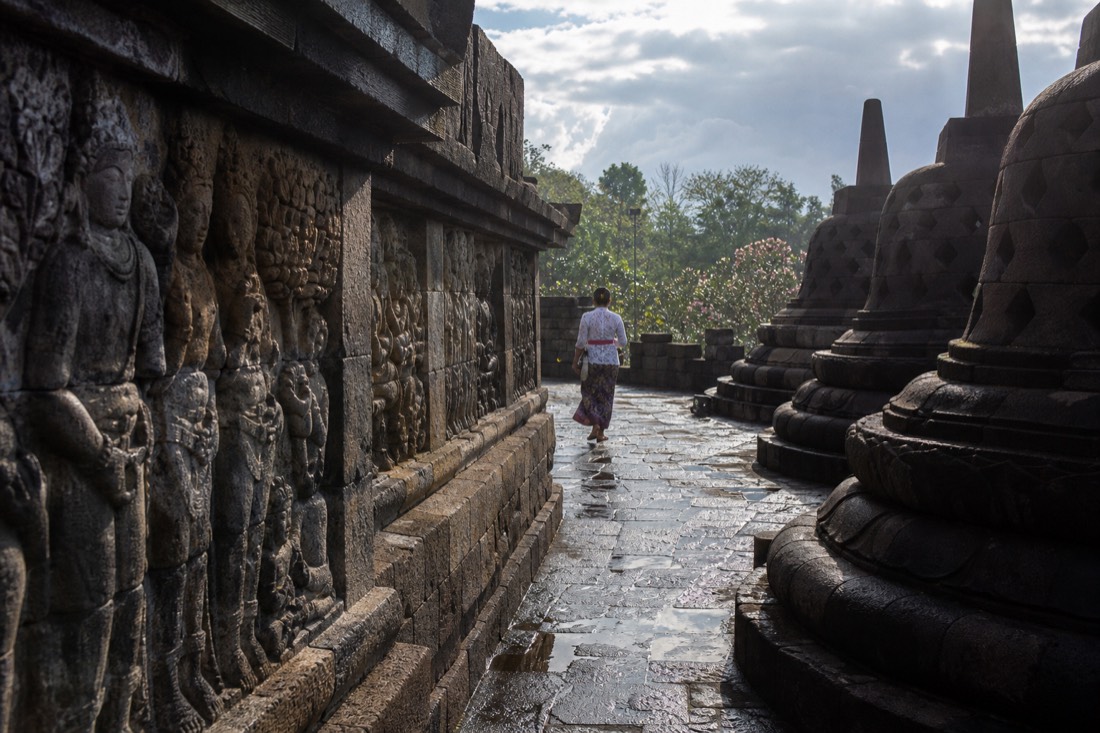
Britannica puts it plainly: a pilgrim starts at the eastern stairway and walks clockwise around each level before going up. The word for that circling is pradakshina, and it is not a suggestion the building makes. It is the only way the panels are in order.
This is the thing visitors miss, and it is the reason I get slightly evangelical. The standard visit is a sprint: gate, stairs, top, photograph, down. It treats Borobudur as a viewpoint with a climb attached. But the reliefs are sequential storytelling on a scale almost nothing else in the world attempts, and if you walk anticlockwise, or cut straight up the stairway, you are reading a book by opening it at random pages. The stone is fine either way. You are the one who loses.
You do not need to know the story cycles by name to get this. Walk one full gallery in the right direction, panel by panel, and you will feel the sequence take hold: a scene, then its consequence, then a scene that answers the first. It is the oldest trick in narrative and it is cut into rock.
Book the sunrise climb
Ready to book the sunrise climb?
Dawn from Punthuk Setumbu, then the Borobudur climb itself, with hotel pickup from Yogyakarta. Free cancellation up to 24 hours, reserve now and pay later: booking takes 2 minutes and costs nothing today.
Check live availability & prices →Why was Borobudur abandoned?
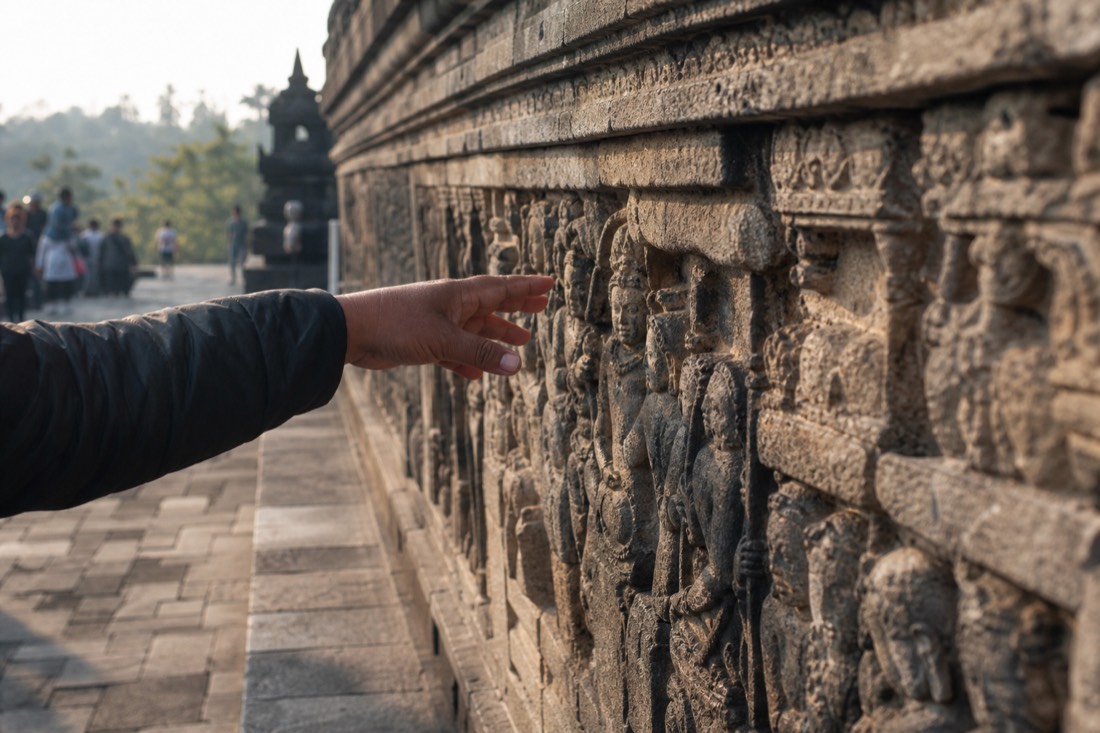
Borobudur fell into disuse somewhere between the 10th and 15th centuries, and no single cause has ever been proved. The one properly documented factor is political: the Javanese court moved east around 929 AD under Mpu Sindok, taking the patronage with it. Java's later turn to Islam finished what the move started.
I want to be careful here, because this is where most writing about Borobudur goes soft. "Mysteriously abandoned" is a good sentence and a bad summary. The honest position is that a monument this size does not need a catastrophe to be left alone. It needs the money and the court to go somewhere else, slowly, over generations.
That part is documented. Mpu Sindok shifted the seat of power from Central Java to East Java around 929 AD, a move attested in inscriptions. Central Java stopped being where decisions were made. A building that runs on royal patronage and pilgrim traffic does not fall down when that happens. It just gets quieter, and then quiet becomes normal, and then a few centuries pass.
| The claim you will read | What the evidence actually supports | How to treat it |
|---|---|---|
| The court moved east around 929 AD under Mpu Sindok | Attested in inscriptions. A real, dated event | Documented. This is the solid ground |
| A Merapi eruption in 1006 buried the temple | A mid-20th-century hypothesis (van Bemmelen). Stratigraphic evidence is not sufficient to pin abandonment on one eruption | Unproven hypothesis. Interesting, not established |
| Java's shift to Islam ended Buddhist use | Broadly accepted as a long, gradual factor, not a datable event | Accepted, but slow and diffuse |
| The temple was forgotten entirely | A Javanese court poem still refers to it around 1365, and local people knew the site when outsiders arrived | Contradicted. It was never lost locally |
| It was "rediscovered" in 1814 | Cleared under Raffles, by roughly 200 workers, guided to it by villagers | Cleared, not discovered |
There is more on this, including the sources, in the why was Borobudur abandoned guide.
Did a volcano bury Borobudur?
Probably not in the way the story is usually told. The idea that a Mount Merapi eruption around 1006 AD buried Borobudur is a hypothesis put forward by the geologist van Bemmelen in the mid-20th century. It is not proven. The stratigraphic evidence has never been enough to hang the abandonment on a single eruption.
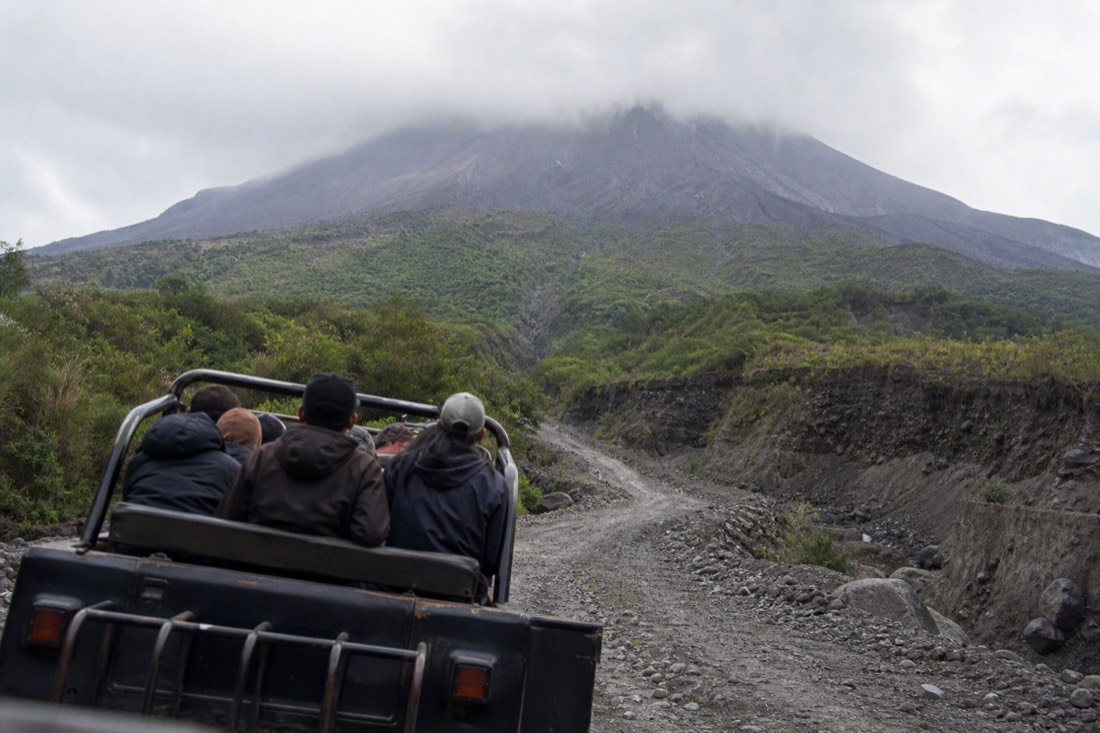
I flag this on the terraces because it is the most repeated untrue-ish thing about my temple. Blogs state it flat: a volcano erupted, ash buried the monument, Java forgot. It is a tidy story and it has a villain, and Merapi is right there on the horizon being photogenic, which does not help.
What is true is that Merapi is one of the most active volcanoes on earth and has thrown ash across this plain repeatedly, including in 2010, when Borobudur was closed and cleaned. Volcanic activity is part of this landscape's story. What has not been demonstrated is that one eruption in 1006 did the specific work of burying and ending Borobudur. A hypothesis is not a finding. Saying so out loud is not pedantry; it is the difference between history and folklore, and you deserve the first one.
Was Borobudur really rediscovered in 1814?
No, and the word is worth pushing back on. In 1814 Thomas Stamford Raffles sent H.C. Cornelius with around 200 workers to clear vegetation and soil from a site local villagers already knew about and led them to. That is a clearing, and a documentation. Nobody in the Kedu Plain needed to be told the temple was there.
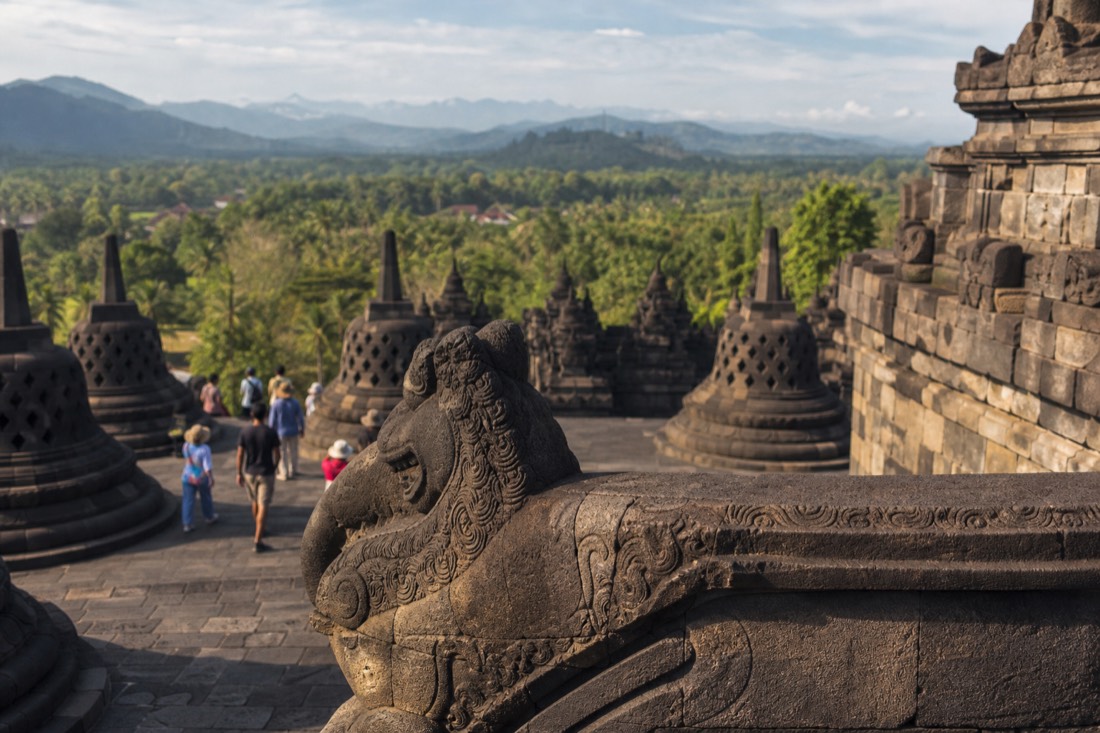
Think about the geography for a second. This is a stone hill 35 metres high in the middle of a farmed plain, in one of the most densely populated agricultural regions of Java. The idea that it vanished from local knowledge does not survive contact with the landscape. It was overgrown, not absent.
The written trail backs the villagers up. A Javanese court poem still mentions the site around 1365, four and a half centuries before Raffles. And when Cornelius arrived, the way he found the monument was by asking people who lived there.
So "rediscovery" describes a European arrival, not the temple's status. Cornelius and his workers did real and valuable labour, and the 1814 clearing is genuinely the start of the site's modern documented life. But the honest sentence is that outsiders were shown something locals had never lost. I use the word "cleared" on tour, and I would encourage you to notice which word a source picks. It tells you whose knowledge that source counts.
How long do you actually need on the terraces?
Most visitors get about 45 minutes on the structure and spend it climbing. Reading even one gallery properly takes that long on its own. If the reliefs are why you came, budget 90 minutes minimum on the monument itself, start at the eastern stairway, and go clockwise.
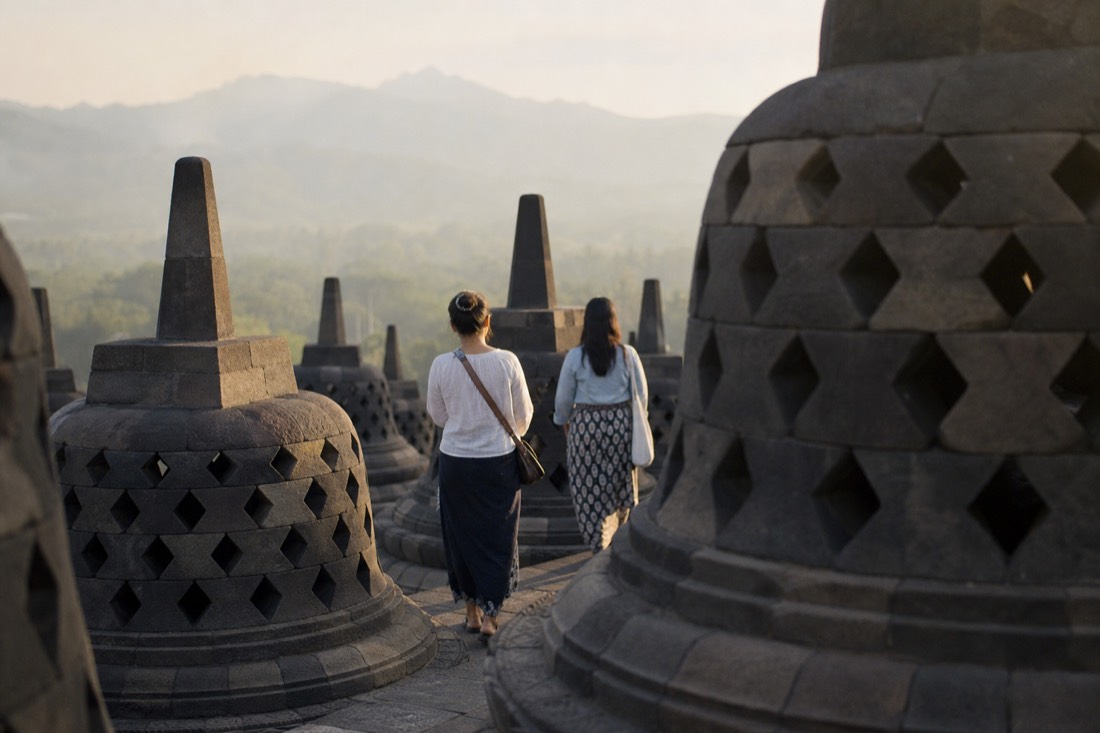
The practical constraint is real: the structure is open 08:30 to 17:00, the climb is ticketed and guided, and a group has a schedule. I am not going to pretend you can spend a day up there. But the difference between a rushed visit and a good one is mostly about the order you do things in, not the hours you have.
| What you are doing | What most visitors give it | What it actually takes | Worth it? |
|---|---|---|---|
| Climbing to the summit and back | 30 to 45 min | 25 min if you do not stop | Yes, but it is the least interesting part |
| One full gallery, clockwise, panel by panel | 5 min, usually by accident | 40 to 50 min | This is the temple. Do this one |
| All the gallery terraces properly | Nobody on a day tour | 3 hours plus | Only if you are coming back |
| The circular terraces and the 72 stupas | 15 min, mostly photographs | 20 min, and worth sitting down for | Yes. The silence after the galleries is the design working |
| The exposed section of the hidden base | Walked past | 10 min | Yes, and almost no one does it |
My honest advice: give up on seeing everything, pick the first gallery, and walk it in the right direction with someone who can tell you what you are looking at. A guide comes with the climb ticket by default, which is the single most underrated thing about how Borobudur is now ticketed. There is more on how that works in the climbing Borobudur guide, and on time budgets in how long to spend at Borobudur.
If you want the version of the day that actually gets you onto the terraces with time to use them, the Sunrise Climb & Prambanan tour is the one I would point a first-time visitor at; you can check live availability & prices on GetYourGuide for your date. It guarantees the climb ticket, which matters, because the climb is the only way onto the galleries.
And if you are weighing this against the other great temple in the region's conversation, Borobudur or Angkor Wat takes that one apart honestly, including the size claim everyone gets wrong.
The pot is still at the bottom of the eastern stairway. Somebody carved it twelve hundred years ago, on a building that took fifty years, for a religion the court would walk away from within a century and a half. Then farmers kept knowing where it was for eight hundred years while the rest of the world did not. That is the history I would want to be told, standing on it.