Guides · History
Why Was Borobudur Abandoned? What Historians Know
The honest answer starts with an admission most articles skip: historians are not certain. Here is what the evidence supports, and where it runs out.
 Written with Dewi Lestari, Borobudur temple tour guide since 2022
Short answer
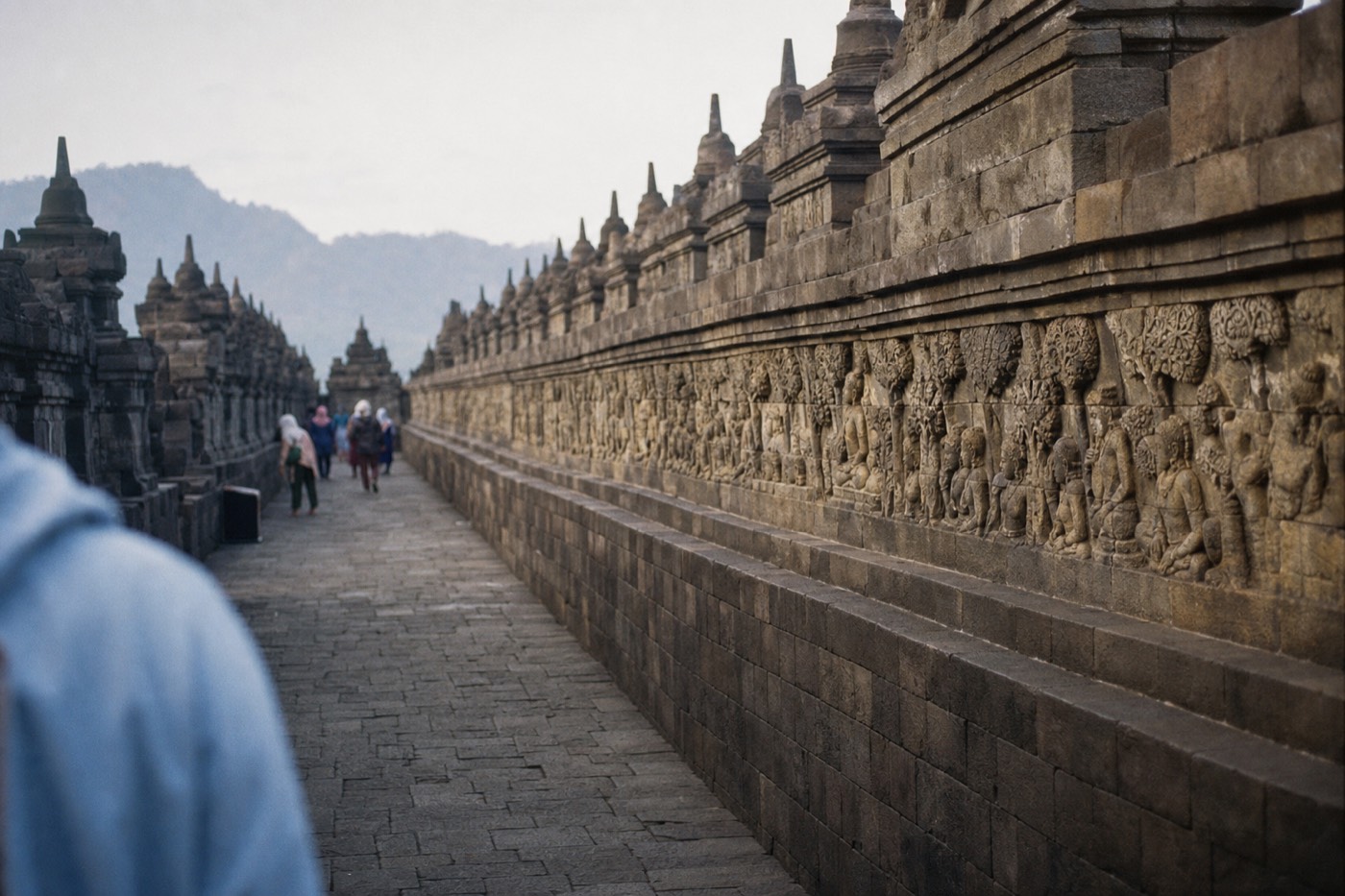
Borobudur fell out of use sometime between the 10th and 15th centuries, and no single proven cause explains it. The strongest documented factor is political: around 929 AD the Javanese court of Mataram moved from Central to East Java under King Mpu Sindok, draining the region around the temple of royal patronage. Java's later turn toward Islam, from the 13th century onward, sealed the decline. A Mount Merapi eruption around 1006 is often blamed, but that remains an unproven hypothesis. The temple was never wholly forgotten; it was cleared of earth and jungle in 1814 after Thomas Stamford Raffles sent the engineer H.C. Cornelius to find it.
The one thing the sources actually document
Borobudur opened around 825 AD as the ceremonial heart of a Buddhist kingdom on the Kedu Plain. Roughly a century later, that kingdom left. Inscriptions record that Mpu Sindok moved the Mataram court east to the Brantas River valley around 929 AD, and Central Java's great temple-building age simply stopped. Why the court moved is itself debated: volcanic activity and pressure from the rival Srivijaya empire are both proposed, neither settled. What is not debated is the effect. A monument on Borobudur's scale needed a royal engine of money, monks and maintenance, and after the move that engine was hundreds of kilometres away.
The volcano theory, labelled honestly
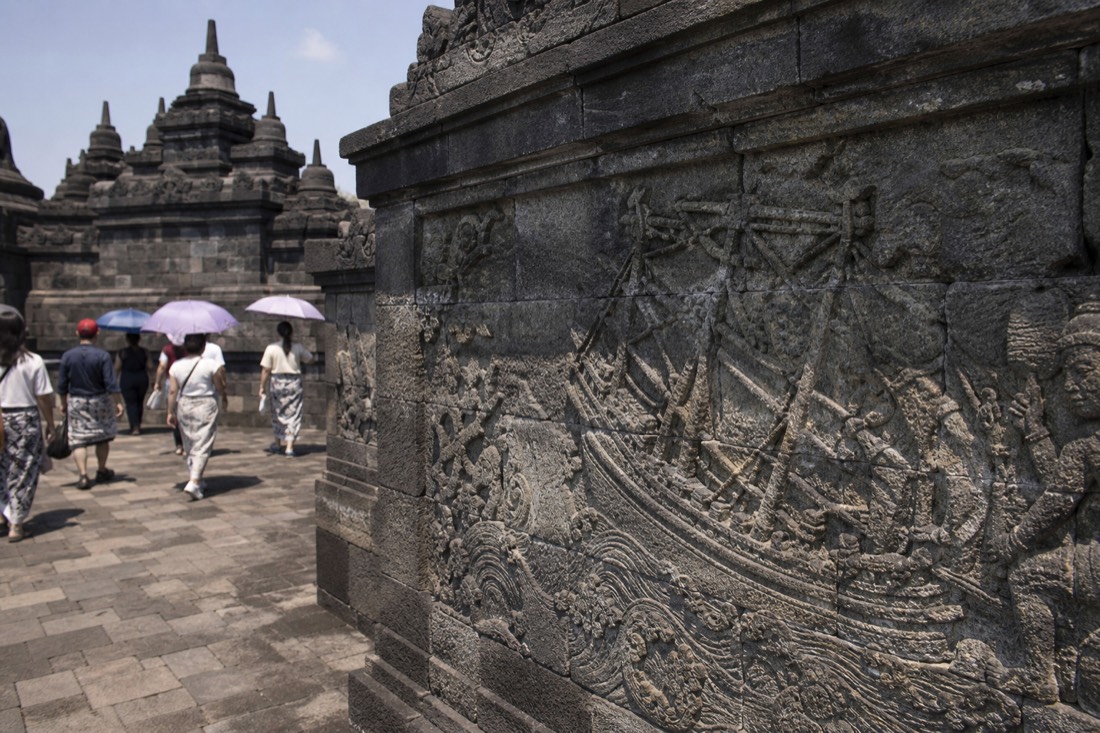
You will read that a Merapi eruption in 1006 buried the temple and drove the population out. The idea goes back to the geologist van Bemmelen in the mid-20th century, and it has never graduated from hypothesis to fact. Merapi did erupt repeatedly across those centuries, ash did settle on the monument, and the volcano still dusts it today, as in 2010. But no stratigraphic layer has been shown to prove a single catastrophic burial that emptied the region. Treat any page that states the 1006 eruption as the confirmed cause as a page that has rounded a maybe up to a fact.
Islam, and a slow fading rather than an exodus
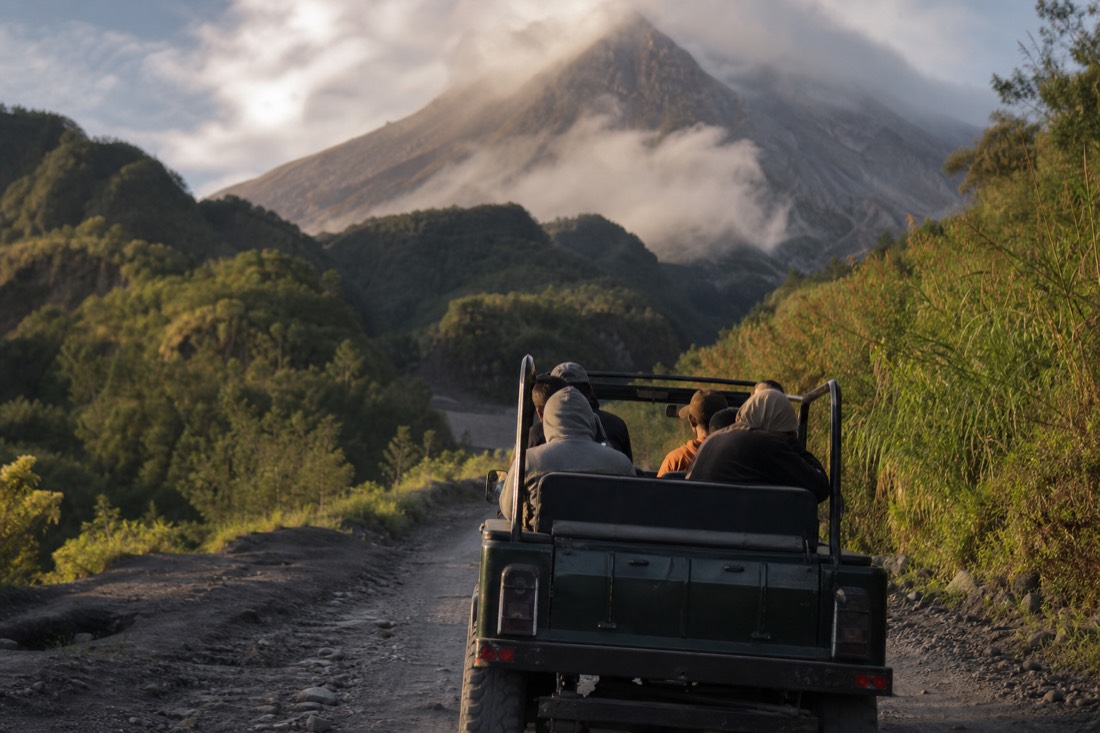
The final factor arrived slowly. Islam spread through Java from the 13th century onward, gathering pace in the 14th to 16th centuries as the Hindu-Buddhist kingdoms declined. A Buddhist monument without a Buddhist court had already lost its congregation; Java's conversion removed the possibility of one returning. There was no dramatic abandonment day. The likeliest picture is a temple sliding from sacred centre to local landmark to overgrown hill across several centuries, which is exactly why no chronicle records "the end".
Book the sunrise climb
Ready to book the sunrise climb?
Dawn from Punthuk Setumbu, then the Borobudur climb itself, with hotel pickup from Yogyakarta. Free cancellation up to 24 hours, reserve now and pay later: booking takes 2 minutes and costs nothing today.
Check live availability & prices →Forgotten? Not quite
The romantic version says the jungle swallowed Borobudur and everyone forgot. The record says otherwise. The Javanese court poem Nagarakretagama, written around 1365, still mentions "the vihara in Budur". Later Javanese chronicles knew the site too, though by then as a place of bad luck: they tell of a rebel meeting his fate there in 1709 and a crown prince who fell ill and died after visiting in 1757, taboo defied. Local memory kept the temple's location alive even as its meaning inverted from holy to haunted.
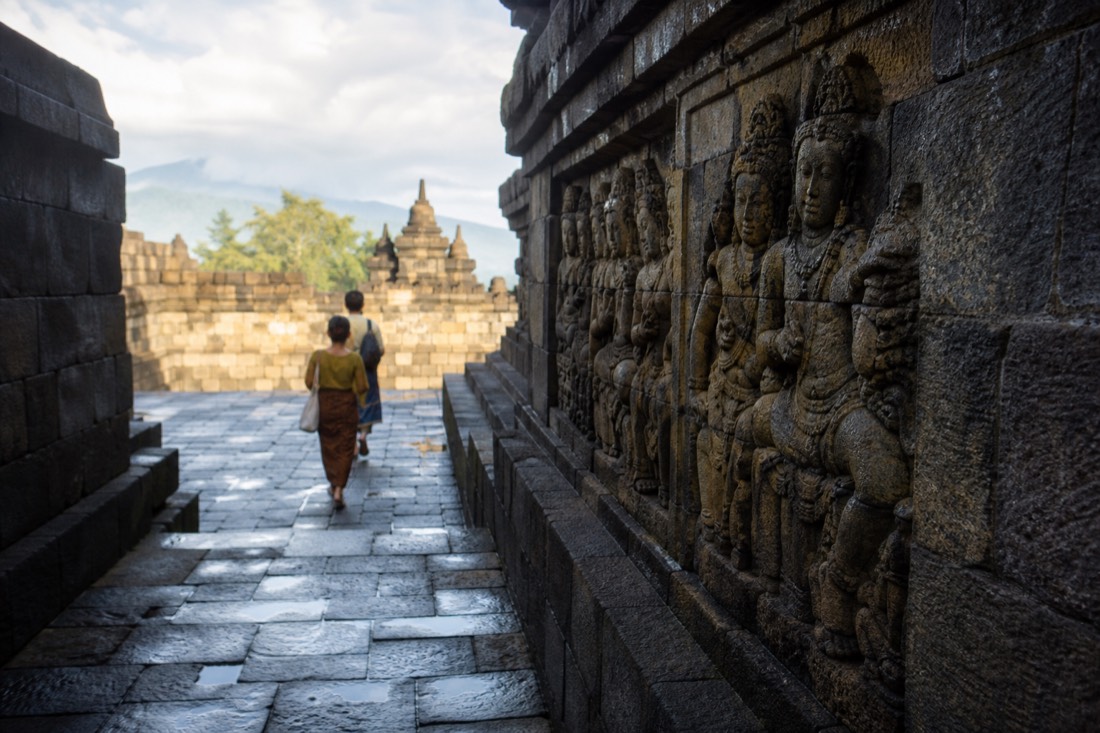
1814: cleared, not "discovered"
During Britain's brief rule of Java, Thomas Stamford Raffles was told in 1814 of a huge monument buried near the village of Bumisegoro. He sent the Dutch engineer H.C. Cornelius, who brought some 200 workers and spent two months cutting vegetation and digging away earth until the galleries emerged. "Rediscovery" flatters the colonial record, since Javanese villagers had guided the party to a site they already knew. Still, 1814 is the year Borobudur re-entered world attention, beginning the long chain of restorations that leads to the monument you can climb today, and eventually to its modern designations, which are less grand than the "seven wonders" label but real.
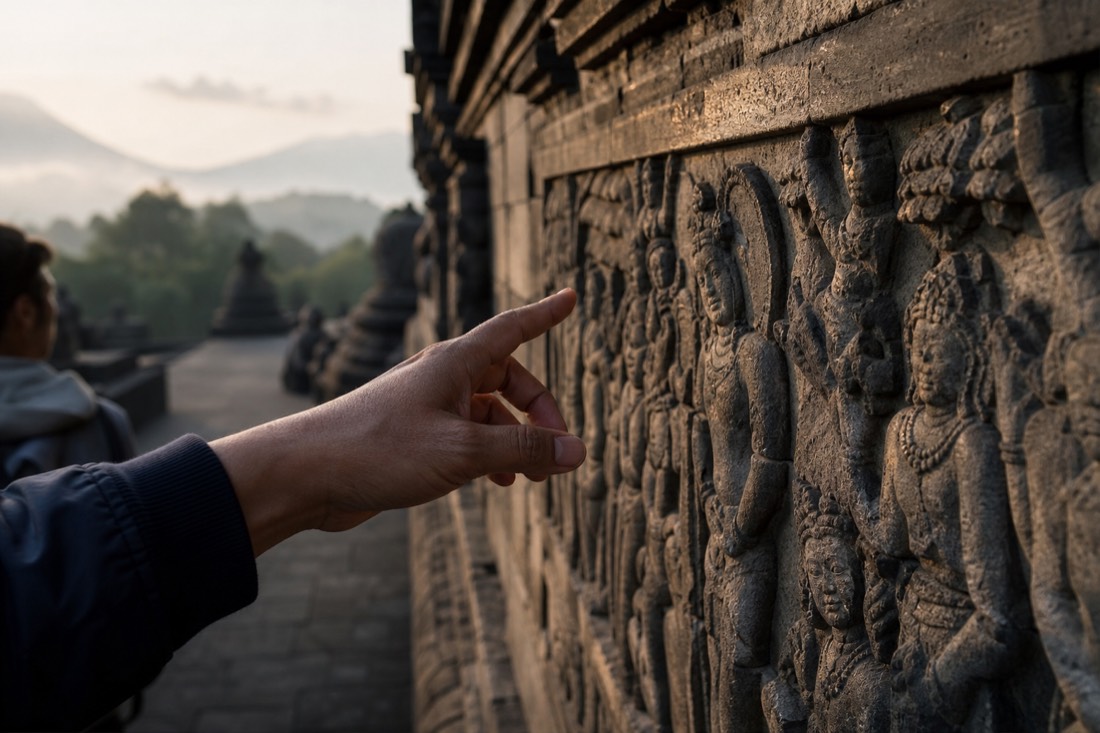
The timeline at a glance
| ~825 AD | Monument completed and in active use, Mahayana Buddhist |
|---|---|
| ~929 AD | Mpu Sindok moves the Mataram court to East Java; patronage ends |
| 1006 | Major Merapi eruption; role in the abandonment is hypothesis, not proof |
| ~1365 | Nagarakretagama still mentions "the vihara in Budur" |
| 13th–16th c. | Islam spreads through Java; Hindu-Buddhist kingdoms decline |
| 1814 | Raffles sends H.C. Cornelius; two months of clearing expose the temple |
| 1991 | UNESCO inscribes the Borobudur Temple Compounds |
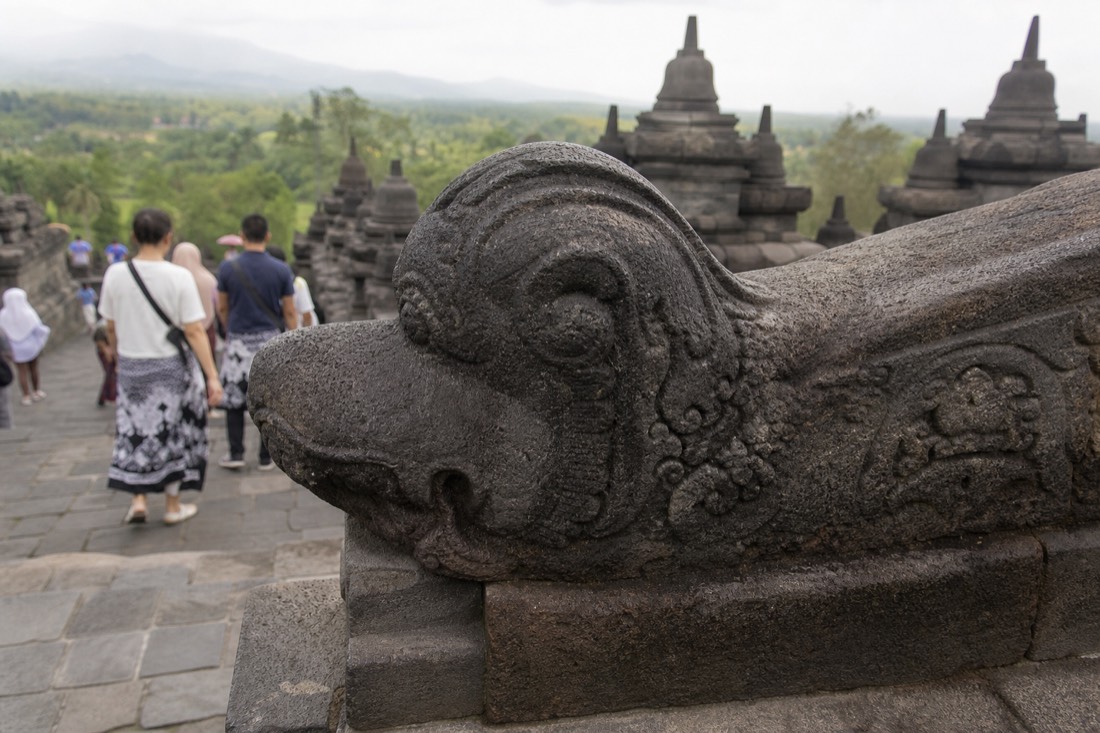
Dating follows UNESCO and the epigraphic record; where scholars disagree, we say so above rather than pick a side. {: .small}
So how do the three main theories actually stack up?
No single theory wins outright. The court's move east around 929 AD has the firmest documentary footing. The gradual turn toward Islam best explains why the temple never recovered. The volcanic theory is the weakest of the three, resting on geology that has never been tied to one burial event. Ranking them honestly means admitting they are not rivals so much as overlapping pressures.
| Theory | What supports it | What stays uncertain |
|---|---|---|
| Court moved east (~929 AD) | Inscriptions record Mpu Sindok relocating the Mataram court to the Brantas valley; Central Java's temple-building stops soon after | Why the court left is itself debated; the move drains patronage but does not by itself empty the region |
| Volcanic activity / Merapi | Merapi erupted repeatedly across these centuries and ash demonstrably settled on the monument | No stratigraphic layer proves a single catastrophic burial; the effect and timing are hypothesis, not fact |
| Slow shift to Islam | Java converted from the 13th century on as Hindu-Buddhist kingdoms declined; a Buddhist site lost its congregation | No record marks an end point; this explains non-recovery better than it explains the initial fall from use |
Read down that "uncertain" column and the pattern is clear. Each theory carries a piece of the story and none carries all of it. The court move removed the money and the monks. The religious shift closed off any return of Buddhist patronage. Volcanic ash and jungle did the physical burying, slowly, over generations. A careful historian holds all three at once rather than crowning one, and treats any confident single-cause claim with suspicion.
What does "abandoned" really mean for a place like Borobudur?
"Abandoned" is a loaded word here, and it hides a distinction that matters. Borobudur stopped being a living Buddhist monument, and it dropped out of wider written and religious record for centuries. It was never fully lost to the people living around it, who always knew a great stone hill stood among their fields. Those are two very different kinds of forgetting.
Think of it as three separate things coming apart at different times. Its function went first: once the court left and Buddhism receded, no one climbed the terraces to worship or maintain them. Its fame went next and more slowly, as the monument slid out of the courtly and religious writing that had once named it. Its location never really went at all. Villagers on the Kedu Plain lived beside the overgrown mound for centuries, and later Javanese chronicles still placed it, even if they recast it as a site of misfortune rather than merit. So when a headline says Borobudur was "lost," the accurate reading is lost to the outside world and lost as a place of use, not vanished from the map. That gap is exactly what the romantic jungle-swallows-temple version papers over.
How did a jungle-covered hill become a restored monument again?
Bringing Borobudur back was not one event but a long chain of work stretching across two centuries. The 1814 clearing under Raffles exposed the galleries; a careful Dutch restoration followed in the early 20th century; and the largest campaign of all, an Indonesia-and-UNESCO effort through the 1970s and early 1980s, dismantled and rebuilt the lower terraces to save them. Each stage fixed problems the last had left.
The 1814 work by H.C. Cornelius and his crew was clearance, not conservation. It uncovered the monument but also exposed it to weather, looting and well-meaning damage over the following decades. The first serious restoration came under the Dutch engineer Theodoor van Erp, whose team worked from roughly 1907 to 1911, resetting stones and rebuilding the upper platforms and stupas. That stabilized the crown of the monument but could not solve the deeper problem: water. Rain was seeping through the hidden fill behind the relief galleries, and the whole structure was slowly bulging and sliding.
The answer was drastic. Across the 1970s and into the early 1980s, Indonesia and UNESCO ran a rescue on a scale few monuments ever receive. Workers took the lower galleries apart stone by stone, cleaned and catalogued the panels, and laid a hidden drainage system behind them before rebuilding. Hundreds of thousands of blocks passed through the operation. The result is the stabilized, drained monument you walk today, and it is why UNESCO could inscribe the Borobudur Temple Compounds on the World Heritage list in 1991. Restoration here is not a finished thing either; conservation against volcanic ash, damp and sheer visitor numbers is ongoing.
What do historians still argue about?
The honest edge of this story is wide. Scholars still debate when exactly Borobudur fell from use, why the court moved east in the first place, whether Merapi played any real part, and even whether the decline was one steady fade or a series of separate blows. The written sources are thin, and much of the argument is inference from silence. That silence is the central problem.
The core difficulty is that almost no source describes the abandonment as it happened. We have the ninth-century construction, the roughly 929 AD court move, a stray mention in later Javanese writing, and then the 1814 clearing, with centuries of near-blank record in between. Historians read that gap through what little survives: inscriptions, later chronicles written long after the fact, geology, and the physical state of the stones. Reasonable specialists disagree about the weight each deserves. Was the court driven east by volcanic disaster, by regional rivalry, by economics, or by some mix no document preserves? Did people keep using Borobudur informally for generations after royal support ended, or did use collapse quickly? The evidence rarely forces a single answer, which is why serious writing on Borobudur is full of "probably," "likely" and "the record does not say." Anyone who hands you a tidy, dated cause has quietly discarded that uncertainty.
What do I tell visitors who ask why it was left behind?
When guests ask me why Borobudur was abandoned, I have guided here since 2022 and I give them the truthful version: nobody knows for certain, and that is part of what makes the place remarkable. I walk them through the court leaving, the slow religious change and the ash from Merapi, and I am careful to say which parts are documented and which are guesswork. Honesty lands better than a neat legend.
What I have learned standing on these terraces with thousands of visitors is that people do not want a fairy tale. They want to understand. I point up toward Merapi, still smoking on a clear morning, and I explain that the volcano is a real presence but an unproven culprit. I tell them the villagers around us never truly forgot this hill, that their own ancestors likely walked past it for centuries. And I remind them that the monument they are climbing was rescued, taken apart and rebuilt in living memory. Standing where a lost century meets a restored monument does something to people. The uncertainty, told straight, makes the reliefs feel closer, not further away.
Common questions
When was Borobudur abandoned?
Sometime between the 10th and 15th centuries, per UNESCO's World Heritage record, and probably gradually. A court poem still mentioned it around 1365, so the fade took centuries rather than a single year.
Did a volcanic eruption bury Borobudur?
Unproven. The 1006 Merapi hypothesis is a real scholarly proposal, but the evidence for one catastrophic burial is too thin to state as fact. Ash and jungle did cover the monument over time.
Who rediscovered Borobudur?
Raffles set it in motion in 1814; H.C. Cornelius and about 200 workers did the clearing. Local Javanese had never entirely lost track of the site.
The abandoned centuries are part of what makes standing on the terraces strange and moving now. If the history has you weighing a trip, our answer to whether Borobudur is worth visiting is an honest place to start, and the Sunrise Climb & Prambanan tour puts you on those terraces with a guide; check live availability & prices on GetYourGuide.