Guides · Worth it?
Is Borobudur Worth Visiting? An Honest Answer
A straight answer, the real reasons behind it, and the parts of the trip nobody puts in the brochure.
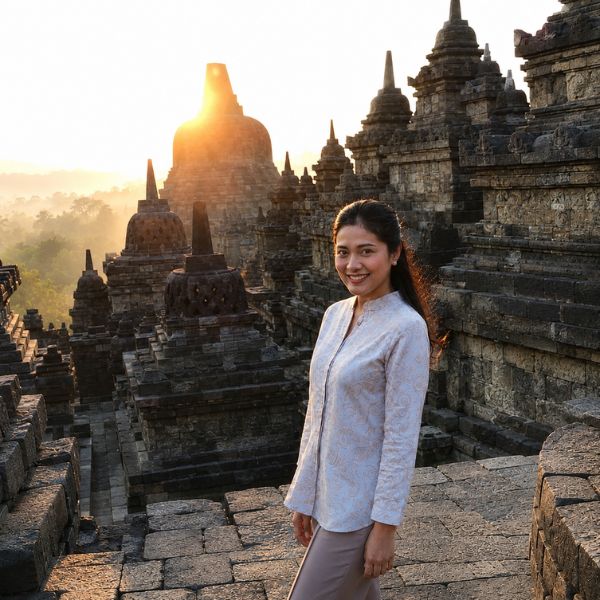 Written with Dewi Lestari, Borobudur temple tour guide since 2022
Short answer
Yes, for most travellers. Borobudur is the largest Buddhist temple on earth, a ninth-century monument wrapped in 1,460 narrative relief panels, standing on a volcano-ringed plain about an hour northwest of Yogyakarta. The honest caveats: it eats at least half a day, midday heat on the open terraces is punishing, and foreign visitors buy the pricier structure-climb ticket, not a cheap grounds pass. If ancient stone carving leaves you cold it may not repay the drive. Almost everyone else finds it does.
Why it earns the trip
Three things separate Borobudur from every other temple you could spend a morning on.
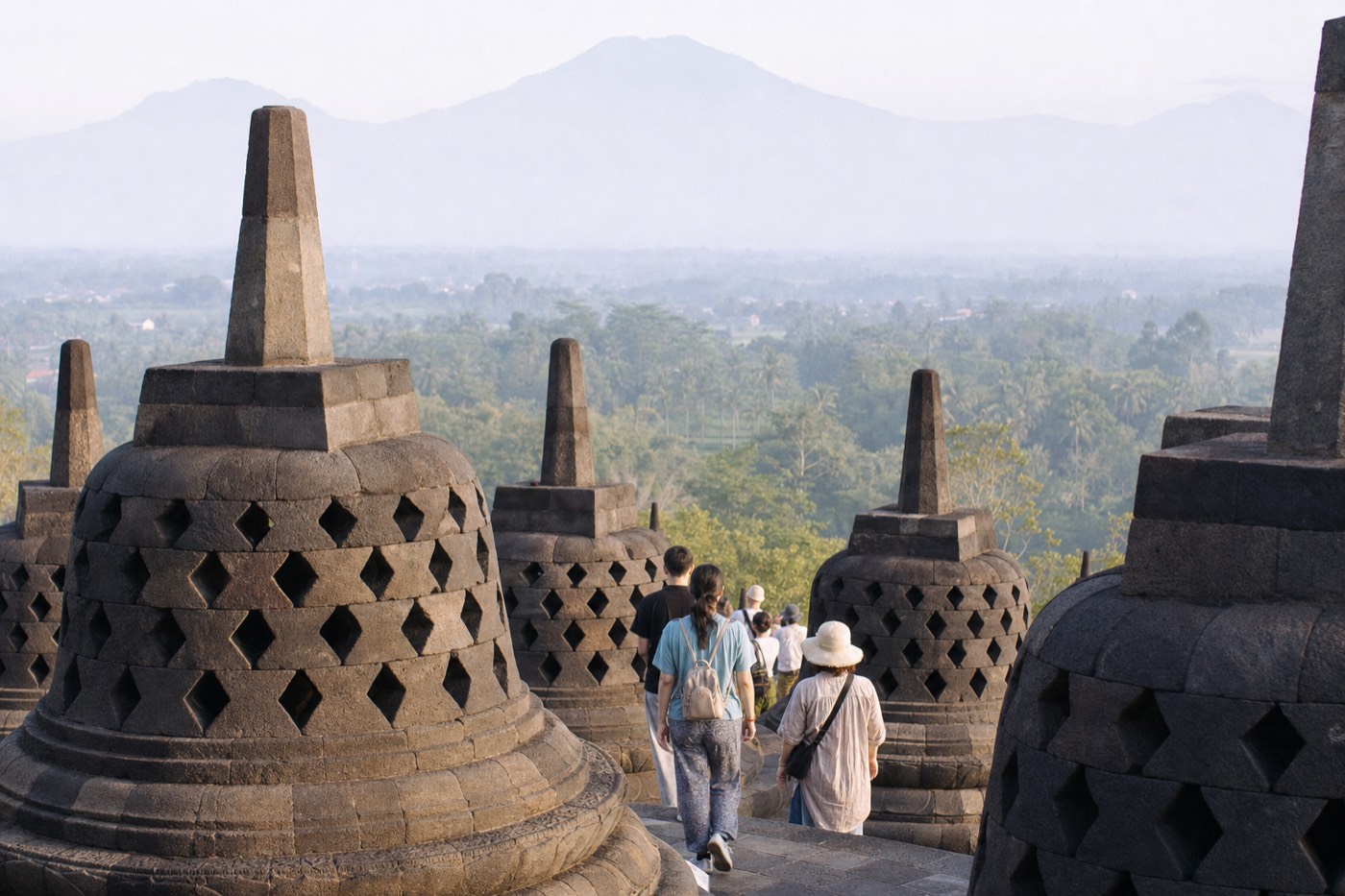
Scale with a single shape. This is the world's largest Buddhist temple, a status UNESCO records in its World Heritage listing, yet it is one building, not a scattered complex. You take it in whole from the ground, then climb through it level by level. Construction began in 778 AD and the monument opened around 825 AD, which means the thing you are standing on predates Angkor Wat by roughly three centuries.
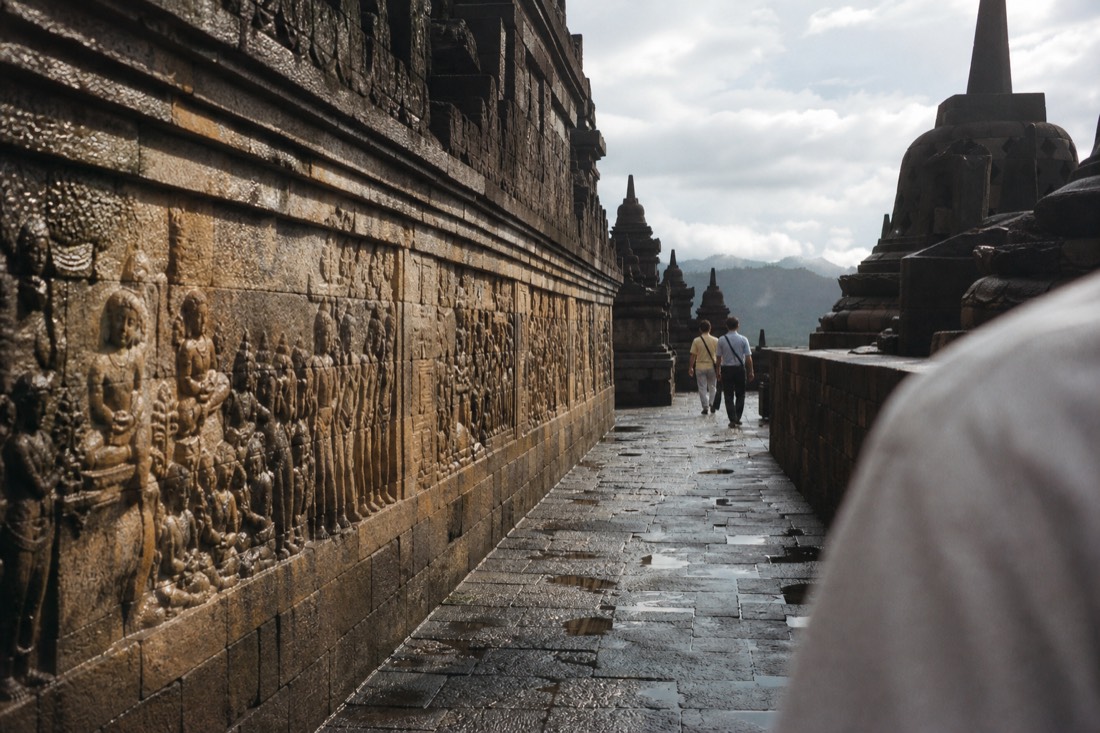
The panels are a book. The 1,460 narrative reliefs are not decoration. Walked in order, terrace by terrace, they tell Buddhist stories from earthly desire at the base to enlightenment at the open upper platforms. A guide comes included with the structure-climb ticket, and this is the rare place where that genuinely matters, because unguided visitors walk past the plot.
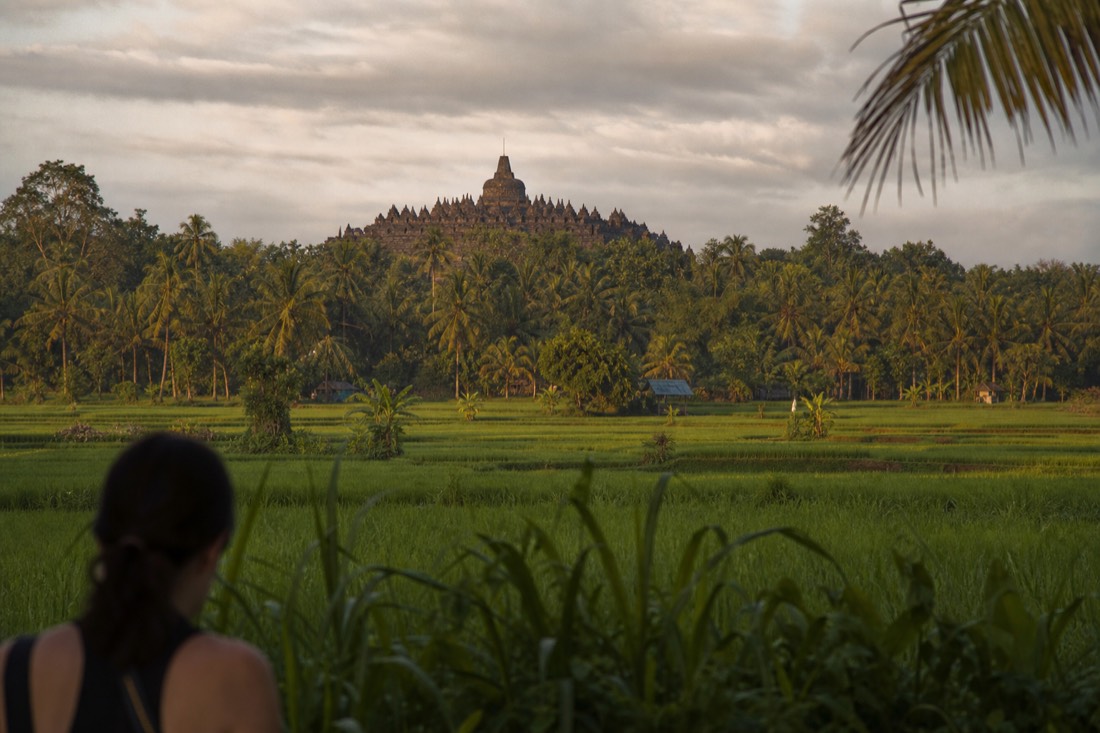
The setting. The temple sits on the Kedu Plain with volcanoes on the horizon. At dawn, seen from the Punthuk Setumbu viewpoint about 2.5 km away, it rises out of mist with Merapi behind it. That view is the photograph that made you consider this trip in the first place.
The honest case against
Borobudur is not a stroll from your hotel. It sits in Magelang Regency, about an hour's drive northwest of Yogyakarta, so with time on site you are committing at least half a day. The terraces are exposed stone; by late morning the heat is real and shade is nearly nonexistent. And ticketing is tiered: the cheaper grounds ticket is sold to domestic visitors only, so a foreign visitor's entry is the structure-climb ticket, whose price appears in the official booking flow. Our tickets guide walks through exactly how that works.
None of these are reasons to skip it. They are reasons to go early, carry water, and know the cost before you commit.
Book the sunrise climb
Ready to book the sunrise climb?
Dawn from Punthuk Setumbu, then the Borobudur climb itself, with hotel pickup from Yogyakarta. Free cancellation up to 24 hours, reserve now and pay later: booking takes 2 minutes and costs nothing today.
Check live availability & prices →What the visit looks like in practice
| Where | Magelang Regency, Central Java, about 1 hour northwest of Yogyakarta |
|---|---|
| Built | Started 778 AD, opened around 825 AD |
| Climb hours | Every day, 08:30 to 17:00; ticket includes a guide and Upanat sandals |
| Relief panels | 1,460 narrative panels read from base to summit |
| Time needed | 2 to 3 hours on site; a half day with travel from Yogyakarta |
| Sunrise option | Tour sunrise is from Punthuk Setumbu, a hill ~2.5 km away, then the climb after opening |
The classic first-timer shape is a dawn start: the Punthuk Setumbu sunrise, then the temple as it opens, before the heat and the crowds arrive together. That is precisely the itinerary of the most-booked tour we list, the Sunrise Climb & Prambanan, rated 4.9 across 1,723 GetYourGuide reviews; check live availability & prices on GetYourGuide. Prefer a normal wake-up? A day tour covers the same monument in kinder light for your sleep schedule, if not for your photographs.
Who should think twice
Travellers with one day in Yogyakarta and no appetite for temples should weigh Borobudur against simply enjoying the city. Anyone whose knees object to stairs should know the climb is the point: the reliefs and stupas live on the upper terraces. And if you have already decided ninth-century Buddhist art is not your thing, no viewpoint photo will change the arithmetic of a half-day round trip. Everyone else: go, and go early.
Who is Borobudur emphatically worth it for, and who might skip it?
If you came to Java for its history, its art, or its landscape, Borobudur is not a maybe. It is the reason to be in Yogyakarta. The travellers who leave lukewarm are usually temple-fatigued, beach-focused, or expecting a quick photo stop rather than a two-hour climb through a stone narrative.
The honest way to answer "worth it" is to stop pretending everyone travels for the same thing. A carving that stops one visitor mid-step is background noise to the next. Here is how it lands by traveller type, based on the people I walk through the galleries.
| Traveller type | Verdict | Why |
|---|---|---|
| History and culture lover | Absolutely worth it | The full narrative sequence, read base to summit with a guide, is the payoff. This is the single best half-day in Central Java for you. |
| Photographer | Worth it, plan the light | The volcano-backed dawn frame and the latticed upper stupas are the shots. Midday flattens everything, so go early or accept harsher images. |
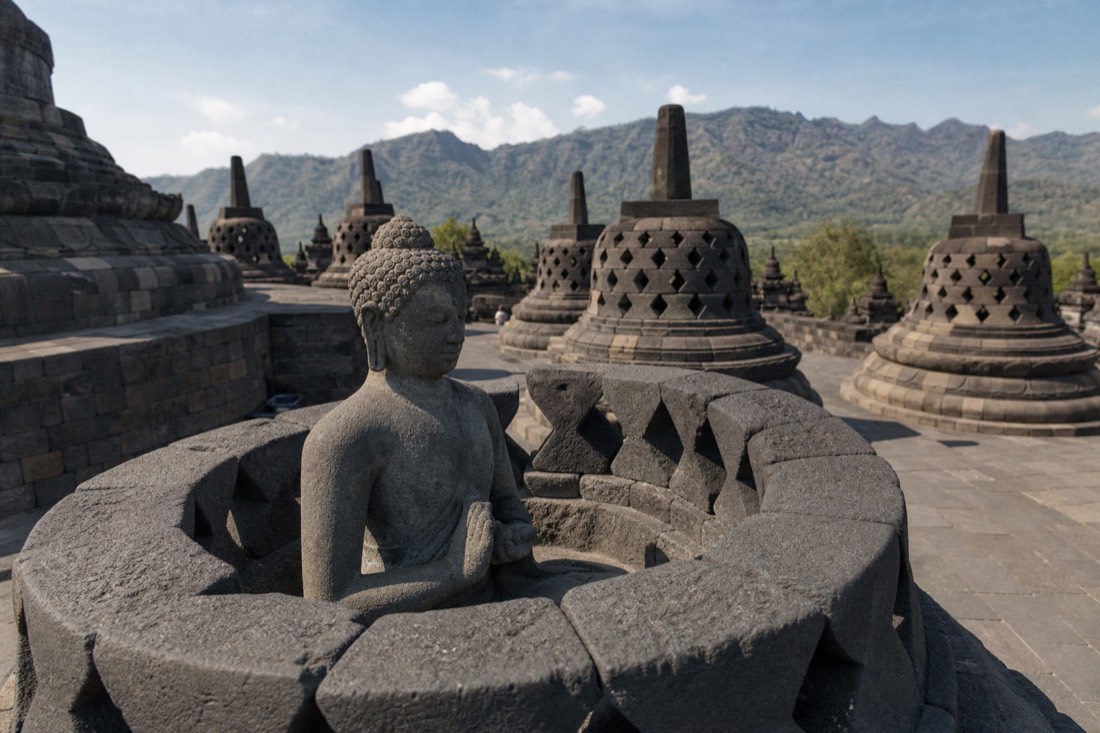
| Families with children | Worth it, manage the stairs and heat | Kids like the Buddha-in-stupa reveal and the open terraces, but small legs tire on the climb. Morning slots and water carry the day. |
| Beach and resort seeker | Skippable | If your trip is built around coast and downtime, a half-day inland round trip may not fit the mood you came for. |
| Temple-fatigued traveller | Depends | If you have just done Angkor or a dozen Thai wats, one monument read as a story still feels different. If you are truly done with old stone, trust that. |
Notice that "skip it" is a real answer here, not a hedge. I would rather a beach traveller spend their one free morning somewhere they will love than trudge a terrace out of obligation. For everyone in the top three rows, though, the arithmetic is not close.
What does a morning at Borobudur actually feel like, hour by hour?
A first-timer's morning runs roughly four hours door to door: a dark pickup, a hilltop dawn looking toward the temple, the drive to the gate, the guided climb through the reliefs as the site opens, then the terraces and descent before midday heat takes over. You are usually back at breakfast by mid-morning.
Here is the shape I set expectations around when I meet a group in the dark. Times shift with season and traffic, so treat this as rhythm, not a stopwatch.
| Time (approx) | What happens | What it feels like |
|---|---|---|
| 04:00 | Hotel pickup in Yogyakarta, drive northwest | Quiet, sleepy, headlamps and coffee in the van |
| 04:45 | Short uphill walk to Punthuk Setumbu | Cool air, a path of phone-torches, anticipation |
| 05:15 | Dawn from the hill, Borobudur emerging from mist | The postcard moment, temple small on the plain with Merapi behind |
| 06:30 | Drive to the monument as it opens | Light climbing, first heat of the day arriving |
| 07:00 | Guided climb, reliefs read base upward | The story unfolds, panel by panel, the part people remember |
| 08:15 | Upper terraces, stupas, open sky | Space opens out, the crowd thins if you moved early |
| 09:00 | Descent and grounds | Warmth building, shade running short, good time to leave |
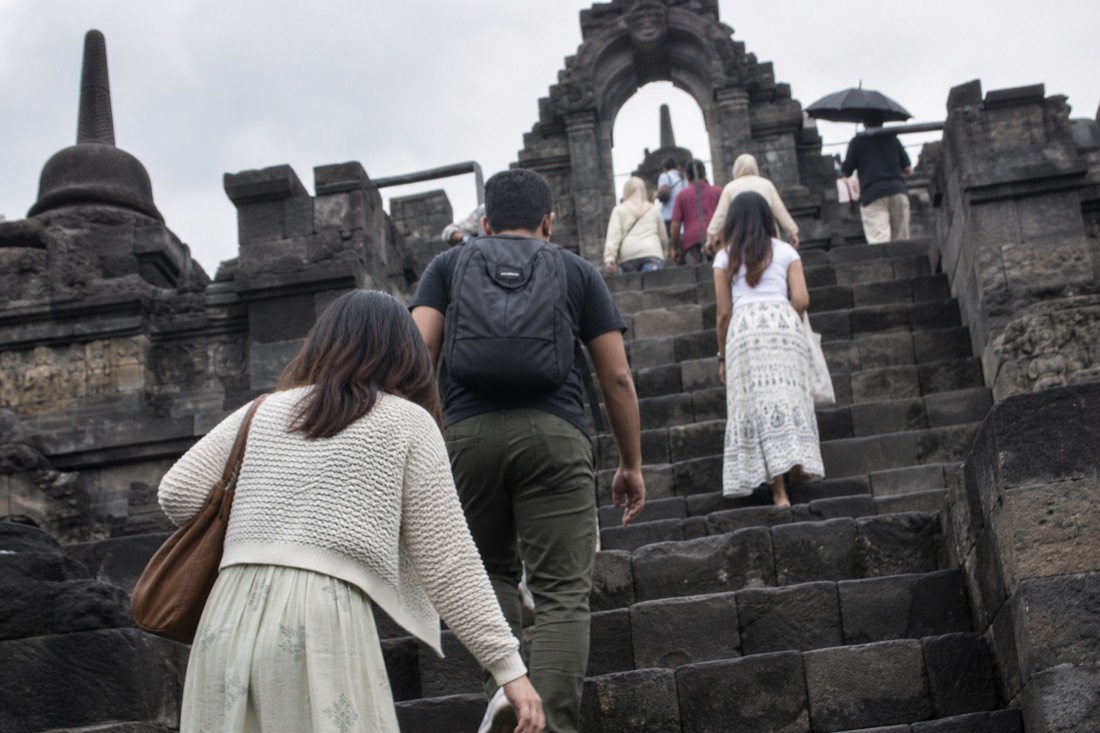
The thing that surprises people is how much the reliefs slow you down once you understand you are reading, not just looking. A visitor rushing the lower galleries covers them in ten minutes. A visitor who knows the base panels show earthly desire and the summit shows release covers them in forty, and remembers them for years. The climb itself is steep in places, real stone steps, and the included Upanat sandals protect the ancient stone rather than your knees, so a slow pace is the honest pace.
What are the honest downsides, and what is the truth about sunrise?
Three things catch visitors out: the heat on exposed terraces by late morning, the crowds that arrive with the sun, and the sunrise itself. Almost every "Borobudur sunrise" tour watches dawn from Punthuk Setumbu hill, about 2.5 km away and facing the monument, not from the temple top. That is a genuinely lovely view, but it is not the same product.
Let me be plain about the sunrise question because it is the one that causes disappointment. The featured tours, including the one this site lists, take you to Punthuk Setumbu, a hill roughly 2.5 km from Borobudur, where you watch the sun come up with the temple sitting small and misty on the plain in front of you. You are looking toward Borobudur. You are not standing on it at dawn. There is a separate, official monument-dawn experience that begins around 04:00 and is capped at 100 people a day, sold on its own, and the hill tours do not grant access to it. If your heart is set on standing on the upper terrace as the sun breaks, that is a different ticket to arrange, and it books out. If you simply want the classic misty-temple-and-volcano photograph, the hill is exactly right and far easier to secure.
The other two downsides are more mundane and more fixable.
| Downside | Reality | How to handle it |
|---|---|---|
| Heat | Terraces are open stone with almost no shade; late morning is punishing | Start at dawn, be descending by 09:00, carry more water than feels necessary |
| Crowds at peak | Tour groups and weekend domestic visitors cluster from mid-morning | The early climb slot puts you ahead of the wave; move upward, not laterally |
| Sunrise expectation | Hill viewpoint, not monument top, on standard tours | Book the hill for the photo, or arrange the capped 04:00 monument ticket separately if you want the terrace at dawn |
None of this is a reason to stay in bed. It is a reason to go early and know what you booked. The visitors who come away thrilled are almost always the ones who were on the terrace by seven and gone before the heat.
How does Borobudur compare to the region's other big sights?
Borobudur and Prambanan are the two headline monuments near Yogyakarta, and they are complementary rather than competing: one Buddhist, one Hindu, both ninth-century, both a short drive from the city. Yogyakarta itself adds palace culture, batik, and food. Most well-planned trips do Borobudur at dawn and Prambanan by late afternoon in a single day.
People often ask which one to choose, and my honest answer is that the good tours do not make you choose. The two temples sit on opposite sides of Yogyakarta, so pairing them is the standard, not a stretch.
| Sight | Character | Why still worth it alongside Borobudur |
|---|---|---|
| Borobudur | One Buddhist monument, read base to summit | The narrative climb and the volcano-plain setting; the morning anchor of the trip |
| Prambanan | Soaring Hindu temple cluster, spires not terraces | A completely different silhouette and religion; best in late-afternoon light, which pairs naturally with a Borobudur dawn |
| Yogyakarta city | Sultan's palace, batik workshops, street food | Context and rest between the temples; the human, living side of a region famous for its stone |
Seen together, the region tells one story from two faiths within a few generations of each other, which is why the classic day tour runs Borobudur then Prambanan rather than picking a side. If you have only one day and one temple in you, take Borobudur for the scale and the story, then let the city fill the rest. If you have the appetite, do both, and let Yogyakarta's palace and kitchens carry the middle of the day. The Sunrise Climb & Prambanan itinerary exists precisely because that sequence works.
Common questions
How long do you need at Borobudur?
Two to three hours at the temple, plus about an hour's drive each way from Yogyakarta. Most visitors fold it into a single-day tour with Prambanan.
Is Borobudur worth it if you have already seen Angkor Wat?
Yes, because they are different experiences. Angkor is a sprawling complex explored over days; Borobudur is one monument read from base to summit in a morning. We compare the two honestly in Borobudur vs Angkor Wat.
Can you do Borobudur as a day trip from Yogyakarta?
Easily. It is about an hour northwest of the city, and the standard day tours pair it with Prambanan so both headline temples fit between breakfast and dinner.