2026-06-09
Borobudur or Angkor Wat: Which One Should You Actually Visit?
Angkor Wat is the largest religious monument; Borobudur is the largest Buddhist temple. Different records, different trips. An honest guide's comparison.
 By Dewi Lestari, Borobudur temple tour guide since 2022
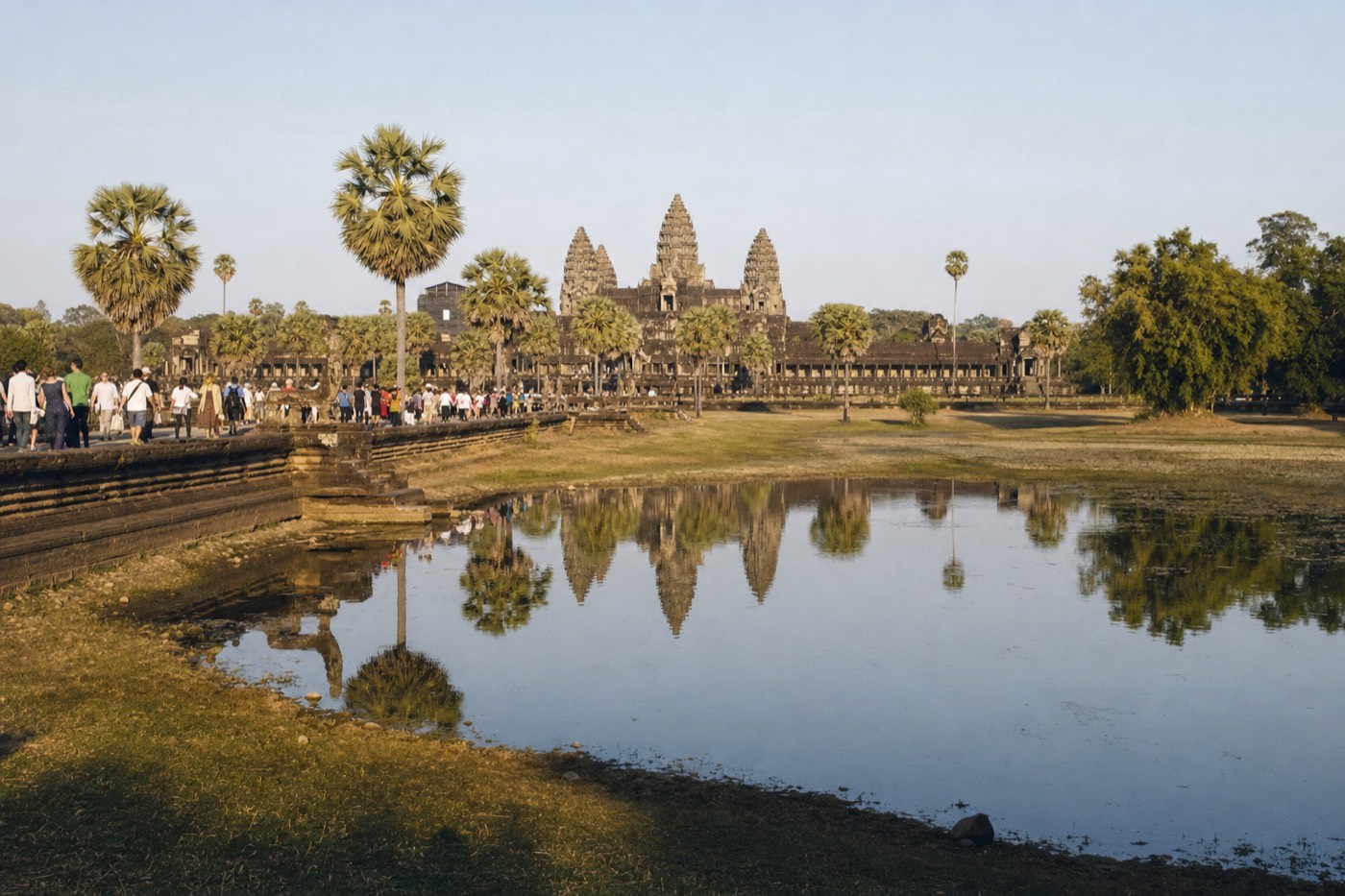
A man on my tour last dry season had been to Angkor three times. He said it apologetically, the way people do when they think they are about to insult your temple, and then he spent forty minutes on the second gallery not saying anything at all. At the bottom he told me the thing I have been quoting ever since: Angkor made him feel small, and this made him feel slow. He meant it as a compliment to both.
I guide at Borobudur. You should read what follows knowing that. I am also not going to tell you Angkor Wat is overrated, because it is not, and because you would be right to stop trusting me the moment I did.
Which is bigger, Borobudur or Angkor Wat?
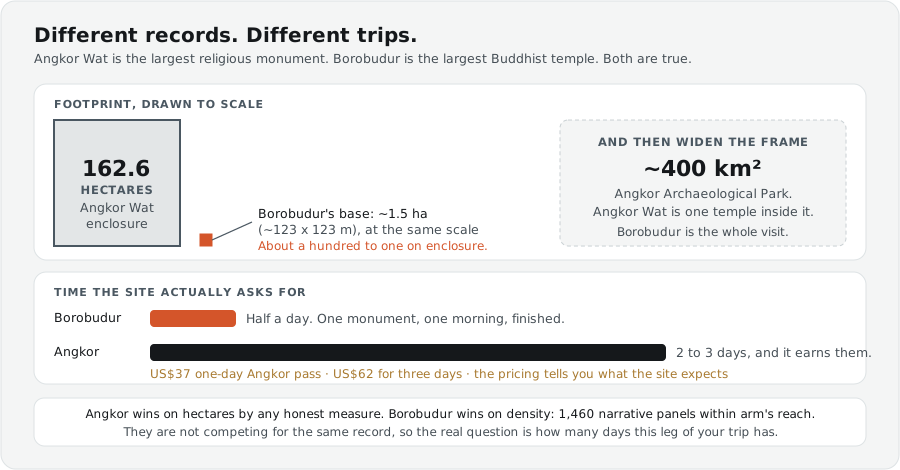
Angkor Wat, and it is not close. But the two hold different records and are not competing for the same one. Angkor Wat is the largest religious monument in the world, with a walled enclosure of 162.6 hectares. Borobudur is the largest Buddhist temple, on a base of roughly 123 by 123 metres.
This is where almost every comparison online falls over, so it is worth slowing down. Those two superlatives are not rival claims to the same title. One is about total religious monuments, of any faith, measured by enclosure. The other is a category record within Buddhism. Both are true at once. A page that says "Borobudur is bigger than Angkor Wat" and a page that says "Angkor Wat is bigger" are usually both quoting real facts and both leaving out the qualifier that makes them make sense.
The scale gap is genuinely enormous. Angkor Wat's enclosure alone is around 162.6 hectares. Borobudur's base is about 1.5 hectares. That is roughly a hundred to one. Then widen the frame again: the Angkor Archaeological Park covers something like 400 square kilometres of temples, reservoirs and forest, and Angkor Wat is one temple inside it.
So Angkor wins on size by any honest measure. What Borobudur has is density, and that turns out to matter more for how you spend a day than the hectares do.
| Borobudur | Angkor Wat | |
|---|---|---|
| The record it actually holds | Largest Buddhist temple | Largest religious monument |
| Footprint | ~123 x 123 m base (~1.5 ha) | 162.6 ha walled enclosure |
| Built | 778 to c. 825 AD | Early 12th century |
| Under | The Sailendra dynasty | Suryavarman II |
| Faith | Mahayana Buddhist throughout | Hindu, later Buddhist |
| The wider site | Compounds with Mendut and Pawon | ~400 km² archaeological park |
| Nearest city | Yogyakarta, ~1 hour away | Siem Reap, 15 to 20 min away |
| UNESCO | Inscribed 1991 | Inscribed 1992 |
Which is older, Borobudur or Angkor Wat?
Borobudur, by roughly three hundred years. Borobudur was begun in 778 AD and finished around 825 AD. Angkor Wat went up in the early 12th century under Suryavarman II. Borobudur was already four centuries old and long out of court favour before the first Angkor Wat stone was cut.
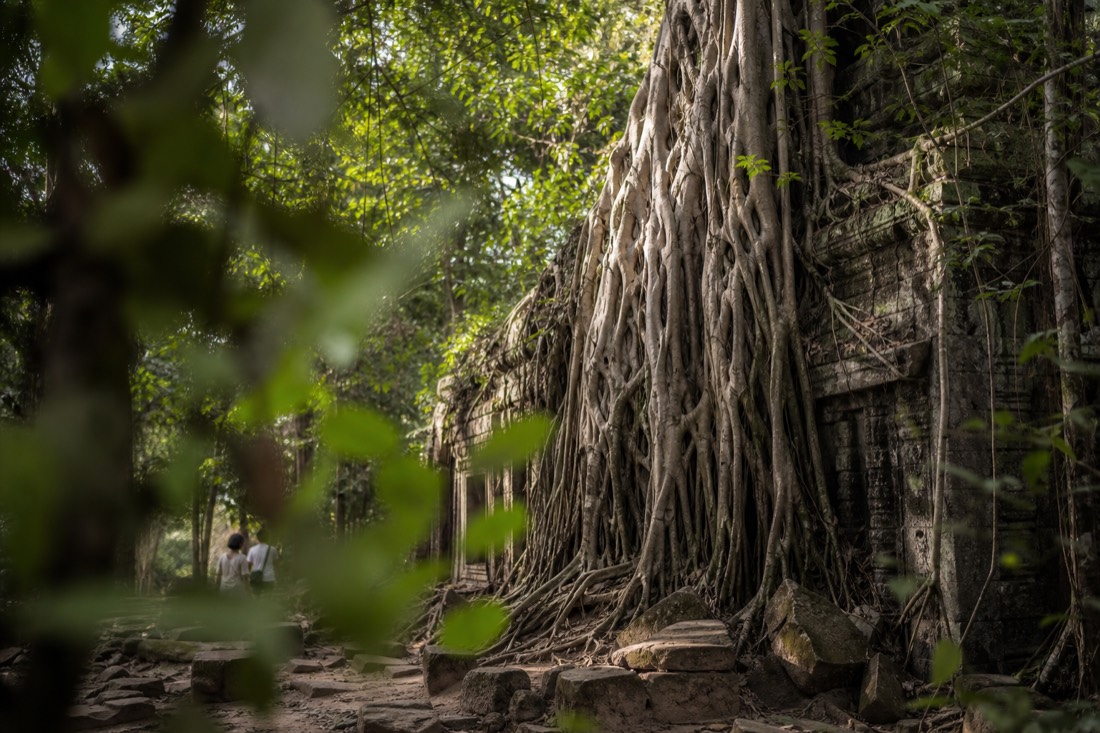
Britannica places Angkor Wat in the 12th century under Suryavarman II, built as a Hindu temple to Vishnu and turned to Buddhist use later. Borobudur went the other way round in a sense: it was Mahayana Buddhist from the first stone and never converted, it was simply left.
The three-century gap changes how you should read them. These are not two expressions of one moment in Southeast Asian religious architecture. Borobudur belongs to a 9th-century Javanese world that also built Prambanan; Angkor Wat belongs to a Khmer empire at its 12th-century height, in a different country, a different language, and a different political order. Comparing them is a bit like comparing Chartres with the Parthenon. Both are stone, both are sacred, and the interesting part is the distance between them.
There is a nice irony in the timing, too. By the time Angkor Wat was being built and admired, Borobudur had already been through the eastward shift of the Javanese court and was sliding towards the quiet centuries. One temple's beginning and the other's ending very nearly overlap.
How much time does each one actually need?
This is the real difference, and it decides the question. Borobudur is a half-day: one monument, a morning, done properly. Angkor wants two to three days minimum, because the park is 400 square kilometres and the temple is the beginning of it. One fits inside a trip; the other is the trip.
I think the time budget is a more useful lens than the size record, and nobody frames it that way.
Borobudur is a single object. You arrive, you climb, you walk the galleries clockwise, you come down. Give it a morning and you have not skimmed it, you have done it. That is unusual for a world monument and it is a real practical virtue: Borobudur slots into a Java itinerary without reorganising the itinerary around itself.
Angkor does not slot into anything. Angkor Wat itself takes a morning, much like Borobudur. But then there is Bayon, and Ta Prohm, and Banteay Srei an hour out, and Preah Khan, and the sensible answer to "how long at Angkor" is three days and a pass to match. That is not a criticism. It is what a 400 square kilometre imperial capital is. It just means the honest question is not "which temple is better" but "how many days does this leg of my trip have".
| Borobudur | Angkor | |
|---|---|---|
| The monument itself | One morning covers it well | One morning for Angkor Wat |
| To feel you saw the site | Half a day | 2 to 3 days |
| Entry, foreign visitor | Structure-climb ticket, price shown in the booking flow | US$37 one-day pass |
| Multi-day entry | Not a thing. You do not need one | 3-day pass US$62; 7-day pass US$72 |
| Getting there | ~1 hour from Yogyakarta, hotel pickup normal | 15 to 20 min from Siem Reap |
| Base town | Yogyakarta, a city with its own reasons to stay | Siem Reap, built around the park |
| Fits a tight itinerary? | Yes, easily | Not really, and it should not have to |
Those visitor figures are worth a second look, because they say something the size record does not. Borobudur takes more people per year than Angkor and is overwhelmingly domestic. Angkor takes fewer and is almost entirely foreign. Borobudur is a monument a nation visits; Angkor is a monument the world flies to. Neither is better. But if you want a site where most of the people around you are there for their own history rather than yours, that is a real difference in the feel of a morning, and it is one reason I would not trade my galleries for anyone's causeway.
Book the sunrise climb
Ready to book the sunrise climb?
Dawn from Punthuk Setumbu, then the Borobudur climb itself, with hotel pickup from Yogyakarta. Free cancellation up to 24 hours, reserve now and pay later: booking takes 2 minutes and costs nothing today.
Check live availability & prices →What does each one actually feel like?
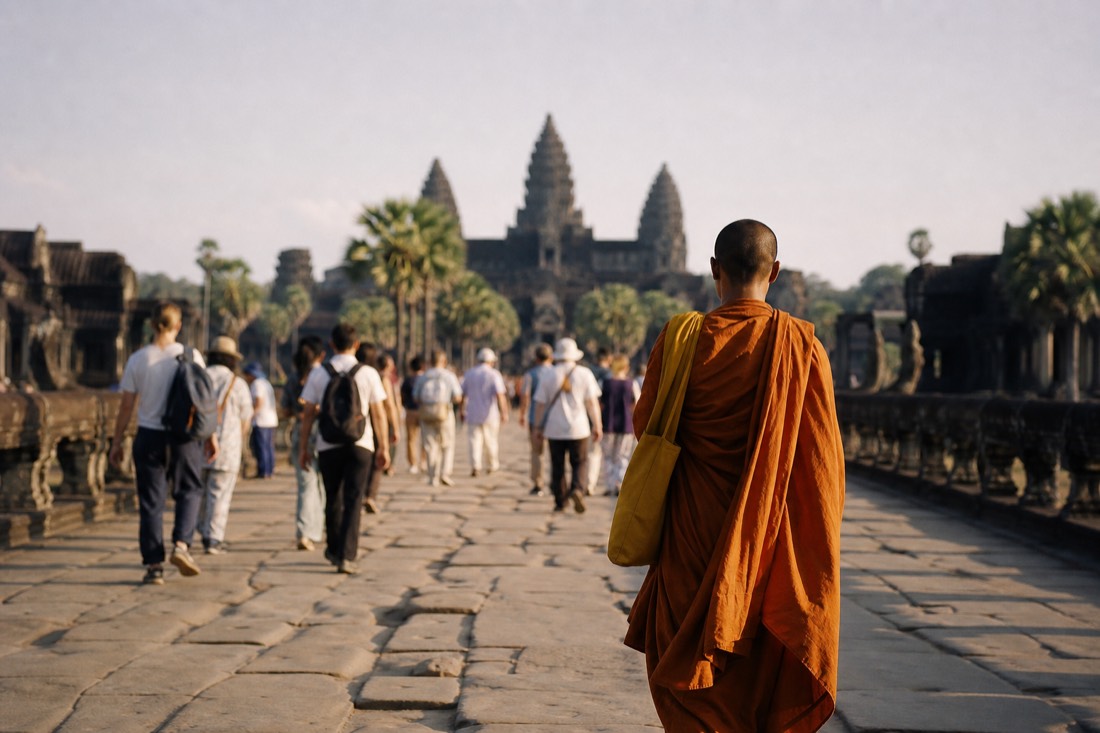
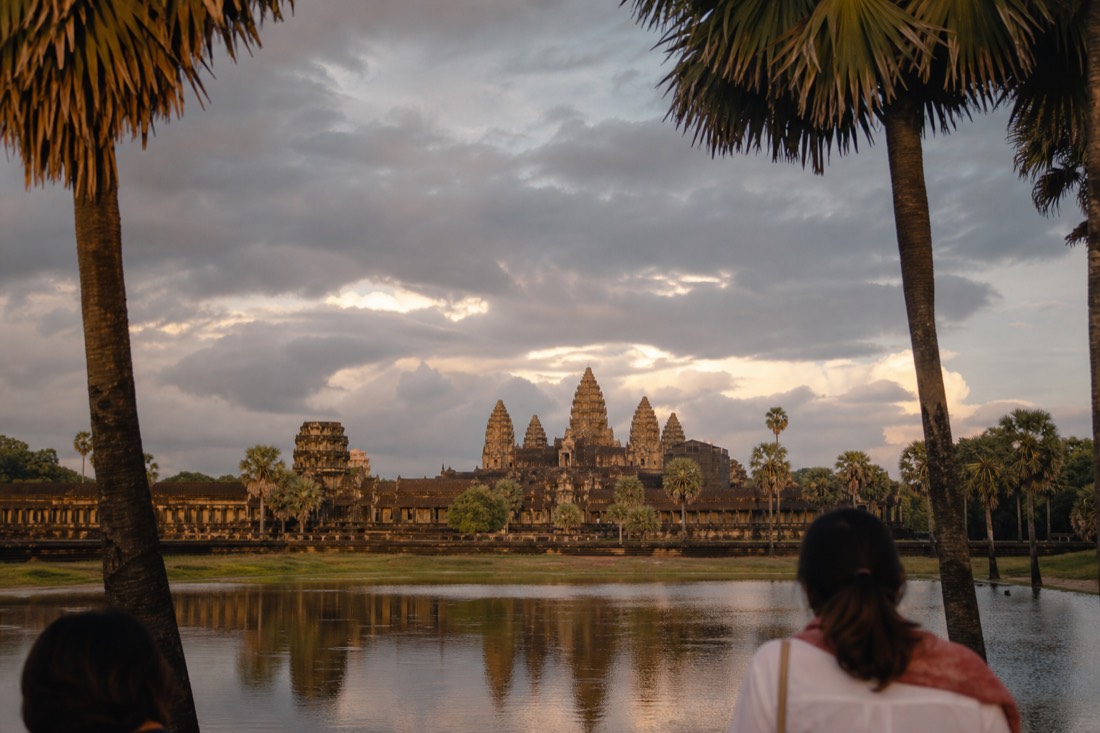
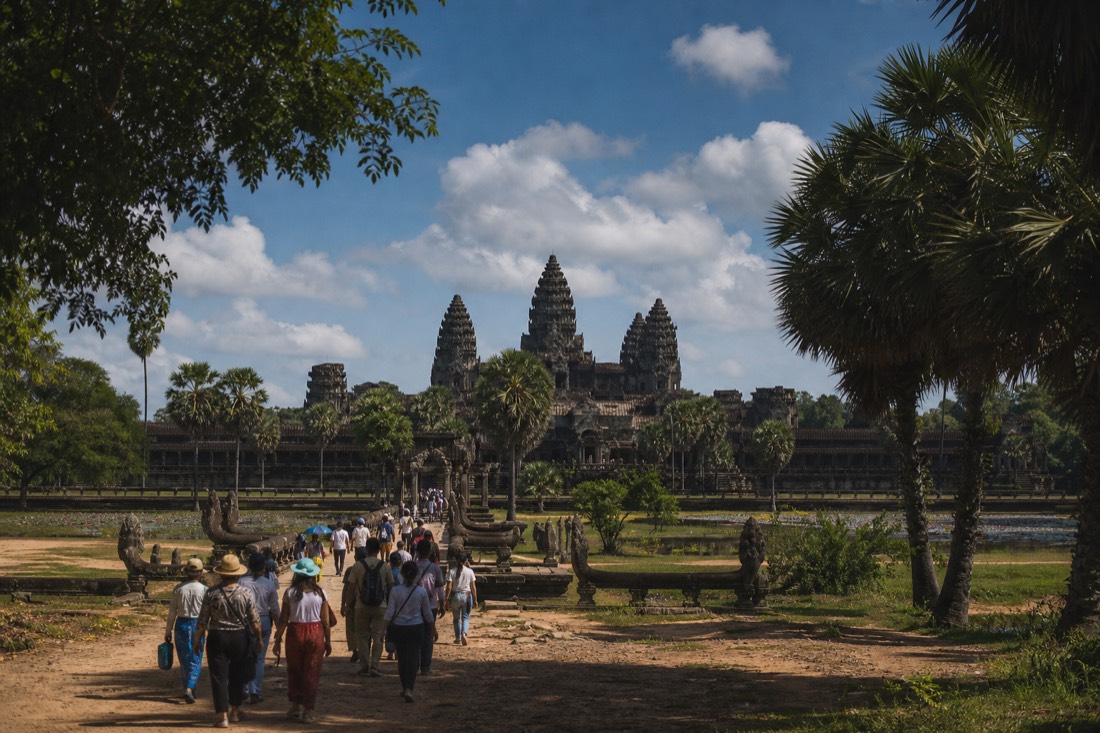
Angkor Wat is an approach: a causeway, a moat, towers resolving as you walk, a building that performs at distance. Borobudur has no approach and no facade. It is a mass you climb into, and the experience is close-range and sequential. One overwhelms you; the other slows you down.
That guest of mine had it exactly right, so I will use his words rather than invent better ones. Small, versus slow.
Angkor Wat is built to be seen. The moat, the causeway, the long walk with the five towers arranging themselves against the sky: that is architecture as arrival, and it is one of the great sights on earth. Photographs work there, because the building is composed for a viewer at a distance.
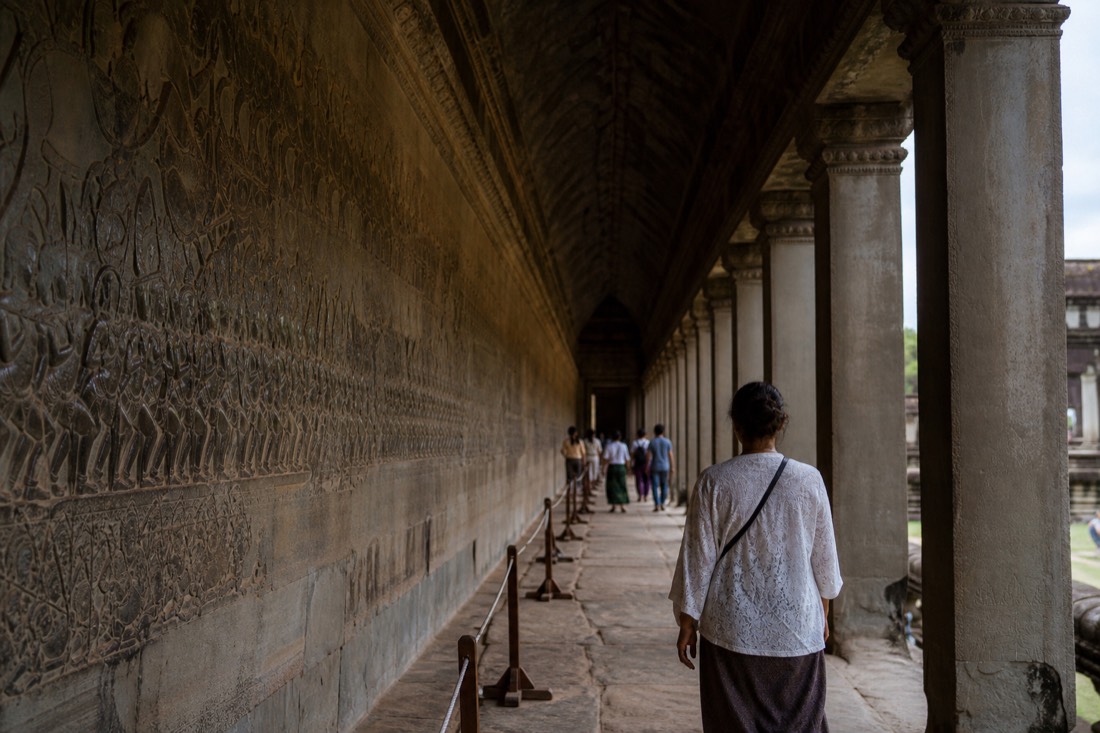
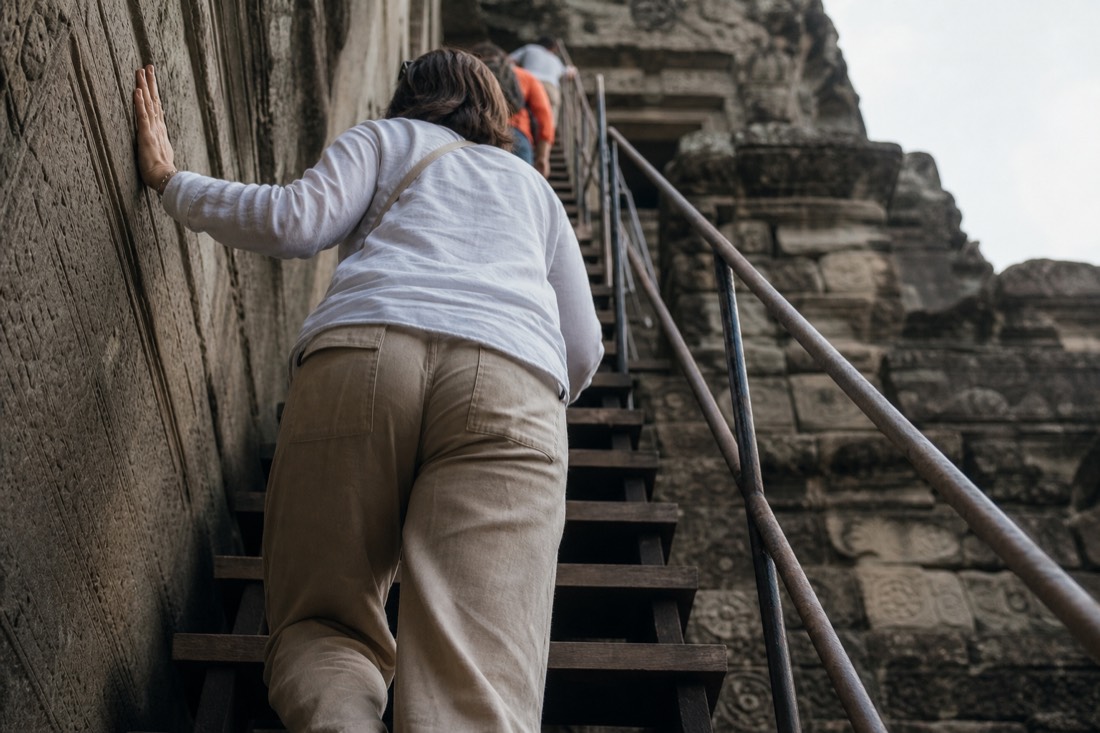
Borobudur refuses all of that. There is no facade, because there is no front. It is a stone hill you walk onto, and once you are in the galleries you cannot see the monument at all, only carved walls either side and a strip of sky. It photographs poorly from inside, which is why every image you have seen is a drone shot or the stupas at dawn. The actual experience is 1,460 narrative relief panels at arm's length, read clockwise and upward. Density instead of drama.
This is why the half-day is not a consolation prize. Borobudur gives you more carved stone within reach of your eyes, per minute, than almost anywhere. It is a reading, not a view. I have written about how the sequence works in the history of Borobudur told from the terraces, because walking it in the wrong direction is the most common way people waste the visit.
Can you visit both on the same trip?
Yes, and plenty of people do, but they are separate countries and separate flights, so treat them as two legs rather than a day trip apart. The usual shape is Siem Reap for three days and Yogyakarta for two, and the order matters less than giving Angkor the days it needs.
Nobody is choosing between these two on a Tuesday morning. They are in different countries, and the real decision is almost always about which one earns a slot in a Southeast Asia itinerary that already has too much in it.
If both are in, the asymmetry works in your favour. Angkor is the anchor: three days, a pass, a base in Siem Reap, and no attempt to do anything else. Most first-timers spend one of those days on a guided sunrise-to-afternoon loop of the main temples to sort the geography out; check price and dates here, then wander looser on your own pass after. Yogyakarta is the lighter leg, because Borobudur is a morning and Prambanan is an afternoon, and you can be back in the city for dinner having seen two world-class monuments of two different faiths. Two nights in Yogyakarta genuinely covers it.
The mistake I see is people budgeting them equally, giving each two days, and getting a rushed Angkor and a padded Java. Angkor is hungrier. Feed it the extra day and let Borobudur be efficient, because being efficient is what Borobudur is unusually good at.
Which should you visit, honestly?
Both, if the trip allows, since they are different enough that neither substitutes for the other. If you must choose: Angkor if you have three days and want scale, ruin and empire. Borobudur if you have a morning, are already in Java, and want narrative density and a monument you can finish.
Let me be as fair as I can while telling you what I think.
Go to Angkor if the temples are the reason for the trip. It deserves the days, and if you go for one rushed morning you will have done it a disservice and probably still be glad you went. Go for the park, not the postcard.
Come to Borobudur if you are in Indonesia, or could be. Java has Yogyakarta, which is a genuinely good city, and a 9th-century Hindu compound forty kilometres from the Buddhist one, and the whole thing costs you a morning. The two-faith story is the part nobody expects; I have pulled it apart in is Prambanan Hindu or Buddhist.
| If this is you | Go | Because |
|---|---|---|
| Three days, temples are the trip | Angkor | The park needs the days and rewards them |
| One morning, already in Java | Borobudur | It is complete in half a day, honestly |
| You want scale and ruin | Angkor | 400 km², forest, empire, collapse |
| You want carving you can read | Borobudur | 1,460 narrative panels within arm's reach |
| You want the temple plus a city | Borobudur | Yogyakarta and Prambanan in the same trip |
| Travelling with people who tire | Borobudur | One monument, one morning, done |
| You have been to one already | The other | They are not substitutes. Genuinely |
The comparison-shopping instinct behind this question is usually a proxy for a scheduling problem, and that is fine. If Borobudur is your morning rather than your pilgrimage, the Sunrise Climb & Prambanan tour is the efficient version, dawn from Punthuk Setumbu and a guaranteed climb ticket; you can check live availability & prices on GetYourGuide for your date. For the one-table version of the size question, the Borobudur vs Angkor Wat guide has it short. If you are still upstream of all this and asking whether the detour earns itself, is Borobudur worth visiting answers it without the sales voice.
Three trips to Angkor and he still stood on my second gallery for forty minutes. That is the whole answer, really. These are not competing products with a winner. They are two entirely different things a civilisation can do with stone, three hundred years and a sea apart, and the only bad version of this decision is the one where you pick on a superlative that was never comparing them in the first place.