2026-07-06
First Time at Borobudur: What to Actually Expect
A Borobudur guide walks you through a real first visit: the drive from Yogyakarta, which ticket foreign visitors can buy, the sandal swap, the climb, and what surprises people.
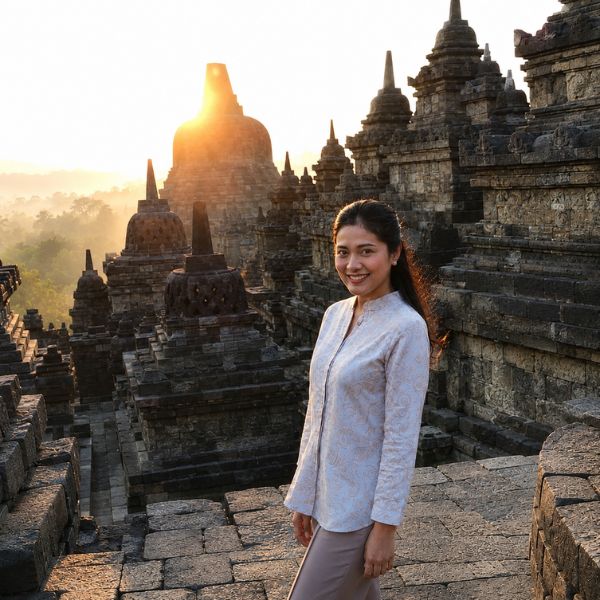 By Dewi Lestari, Borobudur temple tour guide since 2022
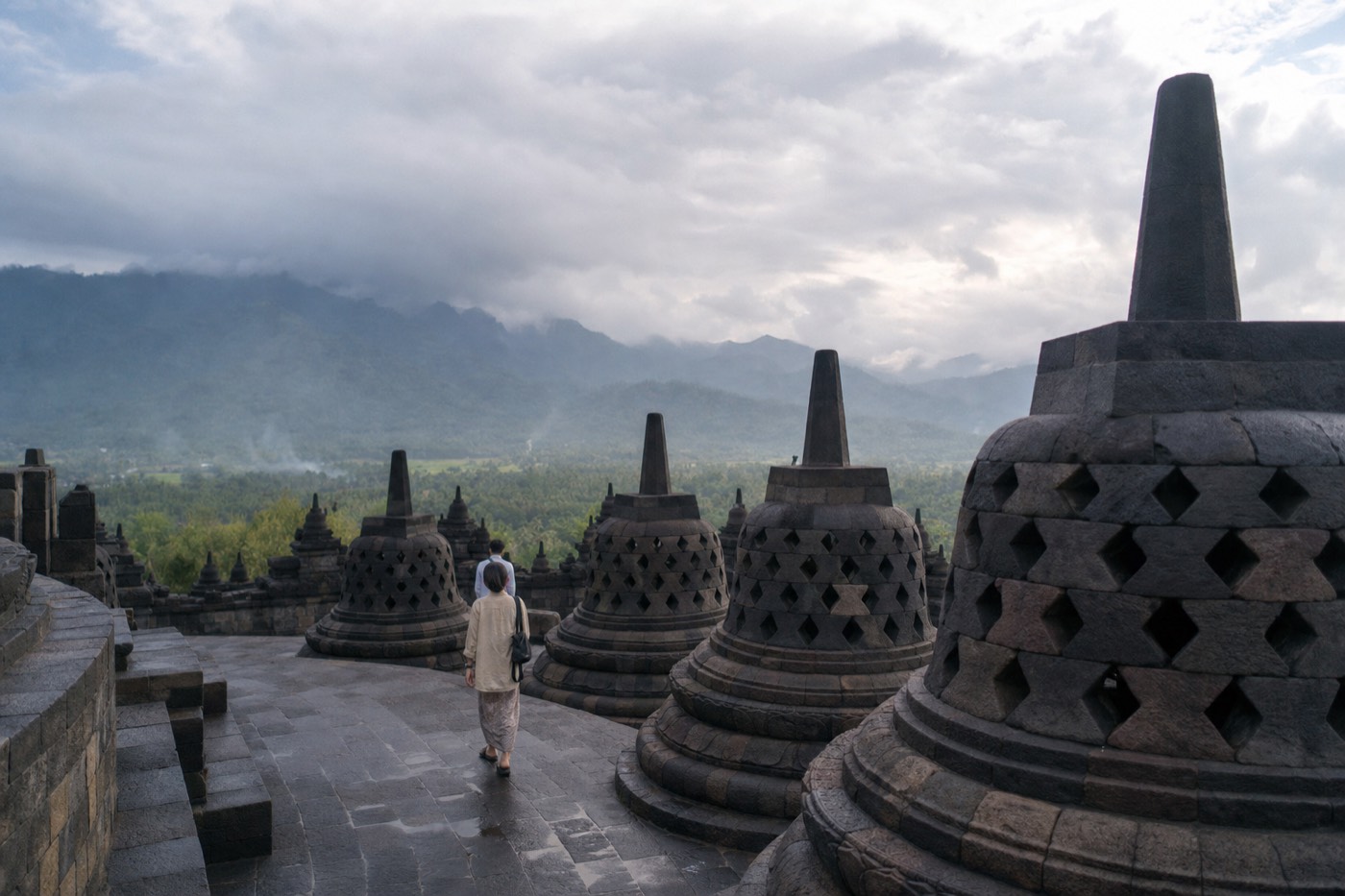
The thing nobody warns you about is the light. You come up the last flight of stairs onto the circular terraces, and the stone goes from grey to a kind of warm bone colour, and there is nothing above you at all. No trees. No roof. Just volcanoes on the horizon and about seventy-two stupas sitting there in the heat like they have been waiting. I have watched more than a thousand travellers make that turn since 2022, and most of them stop talking for a moment. Then, almost always, the first thing they say is that it is bigger than they thought, and hotter.
Let me walk you through the whole morning, in order, the way it actually goes.
How do you get from Yogyakarta to Borobudur?
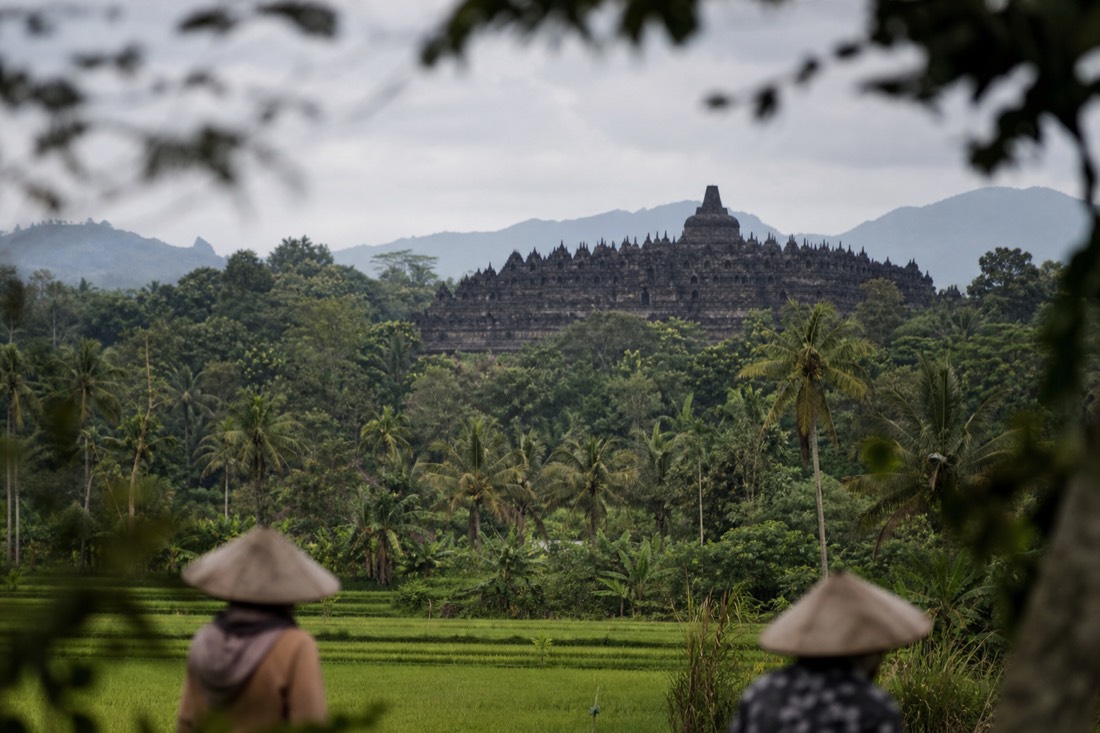
Borobudur sits in Magelang Regency, about an hour northwest of Yogyakarta by road. Most visitors come as a day trip from the city. On a tour with hotel pickup the drive is handled for you; independently you are looking at a car, a driver, or a bus and shuttle combination, plus the return leg.
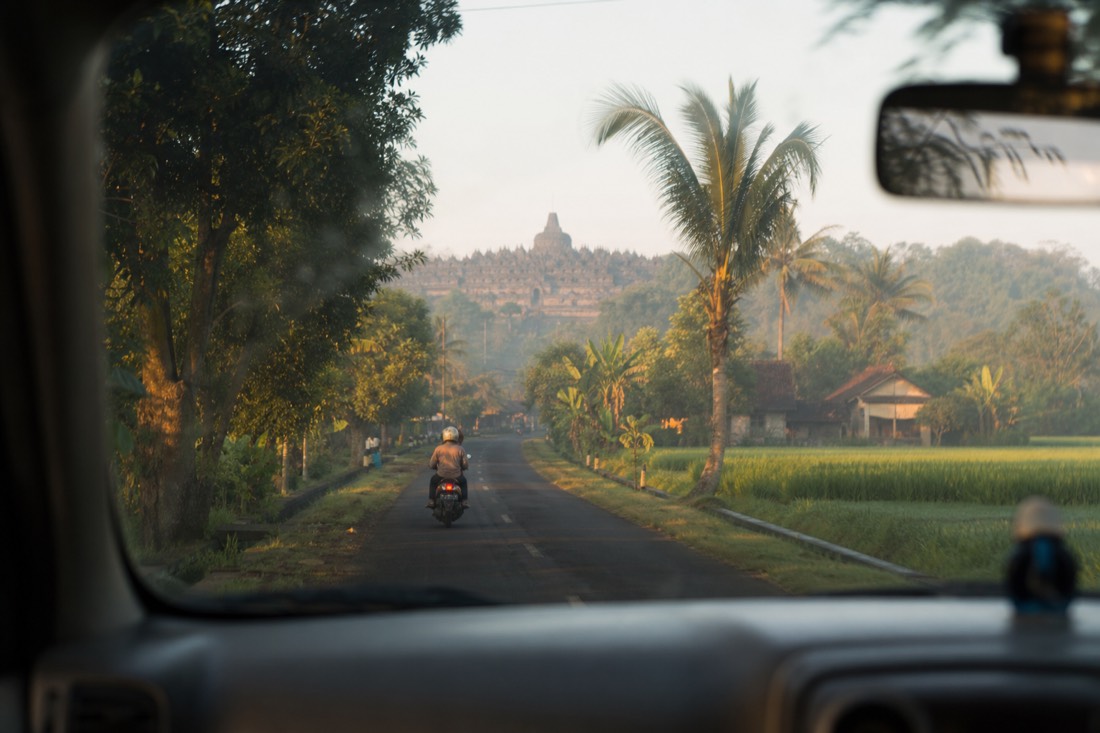
The road runs out through the rice fields and the drive is genuinely pleasant, which is worth knowing because a lot of people brace for it. If you are coming for the dawn from the hill at Punthuk Setumbu, pickup is around 03:30 and you are watching the plain go pink by 05:30. For a normal daytime visit, be at the gates when the structure opens rather than at eleven. The full route breakdown covers the independent options properly.
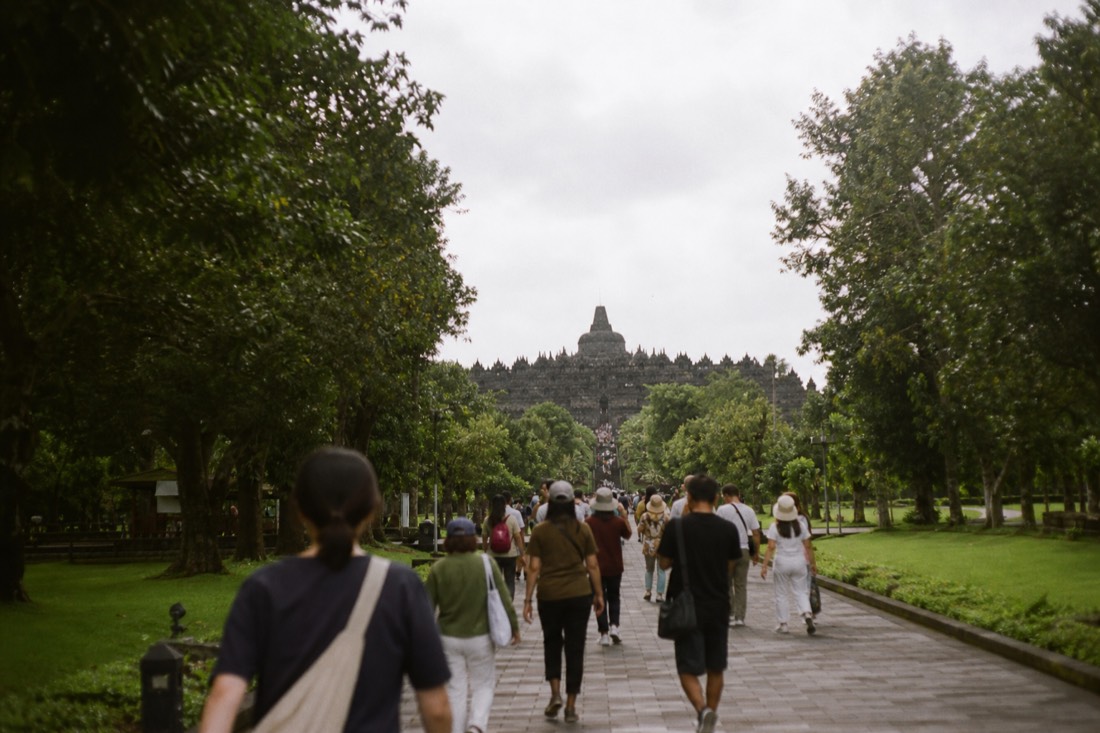
The park itself is large. From the entrance you walk through gardens for maybe ten minutes before the temple resolves in front of you, and that walk is part of the experience rather than an inconvenience.
Which Borobudur ticket can a foreign visitor actually buy?
Two tickets exist: a cheaper grounds ticket and a structure-climb ticket. The grounds ticket is domestic-only, so as a foreign visitor your real option is the climb ticket. It includes access to the structure, a wristband, the Upanat sandals you keep, and a guide.
This catches people out constantly, because half the blogs online still describe a foreign grounds price. The official operator's ticketing page lists the Borobudur Temple Ground ticket as "Only For Domestic Tourist". So the choice a foreign visitor faces is not cheap-versus-expensive. It is the climb ticket or the separate sunrise product, and that is the whole menu.
| Ticket | Who can buy it | Hours | What comes with it |
|---|---|---|---|
| Grounds / Pelataran | Domestic visitors only | 06:30–16:30 | Park and gardens, no structure access |
| Structure climb / Naik Struktur | Everyone | 08:30–17:00 | Structure access, wristband, Upanat sandals to keep, tour guide |
| Official Sunrise | Everyone, capped at 100 a day | 04:00 start | Flashlight, Upanat, guide, breakfast at Manohara |
The domestic climb ticket is listed at IDR 150,000. The foreign climb price is not published on any public page; it appears only once you are inside the booking flow, which is annoying and is also simply the truth. Anyone quoting you a precise foreign figure is repeating a number from somewhere else. Our tickets and prices guide explains that gap in more detail, including why the figure Google shows should not be trusted.
Why do you have to change your shoes at the base?
Upanat sandals are mandatory on the structure. You swap your own shoes for them at the base, they come with your climb ticket, and you keep them. They are woven from pandan leaf and coconut shell over a sponge sole, and their job is to spare ninth-century stone from a million rubber soles a year.
The swap takes two minutes and feels faintly ceremonial. People expect the sandals to be flimsy and they are not; they grip better on worn stone than trainers do, which is precisely the point. It is a nice piece of local economics too: production capacity passed 4,000 pairs a day in early 2024, and the sandals are made by 45 craftspeople across 20 villages around the temple.
Bring socks if you are fussy about your feet, and a bag for your own shoes. That is the entire preparation.
How hard is the climb up Borobudur?
Short, steep, and hot rather than long. Borobudur is nine platforms, six square terraces then three circular, with the main stupa about 35 metres above the base. The stairs are original ninth-century stone, narrow and worn, and there is no shade anywhere on the structure. Fitness is rarely the limit. Heat usually is.
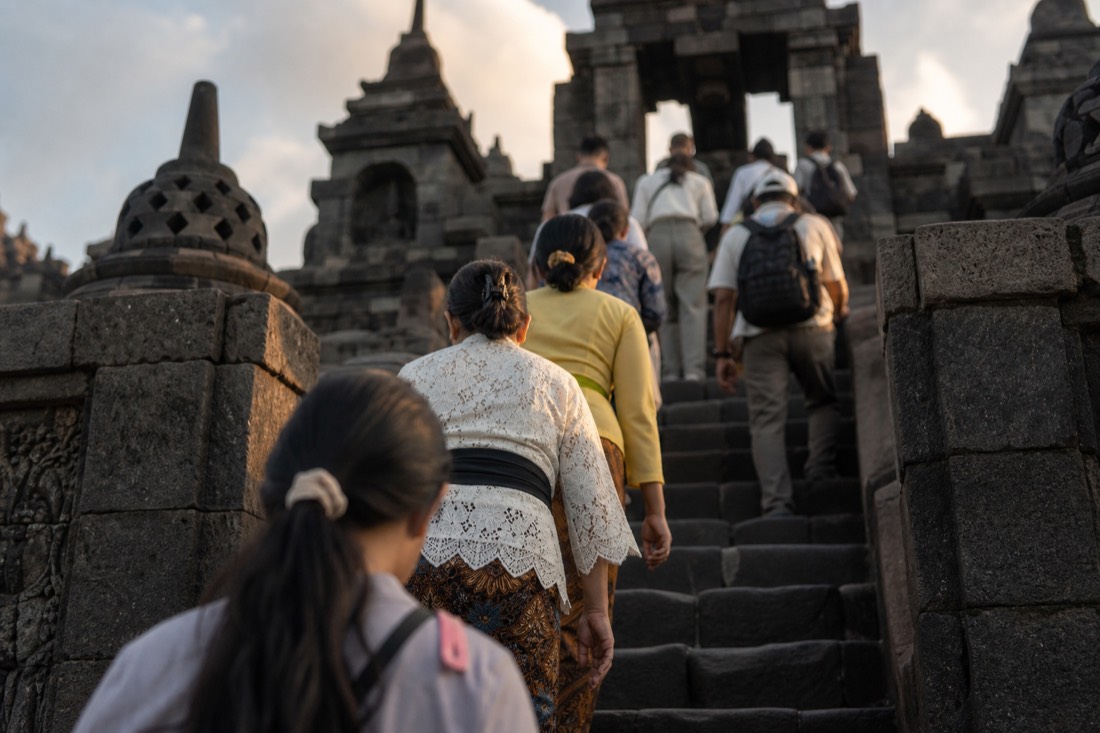
The distance is nothing. A person of average fitness climbs it in fifteen minutes without stopping. But the stairways are steep in the way that old sacred architecture is steep, treads worn into shallow dishes by centuries of feet, and the handrails are modern additions rather than something the builders imagined.
The heat is the real story. You are on pale stone that has been absorbing tropical sun, with nothing over your head, on a plain that regularly sits in the low thirties Celsius by mid-morning. This is why I push everyone toward the first slot of the day. At 08:30 the stone is still cool and the light rakes across the carvings. At noon it is an oven with a view.
Book the sunrise climb
Ready to book the sunrise climb?
Dawn from Punthuk Setumbu, then the Borobudur climb itself, with hotel pickup from Yogyakarta. Free cancellation up to 24 hours, reserve now and pay later: booking takes 2 minutes and costs nothing today.
Check live availability & prices →What are you looking at on the way up?
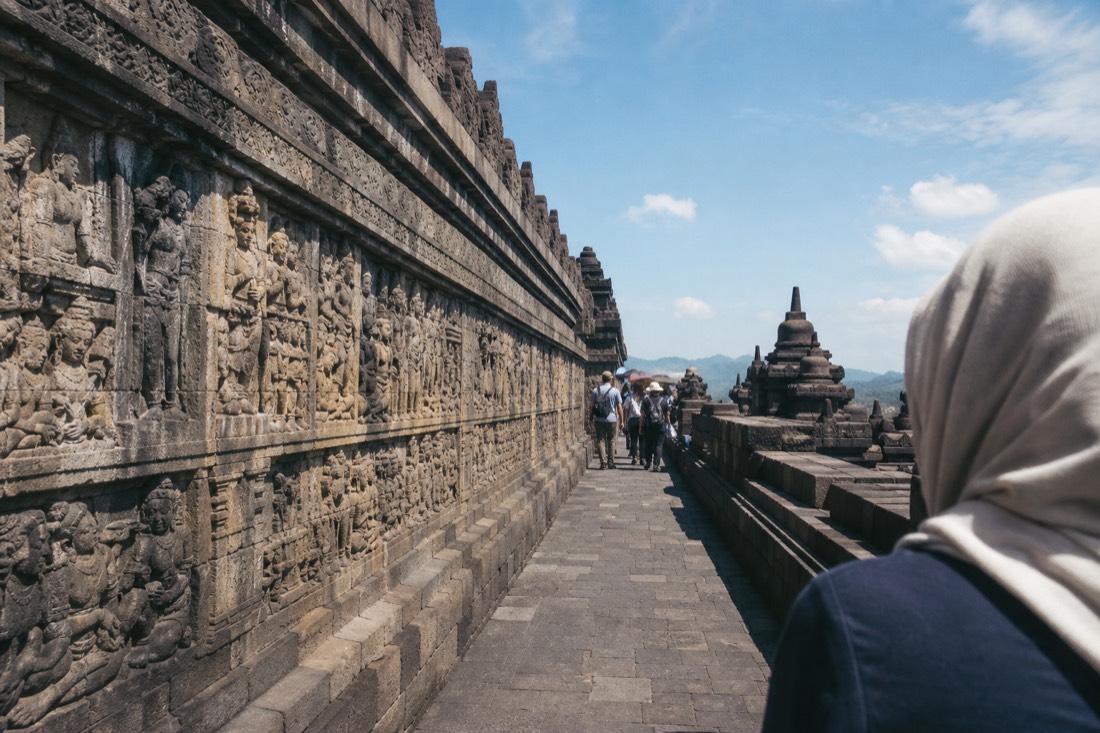
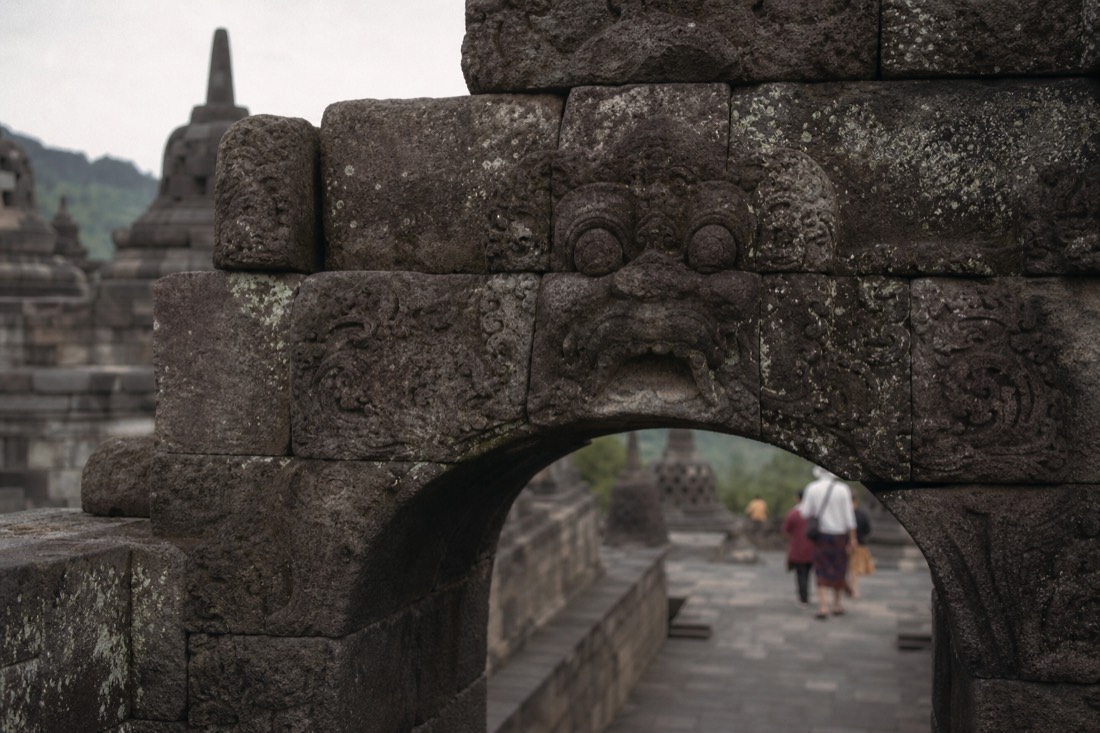
The galleries carry 1,460 narrative relief panels, read clockwise as you rise. Keep the wall on your right, walk the full circuit of each terrace, then climb. The panels are a sequence, not decoration: they run from ordinary human desire at the bottom toward enlightenment at the top, and the architecture is the argument.
This is where a guide earns their keep, and it is why I am glad the ticket includes one. The panels look like beautiful crowded stone until somebody points at a ship, or a scene of a man being robbed, and the whole thing turns into a story you can follow. Borobudur was built as a teaching object. Construction began in 778 AD and finished around 825 AD, and the UNESCO listing for the Borobudur Temple Compounds covers it along with the smaller temples at Mendut and Pawon.
Most first-timers walk straight up the middle without circling. They have just skipped the book and gone to the last page.
What is at the top?
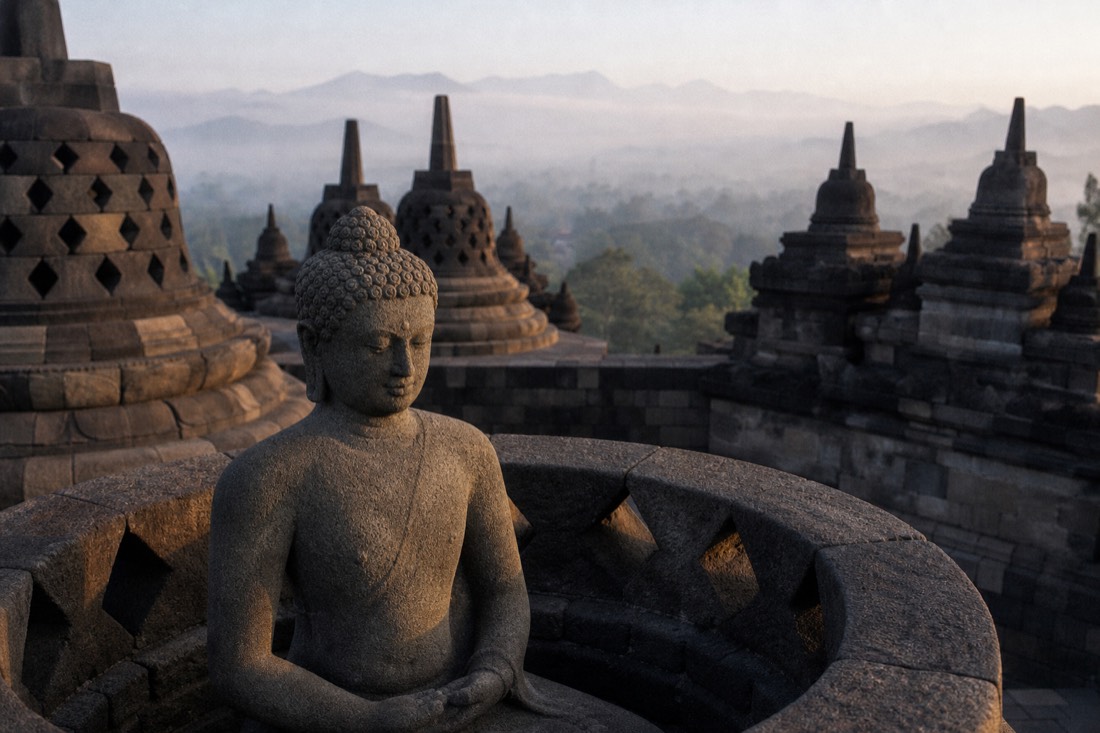
Three circular terraces holding seventy-two perforated stupas, each with a Buddha inside, around one large central stupa. It is open, exposed and quiet, with Merapi and the Menoreh hills on the horizon. This is the view in every photograph of Borobudur, and it is the part people linger over longest.
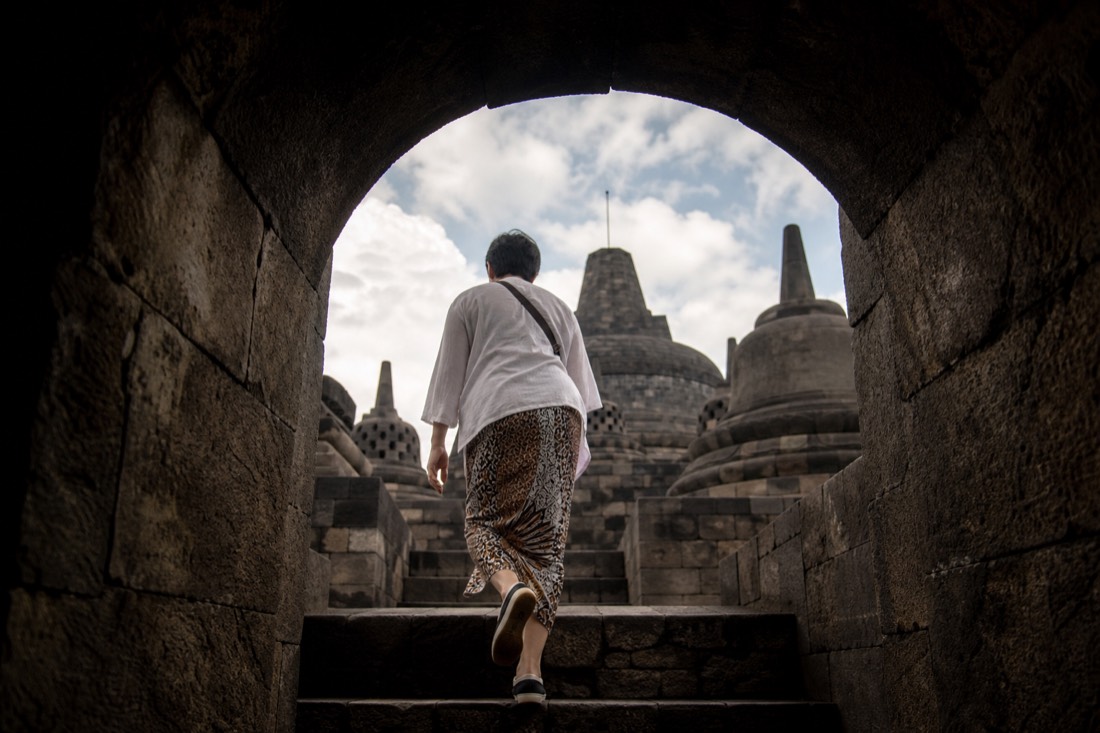
The change in feeling as you come off the square galleries onto the circles is abrupt and, I think, deliberate. The walls fall away. The carvings stop. You are suddenly in the open with the plain around you. Whatever you believe, the building is making a point about ascent and it makes it physically.
Give yourself twenty minutes up there. Sit down. Count Buddhas.
How long should you spend at Borobudur?
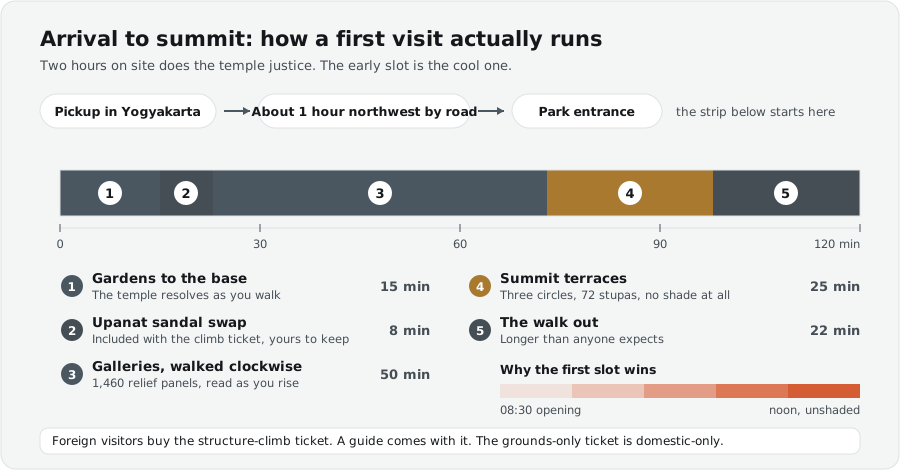
Two hours does the temple justice for a first visit: fifteen minutes through the gardens, a circuit or two of the galleries with your guide, twenty minutes on the summit terraces, and the walk back. Under an hour and you have photographed it rather than seen it. Beyond three hours, in that heat, most people are finished.
Here is the honest time budget, which is the thing tour listings never show you.
| Stage | Realistic time | What decides it |
|---|---|---|
| Entrance to the base of the temple | 10–15 min | Gardens are pleasant, walk them |
| Sandal swap and briefing | 5–10 min | Queue length at the base |
| Galleries and panels | 40–60 min | Whether you circle each terrace or cut up |
| Summit terraces and stupas | 20–30 min | Heat, and how long you sit |
| Walk out, market, toilets | 20 min | The exit route is longer than you expect |
If you are on a combined tour, Prambanan comes after, usually in the afternoon. It is a ninth-century Hindu complex on the other side of Yogyakarta, tall and spiky where Borobudur is broad and solid, and that contrast is why the two are sold together. There is more on pacing in our guide to how long a visit takes.
What surprises first-time visitors most?
Four things, in order: the total absence of shade, the fact that a guide is already included with the climb ticket, how steep the original stairs are, and that a foreign visitor cannot buy the cheap grounds ticket. None of these appear in the photographs.
The shade one is not a small point. People arrive dressed for a temple and not for a stone plateau at the equator. There is no official dress code at Borobudur, despite what a lot of affiliate sites claim; this is an archaeological park, not a living Balinese temple, and the Upanat sandals are the one firm rule. So dress for heat. A hat matters more than covered shoulders. Our what to wear guide unpicks where that myth came from.
| The expectation | The reality |
|---|---|
| "There will be shade somewhere" | None on the structure. None on the terraces |
| "I should book a guide separately" | One is included with the climb ticket |
| "Half a day, minimum" | Two hours is a full, unhurried visit |
| "I'll buy the cheap ticket and just look" | Grounds-only is domestic-only |
| "Sunrise means from the temple" | Usually it means a hill 2.5 km away |
That last one deserves its own explanation, and it has one: the difference between the hill dawn and the temple dawn is the single most misunderstood thing about visiting Borobudur, and it decides what you are actually buying. If you are bringing children, the stairs and the heat change the calculation again, which is its own honest conversation.
For a first visit, the arrangement I would pick is the one that removes the parts you cannot control: the drive, the ticket, and the guide. The Borobudur Sunrise Climb & Prambanan tour does the dawn from Punthuk Setumbu hill, then the climb while the stone is still cool, then Prambanan in the afternoon, and you can check live availability & prices on GetYourGuide. If a 03:30 alarm sounds like a punishment rather than a treat, the day tour with a civilised start reaches the same stone in better temper, and the comparison page sets the three side by side.
Come early. Bring water. Walk the galleries clockwise. That is genuinely most of it.