Guides · What to wear
What to Wear at Borobudur: The One Real Rule and the Invented Ones
A hundred blogs will tell you Borobudur requires covered shoulders and knees and hands you a sarong at the gate. We went looking for that rule in the operator's published materials, in English and Indonesian, and it is not there. Here is what is.
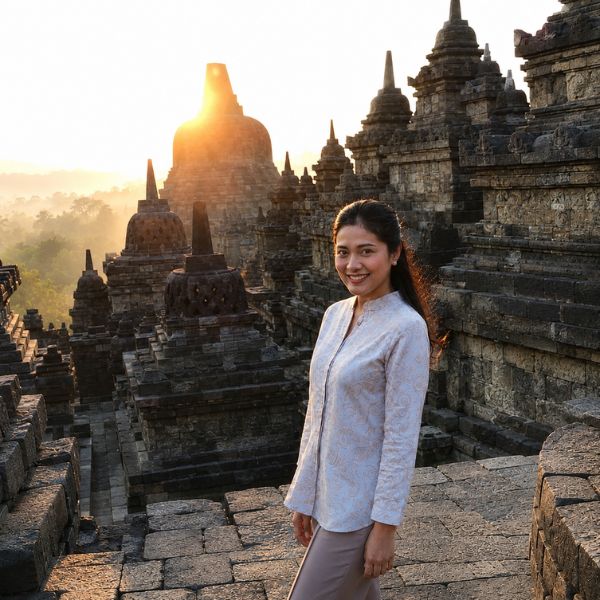 Written with Dewi Lestari, Borobudur temple tour guide since 2022
Short answer
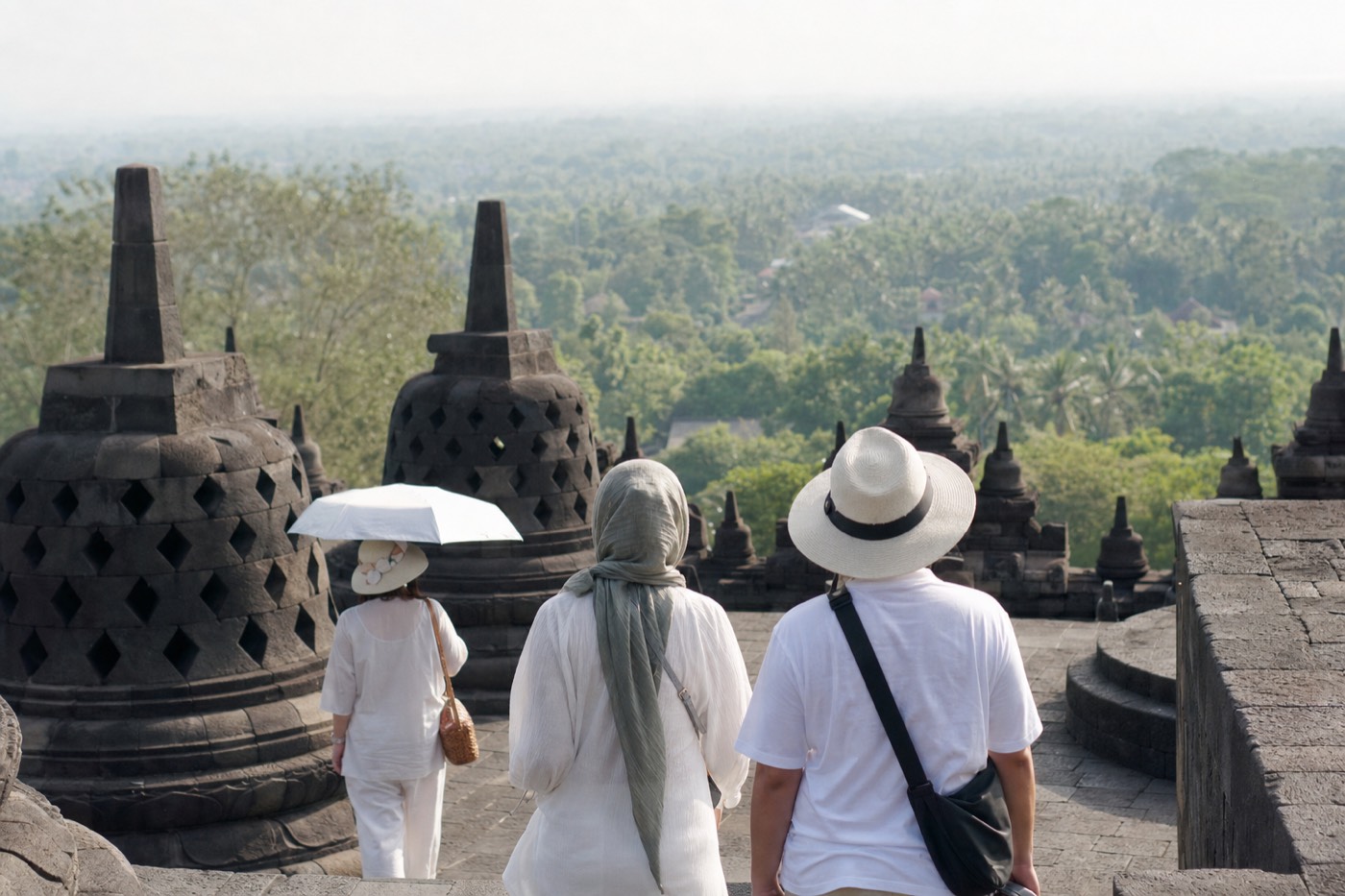
Borobudur publishes no general dress code. Shorts are not banned; shoulders are not policed; no sarong is issued at the gate. The one firm clothing rule is on your feet: everyone climbing the monument wears the Upanat sandals that come with the climb ticket. Modest dress is a courtesy at a sacred Buddhist site, and the strongest practical argument for covering up is the equatorial sun, not any regulation.
The rule that exists
Upanat sandals are the one published clothing rule at Borobudur. They come with the climb ticket, every climber wears them on the structure, and you keep the pair afterward. They exist to protect ninth-century stone from shoe abrasion, and they are made in the villages around the temple.
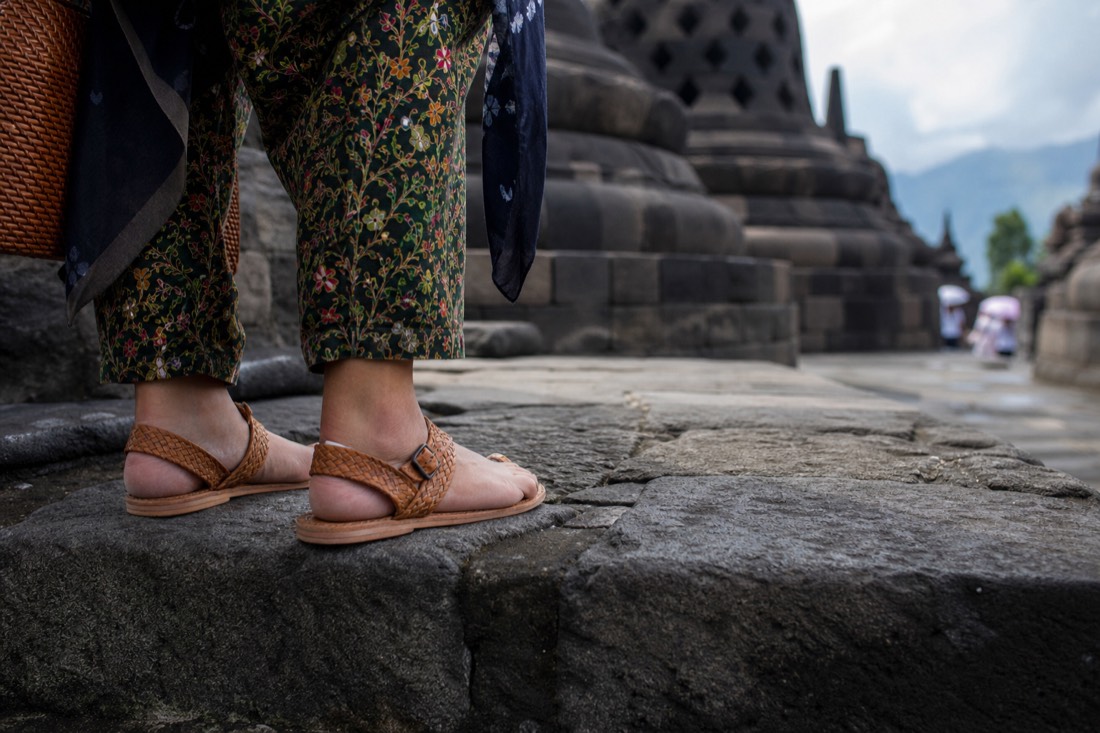
One clothing requirement at Borobudur is real, published, and enforced: Upanat sandals on the structure. They are woven footwear designed to protect the ninth-century stone from shoe abrasion, they are included with the climb ticket, and the operator's own wording is that all visitors on the monument wear them. You hand over nothing and change nothing else; you swap your shoes at the base and keep the sandals afterward as the ticket's built-in souvenir. That, in its entirety, is the official dress code of Borobudur.
| What they are | Woven sandals of pandan leaf and coconut shell over a sponge sole, designed for the temple's stone |
|---|---|
| Who makes them | 45 craftspeople across 20 villages in Borobudur District, organised through the local village enterprise |
| How many | Production capacity passed 4,000 pairs a day in 2024, ahead of visitor demand |
| How you get them | Included with the structure-climb ticket; reported on by Kompas as a deliberate local-economy project |
The rule that does not
No covered-shoulders rule, no knee rule, no sarong handed out at the gate. The claim traces to third-party ticket resellers, and no general dress requirement appears on the operator's ticketing pages or in its Indonesian-language visitor rules, the places a real rule would live.
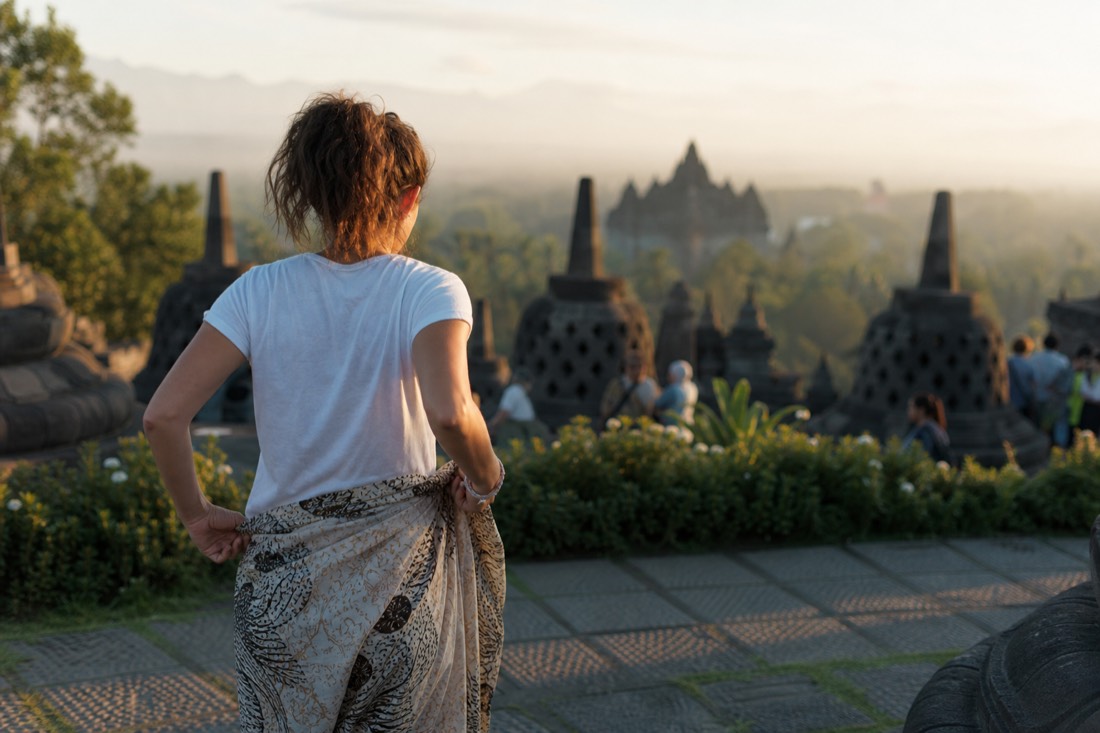
The covered-shoulders-and-knees rule, complete with the free sarong at the entrance, appears on travel blogs with total confidence. Trace it and it leads to resellers, not to the operator. We checked the operator's ticketing pages and visitor information in English, then searched the Indonesian equivalents. No general dress requirement appears in any of it.
The confusion has an understandable source. Bali's temples, where most Indonesia itineraries begin, are living places of worship where sarongs genuinely are required and provided. Visitors carry that expectation to Java. But Borobudur operates as an archaeological park and UNESCO site; worship happens there on specific occasions rather than continuously, and on those occasions the rules are event rules. During Waisak, the Buddhist festival, participants are asked to wear white. That is the pattern: specific requirements attach to specific ceremonies, not to Tuesday afternoon tourism.
So, can you wear shorts?
Yes. No published rule forbids shorts or bare shoulders for anyone. The two real considerations are courtesy, because Borobudur is a sacred Buddhist site, and the equatorial sun, which punishes bare skin on open stone far more reliably than any rulebook.
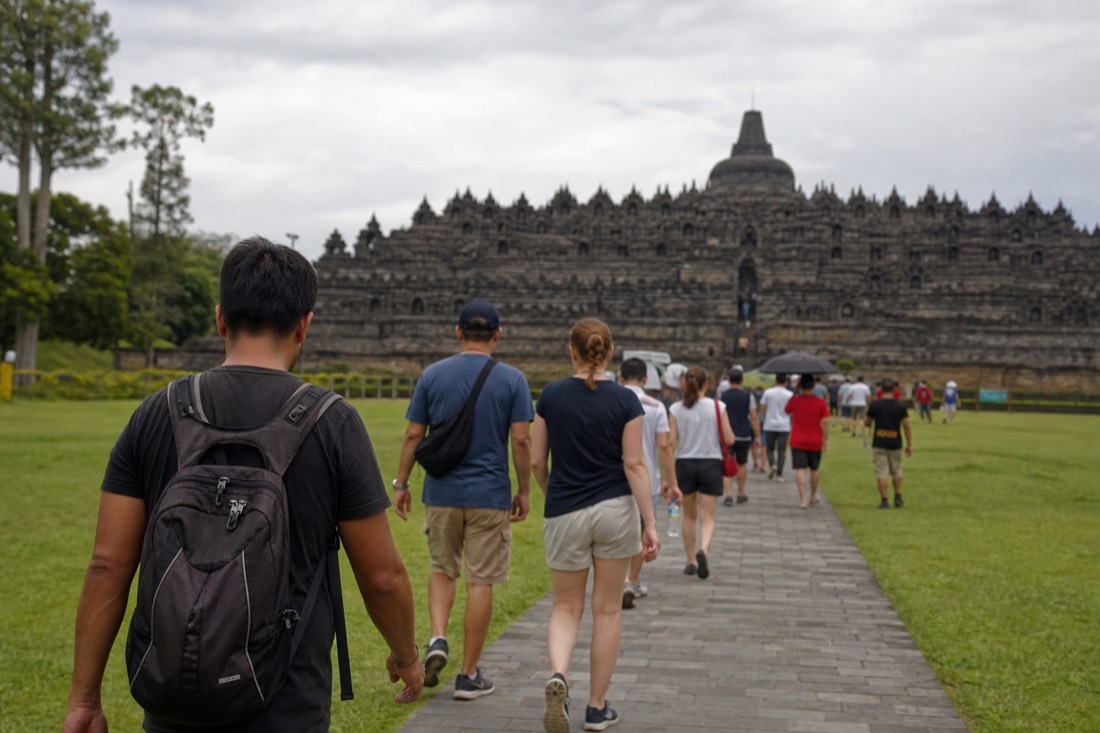
Nobody at the gate measures hemlines, and on any given morning the terraces hold every clothing choice a planeload of tourists can produce. The real question is the one etiquette asks: this is one of the sacred places of Buddhism, monks and pilgrims do visit, and a courtesy toward that costs you nothing. Many travellers, Dewi among them when she is asked, land on knee-length or longer simply because it reads as respect in every culture that will be standing next to you.
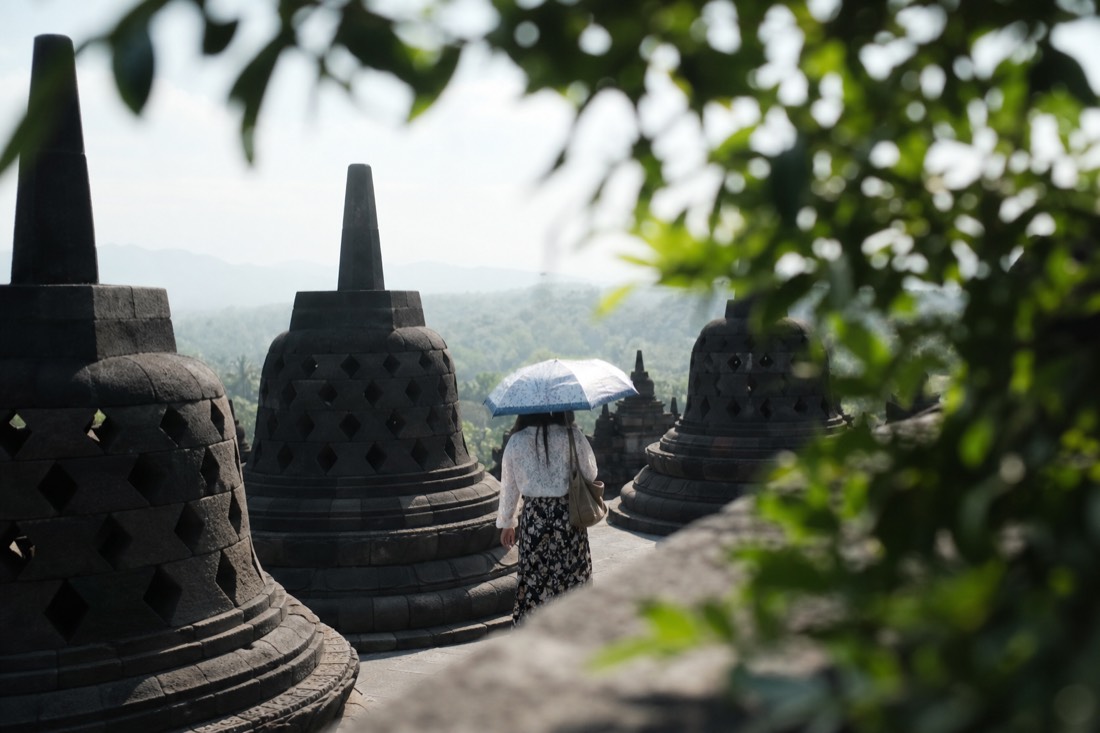
Then there is the argument that settles it for most people once they arrive: the sun. The terraces are open stone at seven degrees south with no shade at all, and by mid-morning they cook. Light, loose, covering layers, a hat and sunscreen beat shorts and bare shoulders on pure comfort, whatever your view on etiquette. The best-time guide explains the hours this matters most; if you are on a dawn tour, add a layer for the genuinely chilly pre-sunrise wait on Punthuk Setumbu.
Rule or etiquette: the whole picture
Book the sunrise climb
Ready to book the sunrise climb?
Dawn from Punthuk Setumbu, then the Borobudur climb itself, with hotel pickup from Yogyakarta. Free cancellation up to 24 hours, reserve now and pay later: booking takes 2 minutes and costs nothing today.
Check live availability & prices →Item by item: rule, etiquette, or just sense
| Upanat sandals on the structure | **Rule.** Published, included with the ticket, worn by everyone |
|---|---|
| Shorts | **No rule.** Knee-length or longer is courtesy at a sacred site, and better sun cover |
| Bare shoulders | **No rule.** Same courtesy logic; the midday sun settles it for most people anyway |
| Sarong | **Not required, not issued.** A reseller invention borrowed from Bali's living temples |
| White clothing | **Event rule only**, for ceremonies such as Waisak |
| Hat, sunscreen, water | **No rule, near-mandatory in practice.** Open stone, no shade, seven degrees south |
What Dewi tells her guests
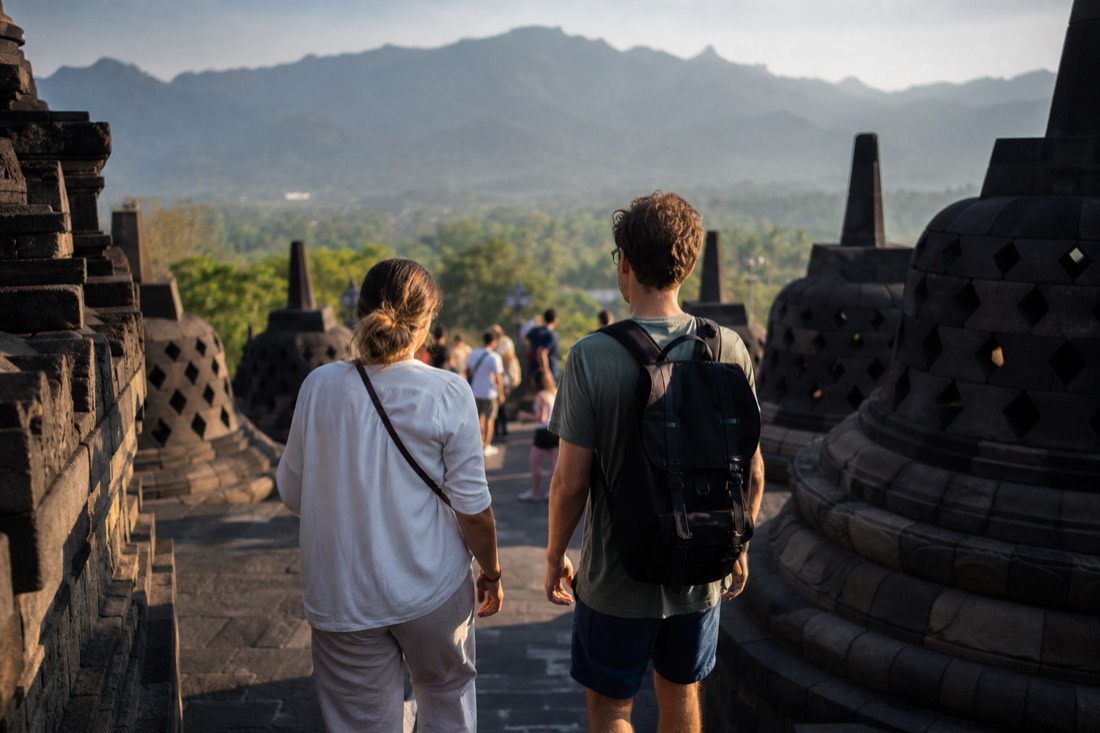
Asked what to wear, she gives the same answer most mornings: dress for the sun and the stairs, keep it modest because the place deserves it, and put your energy into footwear you can climb steep, uneven, nine-hundred-year-old steps in, right up until you trade them for the Upanat at the base. The visitors who struggle are never the ones in shorts. They are the ones with no hat, no water, and a phone that overheats before the top terrace.
What to bring, by time slot
The kit changes more by hour than by rule: a warm layer for any dawn start, sun cover and water for everything after 09:00, and stair-friendly shoes all day, traded for Upanat at the base.
| 04:00 official sunrise | Warm layer for the dark wait, flashlight is provided, Upanat provided |
|---|---|
| Dawn tours (Punthuk Setumbu hill) | Warm layer, shoes for a short uphill path in the dark; shed the layer by 07:00 |
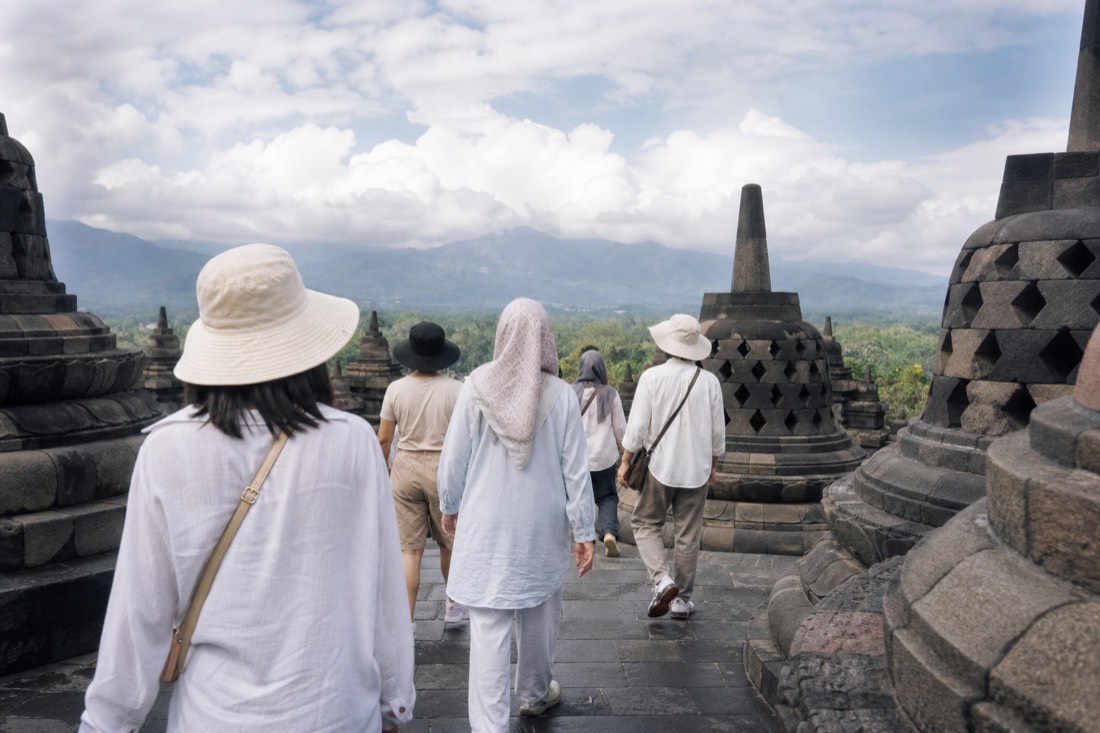
| Morning climb, 08:30 onward | Hat, sunscreen, water; light long sleeves work better than bare shoulders |
| Midday | All of the above, more water, and no shade anywhere on the terraces |
Most visitors meet all of this inside a tour, where the timing is set for you; the most-booked is the Sunrise Climb & Prambanan, and you can check live availability & prices on GetYourGuide for your date.
What should you actually wear, item by item?
Dress for equatorial heat and steep old stone, not for a rulebook that does not exist. A breathable top, knee-length or longer bottoms, stair-steady shoes you swap for Upanat at the base, plus a hat, sunscreen and a light layer, covers every real consideration Borobudur throws at you.
None of the below is a requirement. There is no published general dress code to obey, so read this as comfort-and-courtesy advice from someone who climbs the monument most weeks, not a checklist the gate enforces.
| Item | What works | Why |
|---|---|---|
| Top | Loose, breathable cotton or linen; light long sleeves beat bare shoulders | Sun on open stone is the real threat, and modest cover reads as respect at a sacred site |
| Bottoms | Knee-length or longer, with enough give for steep steps | No rule bans shorts, but longer fabric shades your legs and suits the place |
| Footwear | Closed, grippy shoes for the grounds; traded for Upanat on the structure | Uneven ninth-century stone and stairs; your own sandals get sweaty and slip |
| Sun protection | Wide-brim hat and sunscreen, reapplied | Seven degrees south, no shade anywhere on the terraces |
| Light layer | A thin cover-up or rain shell that packs small | Pre-dawn cool or a wet-season downpour, both arrive without much warning |
The pattern behind the table is simple. Where a choice is contested online, it is almost never contested by an actual rule. Shorts, shoulders, hemlines: the operator says nothing about any of them. What the terraces do say, loudly, is that they are hot, bright and unshaded, so the clothing that keeps you comfortable happens to be the clothing that also reads as respectful. That overlap is why the advice looks like a dress code even though it is not one. Pick fabrics that breathe, cover enough to keep the sun off, and save your real decision-making for shoes.
How does the season change what you wear?
More than the temple rules do. Dry season, roughly May to October, is hot, bright and cloudless, so sun cover does the heavy lifting. Wet season, roughly November to April, stays warm but brings sharp afternoon downpours, so a packable rain layer earns its place in your bag.
Java sits close to the equator, so the temperature barely shifts across the year. What shifts is the sky. That single variable, sun versus rain, is what should nudge your packing, and it matters far more than any question of what is or is not allowed on the monument.
| Season | What the weather does | What to add |
|---|---|---|
| Dry (May to October) | Hot, strong sun, little cloud, dusty by midday | Extra sun cover, more water, sunglasses; leave the rain shell behind |
| Shoulder months (April, November) | Unsettled, can swing either way inside a day | Pack both a sun hat and a thin rain layer |
| Wet (November to April) | Warm mornings, heavy afternoon rain, humid air | Light rain shell or poncho, quick-dry fabrics, grippier shoes for slick stone |
A few things stay constant whatever the calendar says. Mornings are the coolest, kindest window in every season, which is part of why the sunrise and early-climb slots are worth the alarm. The humidity is real year-round, so quick-dry beats heavy cotton if you sweat easily. And in the wet months the rain tends to hold off until afternoon rather than ruining the morning, so an early visit often dodges the downpour entirely. The best-time guide goes deeper on which weeks and hours line up best.
What should you skip or leave behind?
Leave the sarong plan at home. No one issues one at Borobudur and no rule asks for it; that claim came from ticket resellers borrowing Bali's temple etiquette. Skip heels and stiff dress shoes too, because old uneven stone punishes them, and check the separate rules before you pack a tripod or drone.
The sarong myth is worth stating flatly one more time, because it drives real packing decisions. Travellers arrive clutching a scarf they were told they would need at the gate, and they never need it. The free-sarong-and-covered-shoulders line traces back to affiliate reseller pages, not to the operator's published materials, which say nothing of the kind in English or Indonesian. Bali's living temples do require and lend sarongs; Borobudur, an archaeological park and UNESCO site, does not. Carry a light layer if you want one for the sun, but do not build your outfit around a rule that is not there.
Footwear is where poor choices actually cost you. Heels sink and catch on worn stone, and stiff dress shoes turn the grounds walk and base stairs into a chore before you ever reach the Upanat swap. Flip-flops sit at the other extreme, fine for the car and a nuisance on the climb. Something closed, flat and grippy is the sweet spot.
Two categories sit outside the clothing question entirely. Tripods and drones fall under separate photography and heritage-site permissions, not under anything you wear, and those permissions can differ from the ordinary visitor rules. If either is part of your plan, treat it as its own item to check ahead of time rather than assuming a climb ticket covers it. And the umbrella you might reach for in the wet season is easier as a packable poncho, since your hands are busy on the stairs.
Common questions
Can women wear shorts or sleeveless tops at Borobudur?
Yes, no published rule forbids either, for anyone. The considerations are courtesy at a sacred site and the very real sun, both of which nudge most visitors toward light covering layers by choice.
Will I be given a sarong at the entrance?
No. The free-sarong claim comes from third-party reseller sites, not the operator. The only issued clothing item is the Upanat sandals with the climb ticket.
What shoes should I bring?
Whatever climbs stairs comfortably; you swap into the Upanat sandals on the structure anyway. Flip-flops make the outer grounds sweaty and the base stairs annoying, and that is the extent of the footwear stakes.
Is the advice different for the sunrise slots?
Only by temperature. The 04:00 official slot and the Punthuk Setumbu hill wait are genuinely cool, so bring a layer you can shed by 07:00, when the day's real climate takes over.