2026-06-02
Borobudur with Kids: An Honest Family Guide
A Borobudur guide on visiting with children: the stairs and the heat are the real constraints, no age rule is published, and why the pre-dawn start is what breaks families.
 By Dewi Lestari, Borobudur temple tour guide since 2022
A father handed me his four-year-old on the fifth gallery once, without a word, because his arms had given out and the boy had fallen asleep in the heat with his cheek against a relief panel of a shipwreck. We got them both down fine. But I have thought about that morning a lot, because everything that made it hard was predictable, and none of it was in anything they had read beforehand.
So here is the version I would want if I were flying my own children halfway around the world to look at a ninth-century Buddhist monument.
Is there an age limit for climbing Borobudur?
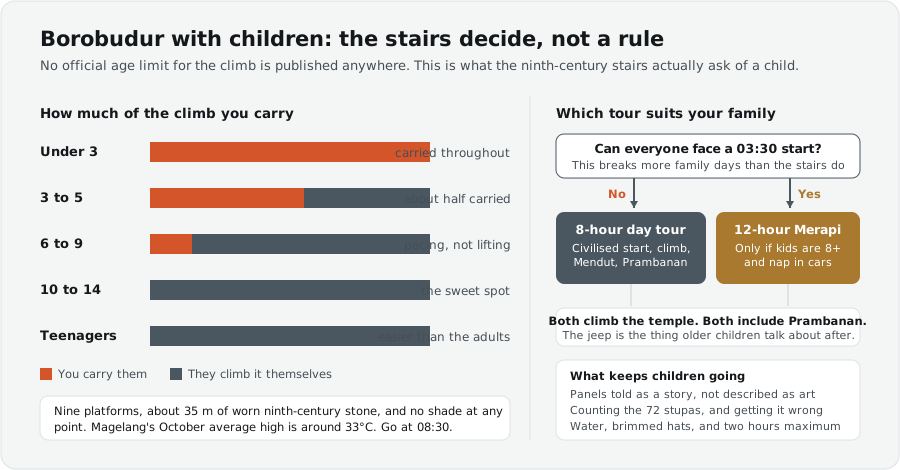
We could not find a published age restriction for the structure climb on any official page, in English or Indonesian. That is an honest gap rather than a green light. The real constraints are physical: steep, worn ninth-century stairs and unshaded stone in tropical heat. Those decide it, not a rule.
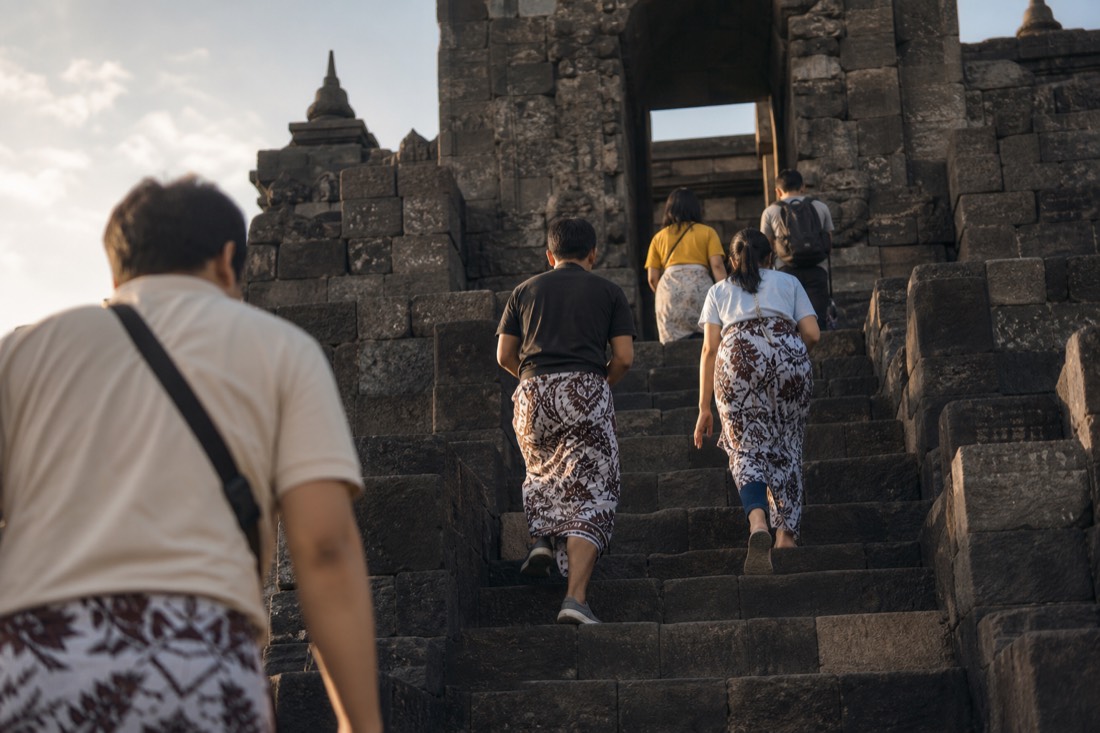
I want to be precise here, because a lot of sites will confidently tell you there is a minimum age. When we went looking through the operator's own ticketing and information pages, no age or accessibility limit for the ordinary climb turned up. What did turn up is that the structure-climb ticket includes a guide and the mandatory Upanat sandals, and that the grounds-only ticket is domestic-only.
So nobody at the gate will stop you bringing a three-year-old up. Whether you should is a different question, and it depends on the stairs rather than the birthday.
What is actually hard about Borobudur with young children?
The stairs. Borobudur's stairways are original ninth-century stone, narrow, steep, and worn into shallow dishes by centuries of feet. There are nine platforms, six square then three circular, rising about 35 metres. For an adult that is fifteen easy minutes. For a small child it is a series of steps built at adult scale, repeatedly.
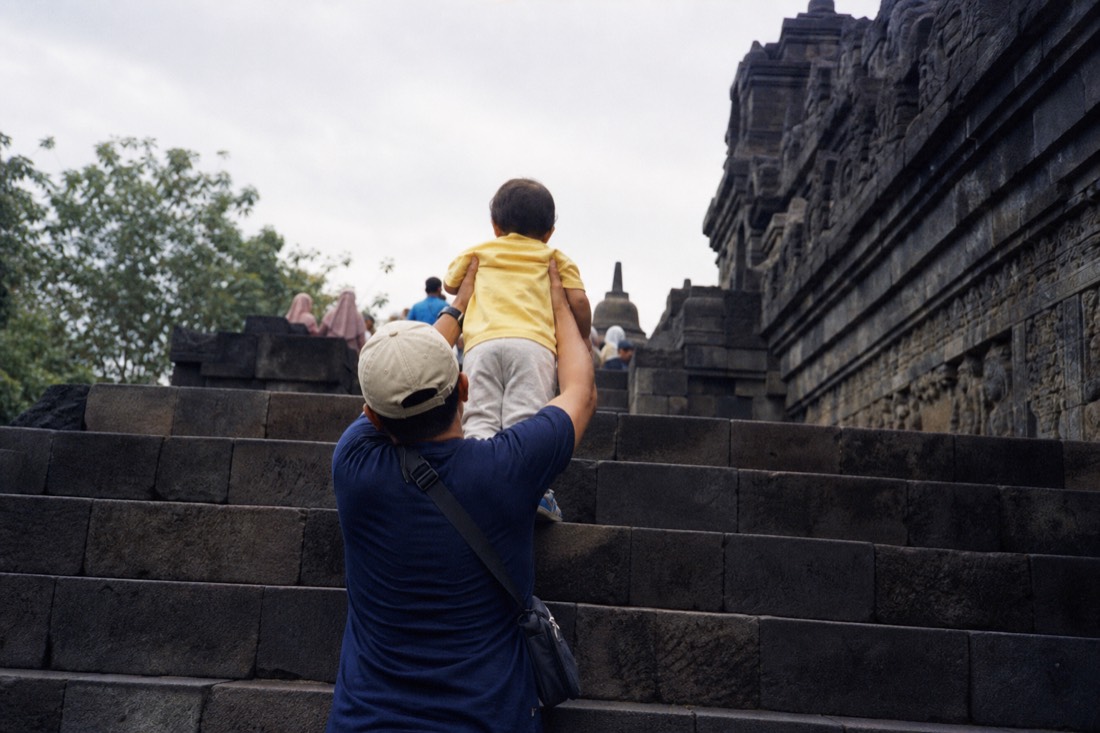
Picture a staircase where each tread is polished smooth in the middle and slightly cupped, at a pitch closer to a ladder than a modern flight, with a handrail that was added for tourists rather than designed in. An eight-year-old goes up it like a goat. A three-year-old cannot, which means you carry them, which means you are climbing steep stone in the heat with fifteen kilos on your shoulder and one hand for the rail.
That is the constraint: not dangerous, not forbidden, just carrying.
| Age band | The climb itself | What usually goes wrong | Honest verdict |
|---|---|---|---|
| Under 3 | Carried the whole way | Adult exhaustion, heat on a sleeping child | Grounds and gardens, skip the structure |
| 3 to 5 | Half climbing, half carried | Stairs at adult scale, no interest in panels | Doable, plan to carry, keep it short |
| 6 to 9 | Manages it, needs pacing | Heat and boredom, not the steps | Good, if you give them a job |
| 10 to 14 | No physical issue at all | Nothing, honestly | The sweet spot |
| Teenagers | Easier than the adults | The 03:30 alarm | Fine, if you let them sleep |
How do children handle the heat at Borobudur?
Badly, if you visit late. There is no shade anywhere on the structure or the terraces, and the pale stone holds the sun. Magelang's average October high sits around 33°C. Children overheat faster than adults and complain later than they should. The first slot of the day, from 08:30, is the single best decision you can make.
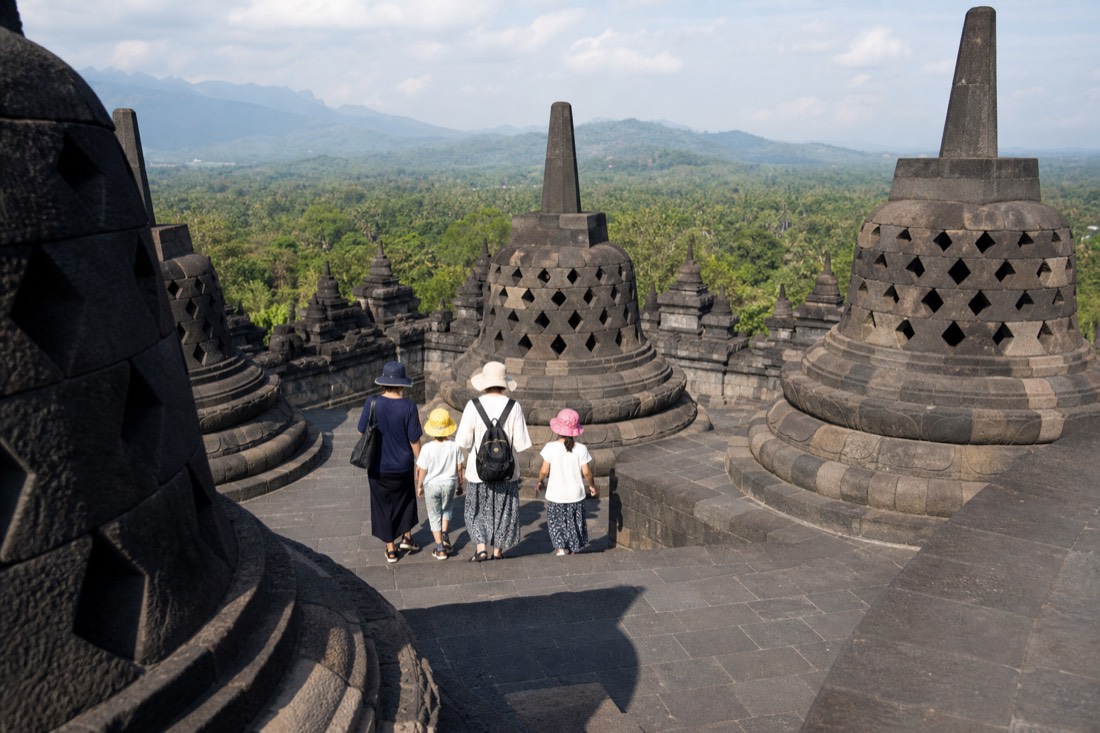
This is the thing families underestimate most. You are on an exposed stone plateau near the equator with a monument that provides no cover by design. At half past eight the stone is still cool from the night and the light comes in sideways across the carvings, which is also when they look best. By eleven the same stairs are a different proposition entirely.
Water and hats, then. Not fashionable hats. Actual brimmed ones.
Which Borobudur tour works best for a family?
Usually the 8-hour day tour with a civilised start. The pre-dawn sunrise tours leave Yogyakarta around 03:30, which means waking children at 03:00 for a hill viewpoint they will not care about, then asking them to climb a temple. The day tour reaches the same stone with everyone rested.
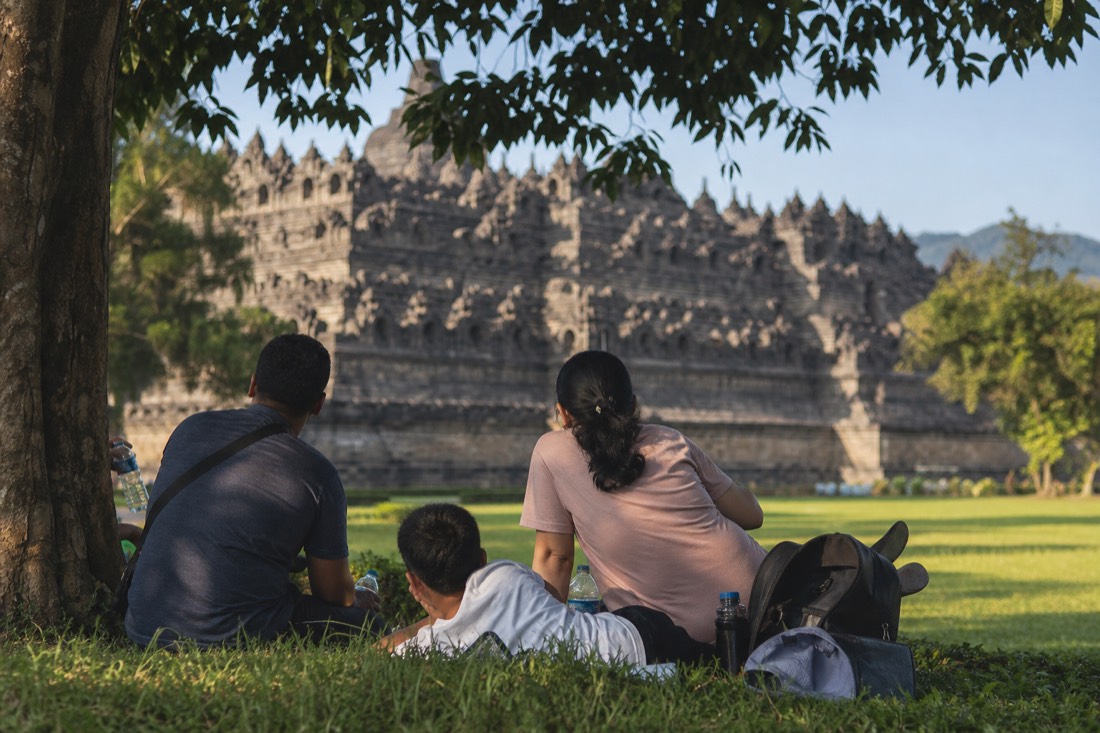
This is the part where I am supposed to sell you the most popular tour, and I am not going to, because for families it is often the wrong one. The 03:30 departure is what breaks family days. Not the stairs. Not the heat. The alarm. A tired six-year-old at a temple is a tired six-year-old wherever you put them, and no view fixes it.
| Tour | Start | Length | Family reality |
|---|---|---|---|
| Borobudur Climb & Prambanan Day Tour | Civilised morning | ~8 hours | The default for families. Adds Candi Mendut. No 03:00 alarm |
| Sunrise, Merapi Volcano & Prambanan | ~03:30 | ~12 hours | Brutal start, but the Merapi jeep is the bit older kids talk about for years |
| Borobudur Sunrise Climb & Prambanan | ~03:30 | Half to full day | Best for couples and photographers, hardest sell to a nine-year-old |
The Merapi tour deserves an honest word, because it is the exception that keeps proving itself. Yes, it is twelve hours and it starts before dawn. But a jeep bouncing over volcanic rubble is, to a ten-year-old, unambiguously better than any temple, and I have watched families where the parents came for Borobudur and the children went home talking about the volcano. If your children nap in cars and love being thrown around, that trade can be worth it. You can check live availability & prices on GetYourGuide for the sunrise climb option if the dawn is genuinely what you want, remembering that its sunrise is watched from Punthuk Setumbu hill and the climb comes after, and the comparison page puts all three side by side without the marketing.
Book the day tour
Rather skip the 3am alarm?
The daytime Borobudur climb with Candi Mendut and Prambanan, no pre-dawn start, hotel pickup included. Free cancellation up to 24 hours, reserve now and pay later: booking takes 2 minutes and costs nothing today.
Check live availability & prices →Do children need their own ticket for Borobudur?
Child pricing exists at the domestic tier. For foreign families, the operator does not publish a child price for the structure climb on any public page, and it does not publish the foreign adult price either. Both appear only in the booking flow or on your tour's listing, which is why a tour that bundles entry removes a real headache.
I would rather say this plainly than invent a figure for you. The domestic climb ticket is listed at IDR 150,000 and that number is solid. Everything on the foreign side of the ledger is gated. Our tickets and prices guide sets out what is published and what is not, and why the numbers on other blogs should be treated with suspicion.
The practical upshot for a family of four: a tour that includes climb access answers the ticket question before you land, and a guide comes with the climb ticket regardless.
What actually engages children at Borobudur?
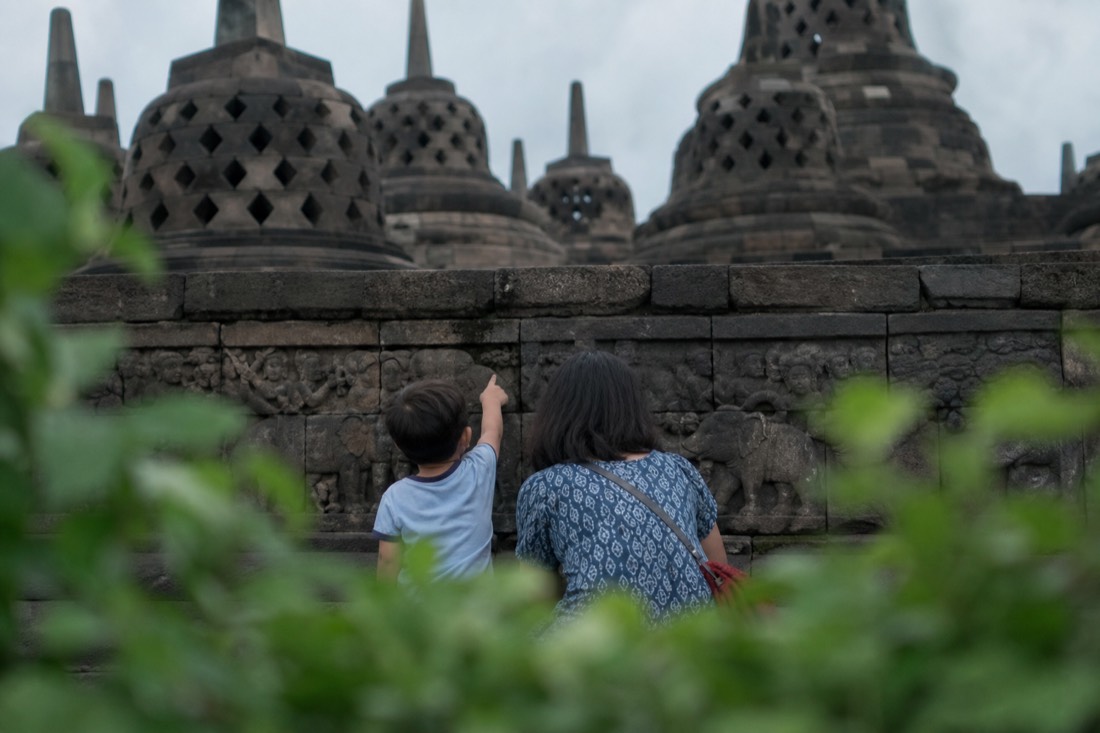
The panels, told as a story rather than described as art. There are 1,460 narrative reliefs and they run in sequence, clockwise and upward. Children who are bored by carvings are rarely bored by a shipwreck, a robbery, or an elephant. The stupas work too: 72 of them, each with a Buddha inside, and counting them is a genuinely good game.
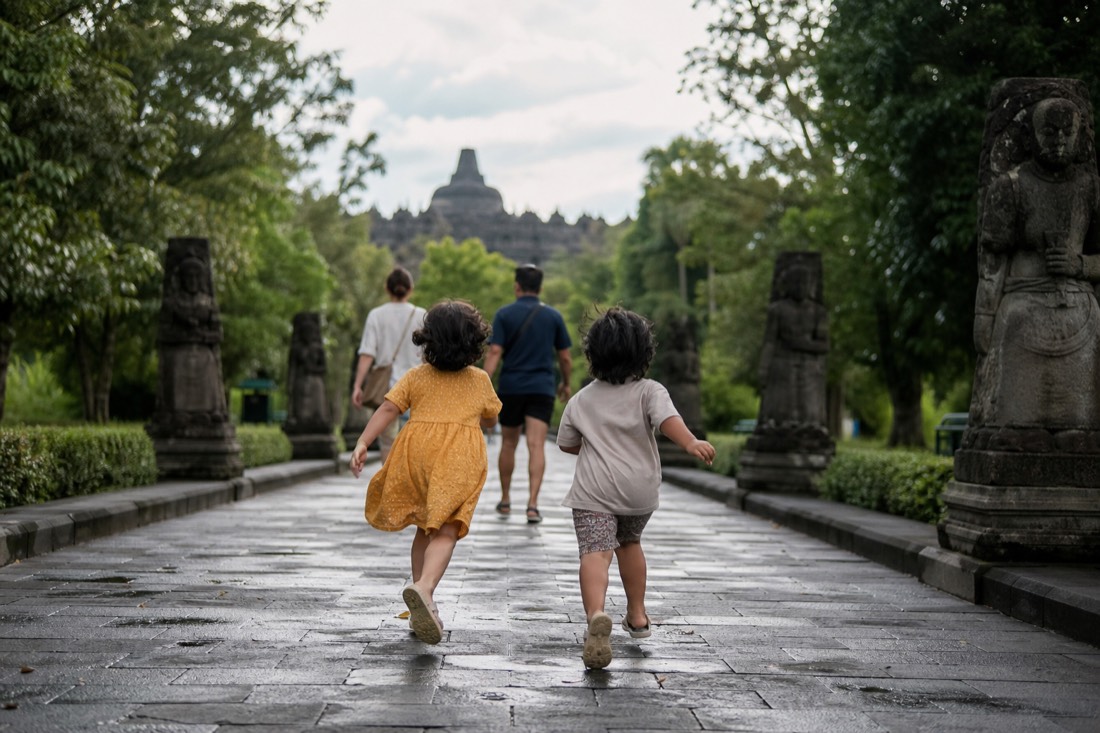
This is the honest secret of guiding families here. Nobody under twelve wants a lecture on Mahayana cosmology. But the monument was built as a teaching object for people who could not read, which makes the carvings a comic strip in stone, and a comic strip is a format children invented for themselves. Point at the ship. Ask what happens next. Walk to the next panel. They will follow you around the entire gallery.
The stupas at the top do the rest. They are perforated, so you can peer in and find a Buddha sitting in the dark, and that hunt keeps a seven-year-old occupied for the twenty minutes you want up there.
| What we tried | Ages it works on | Why |
|---|---|---|
| "Find the ship" on the panels | 4 to 10 | A picture story with a next page |
| Counting the stupas | 5 to 9 | 72 of them, and they will get it wrong |
| Spotting Merapi on the horizon | 6 and up | A real volcano, visible, smoking |
| Explaining the terraces as levels | 8 and up | It is a video game structure, and they see it |
| The Upanat sandal swap | Everyone | They get to keep them |
What should you bring, and when should you go?
Water per person, brimmed hats, sunscreen applied before you arrive, socks if your child dislikes borrowed footwear, and a bag for their shoes. Go at the 08:30 opening. Budget two hours on site and no more; families who plan three hours spend the last one miserable.
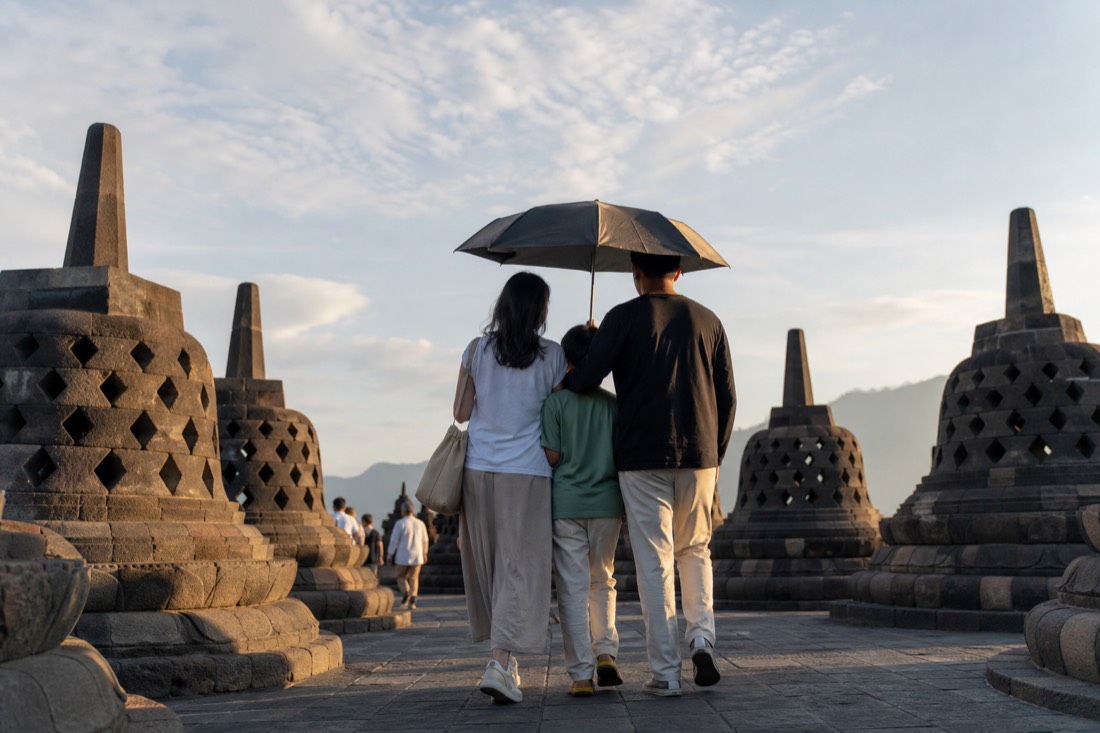
Two hours is the number. Fifteen minutes through the gardens, a few minutes at the base for the sandal swap, forty to sixty on the galleries if your children are engaged, twenty on the summit, then the walk out, which is always longer than anyone expects. Our guide to how long a visit takes breaks that down properly, and the same logic applies with children, just with less slack.
Prambanan comes in the afternoon on all three tours, and it lands differently with children: taller, spikier, more obviously dramatic, and Hindu rather than Buddhist. Some children who shrugged at Borobudur wake up at Prambanan.
So is Borobudur worth it with children?
Yes, above about six, without much hesitation. Below three, take the gardens and skip the structure, and no one will have wasted the trip. Between three and five it comes down to how much carrying you are willing to do in the heat, which is a question only you can answer honestly.
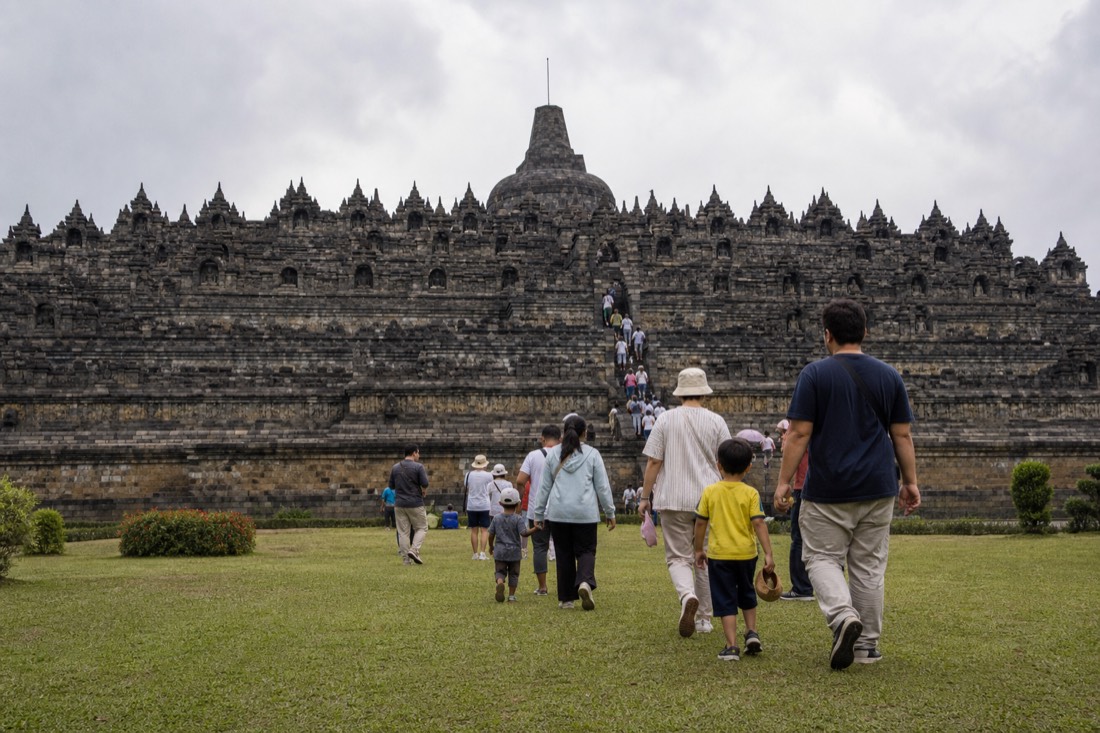
What I would not do is let a website tell you your four-year-old cannot climb it, because no such rule appears to exist. And I would not let one tell you it will be easy either. It is steep, exposed old stone, and you are the one carrying.
If you are still working out what the day itself feels like, what to actually expect on a first visit walks the whole morning through in order. And if someone in your family is set on sunrise, read the difference between the hill dawn and the temple dawn before you book anything, because those are two different products at two very different prices, and the one families usually imagine is not the one they usually buy. The UNESCO listing for the Borobudur Temple Compounds is also a surprisingly good thing to read aloud to a curious ten-year-old on the drive out.
Bring the water. Go early. Let them count the stupas.