2026-07-13
Can You Wear Shorts at Borobudur? What the Rules Actually Say
No official dress code exists at Borobudur, in English or Indonesian. The one real clothing rule is the Upanat sandals. Here is what is regulation, what is courtesy, and what is just sun.
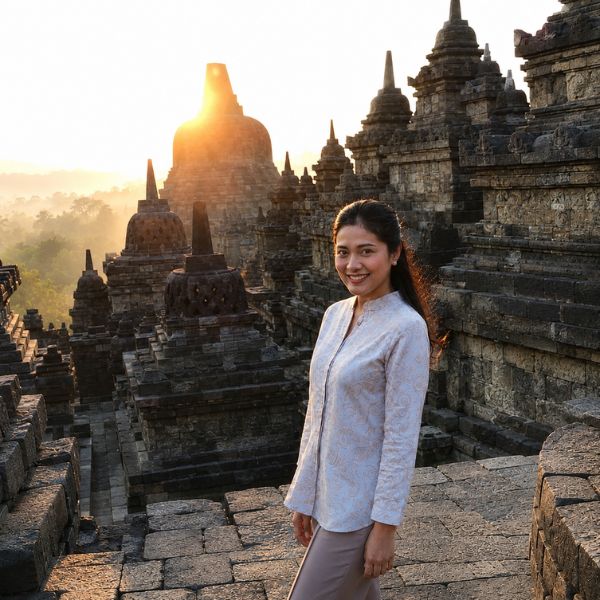 By Dewi Lestari, Borobudur temple tour guide since 2022
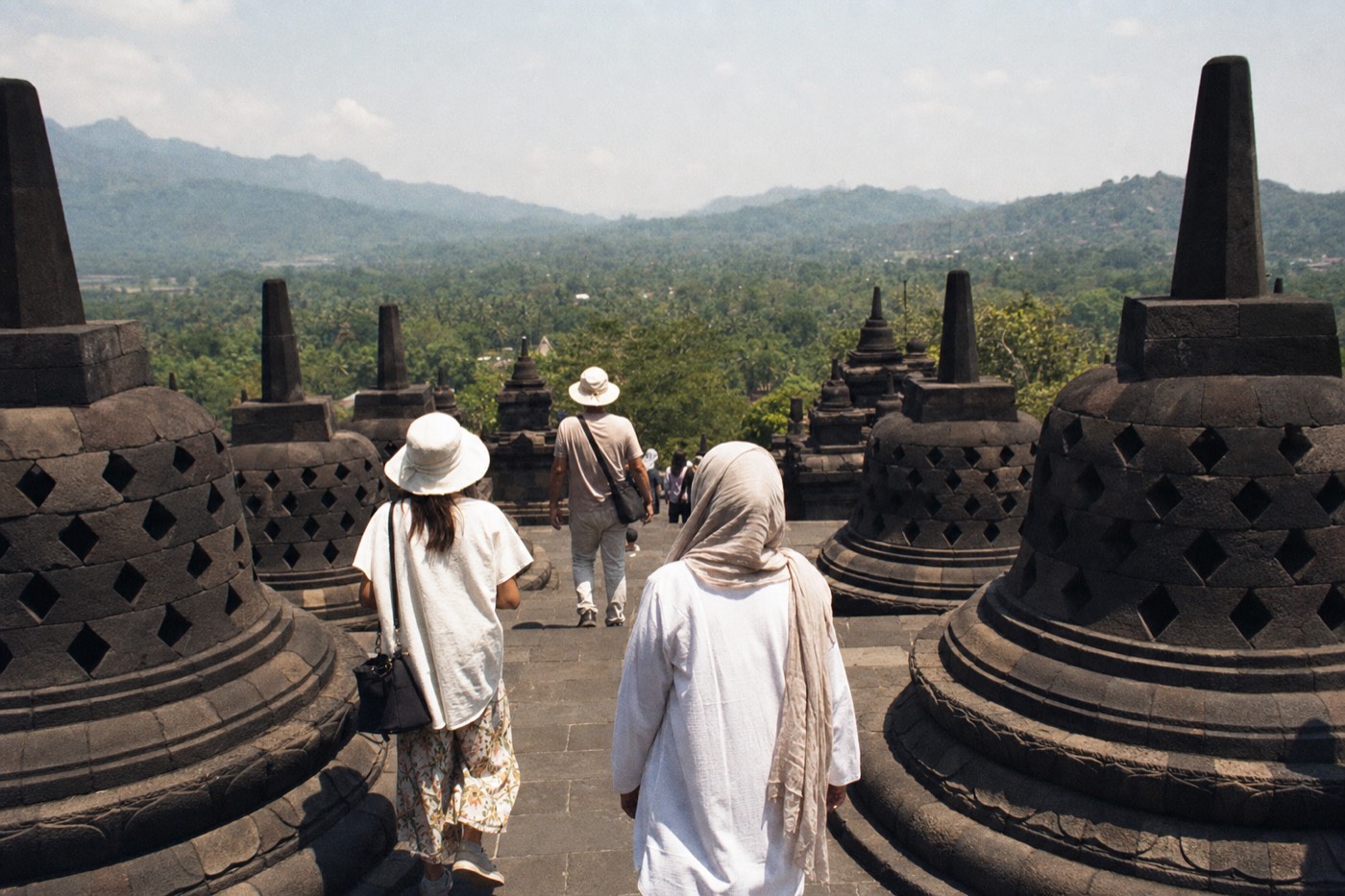
Most mornings someone in my group asks it at the gate, usually quietly, usually after a long look at what everyone else is wearing. They have read that they will be turned away in shorts. They are standing there in shorts. And nothing happens, because nothing was ever going to happen. The wristband goes on, the sandals come out of the box, and we walk up onto stone that by nine o'clock is already throwing heat back at us. The clothing question at Borobudur has a real answer. It is just not the one the search results give you.
Can you wear shorts at Borobudur?
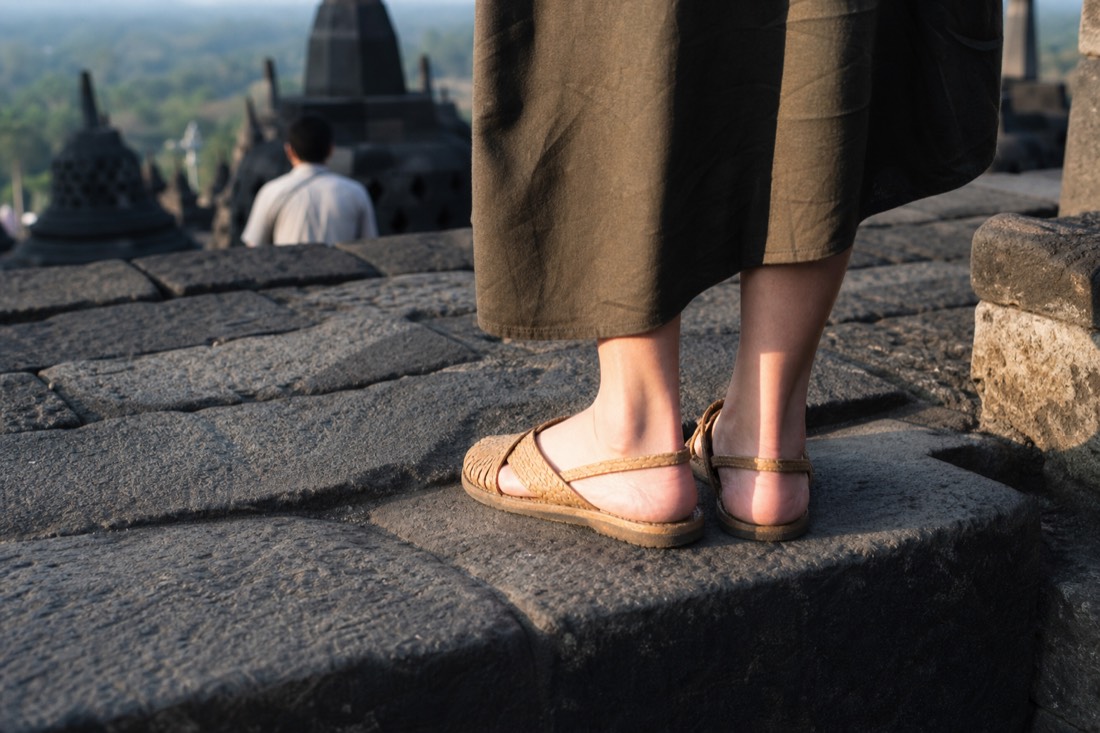
Yes. Shorts are allowed. The operator publishes no general dress code for Borobudur in English or in Indonesian, and nobody at the gate measures your hemline. The only firm clothing rule is footwear: you wear the Upanat sandals issued with your ticket once you step onto the monument itself.
I want to be precise about that. It does not say modesty is irrelevant at a Buddhist site. It says the specific thing travellers panic about, being refused entry over bare knees or bare shoulders, corresponds to no published rule. I have guided here since 2022, I have never seen it happen, and I cannot find the rule anyone claims to be quoting.
Read the operator's own ticketing page for the temple. It lists what the climb ticket includes, the hours, the sandals. There is no clothing requirement on it. The Indonesian-language version does not add one either. A rule that exists nowhere in the operator's material is not a rule.
Is there an official dress code at Borobudur?
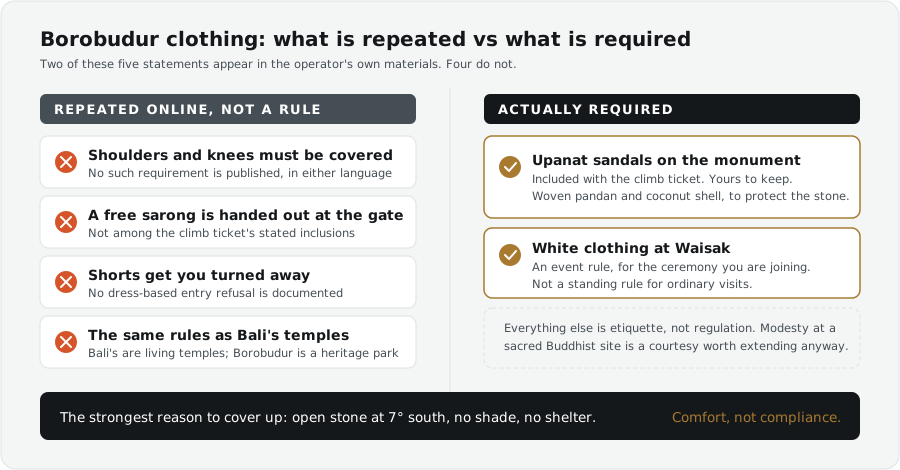
No general dress code is published by Borobudur's operator in either language. What exists instead is a footwear rule for the monument's stone, plus separate dress requirements for specific religious events. Everything else you have read about shoulders and knees is etiquette advice presented as regulation.
The distinction matters because these three things get flattened into one on almost every page you will find.
| The claim | Status | What is actually true |
|---|---|---|
| Shoulders and knees must be covered | Not a published rule | No such requirement appears in the operator's materials |
| A free sarong is handed out at the gate | Not a published rule | This is not part of the ticket's stated inclusions |
| You will be refused entry in shorts | Not a published rule | No dress-based entry refusal is documented |
| You must wear the Upanat sandals on the structure | Real, and firm | Issued with the climb ticket, worn on the monument |
| White clothing at Waisak | Real, event-specific | Applies to the ceremony, not to ordinary visits |
Notice the shape of that table. Everything real is narrow and specific. Everything invented is broad and moralising. That is usually how you tell them apart.
Where does the "covered shoulders and knees, free sarong" rule come from?
It traces to competitor affiliate pages, not to the operator. The claim gets copied from one travel site to the next until sheer repetition makes it feel official. No version of it cites the operator, because the operator never said it.
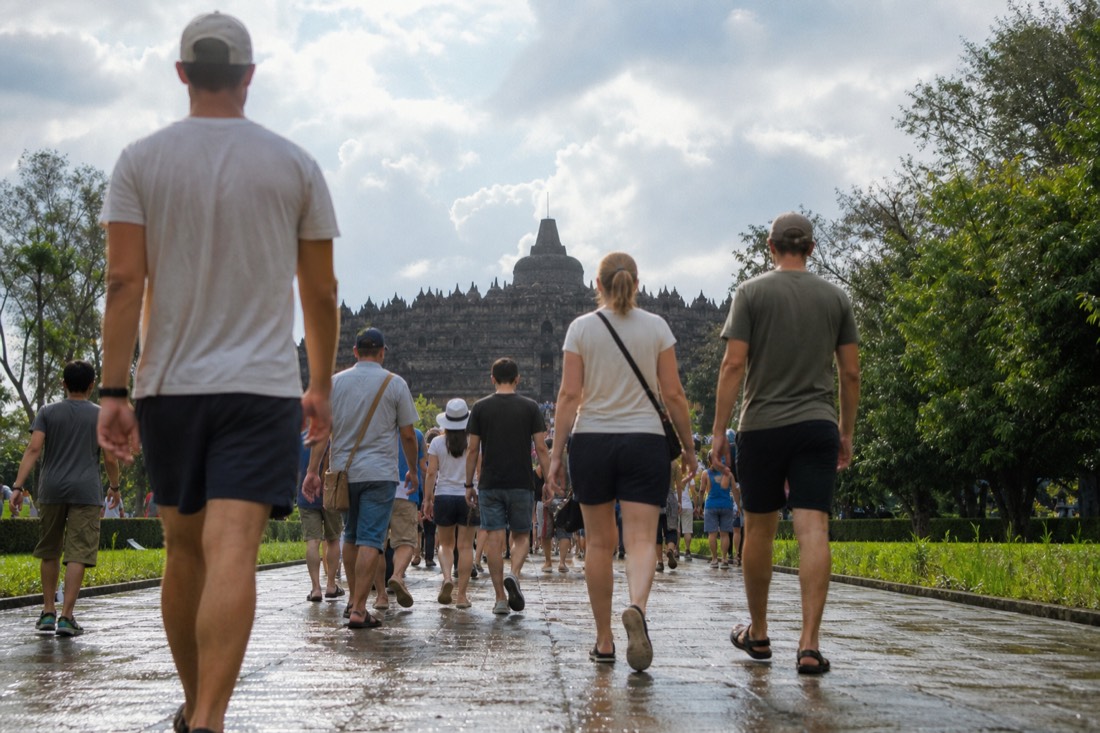
This is the part I find genuinely irritating, and I say that as someone whose living depends on tour bookings. A site writes "cover your shoulders and knees, sarongs are provided free at the entrance" because it sounds authoritative and costs nothing to assert. The next writer, researching by reading the first, repeats it. Ten pages later it is consensus. Nobody lied exactly. Nobody checked either.
You can test the claim yourself in about four minutes, which is what convinced me. Open the operator's ticket page. Search it for the word "dress". Search the Indonesian page for "pakaian". Then ask why a rule enforced on every visitor would appear on none of the pages that visitor is required to read. The answer is that it is not enforced, because it does not exist.
What clothing rule does Borobudur actually enforce?
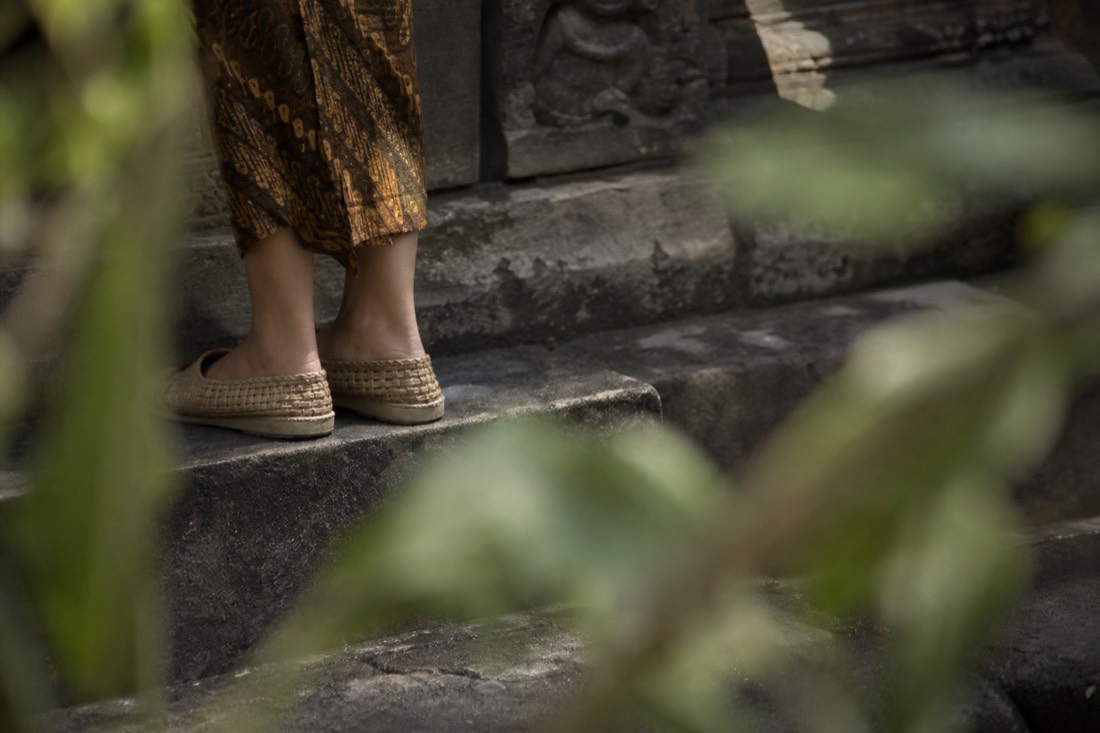
One: the Upanat sandals. Since the climb reopened, everyone who goes up onto the structure wears them, and they come with the ticket at no extra charge. You keep them afterwards. This is the single clothing item Borobudur genuinely requires, and it is about protecting the stone, not you.
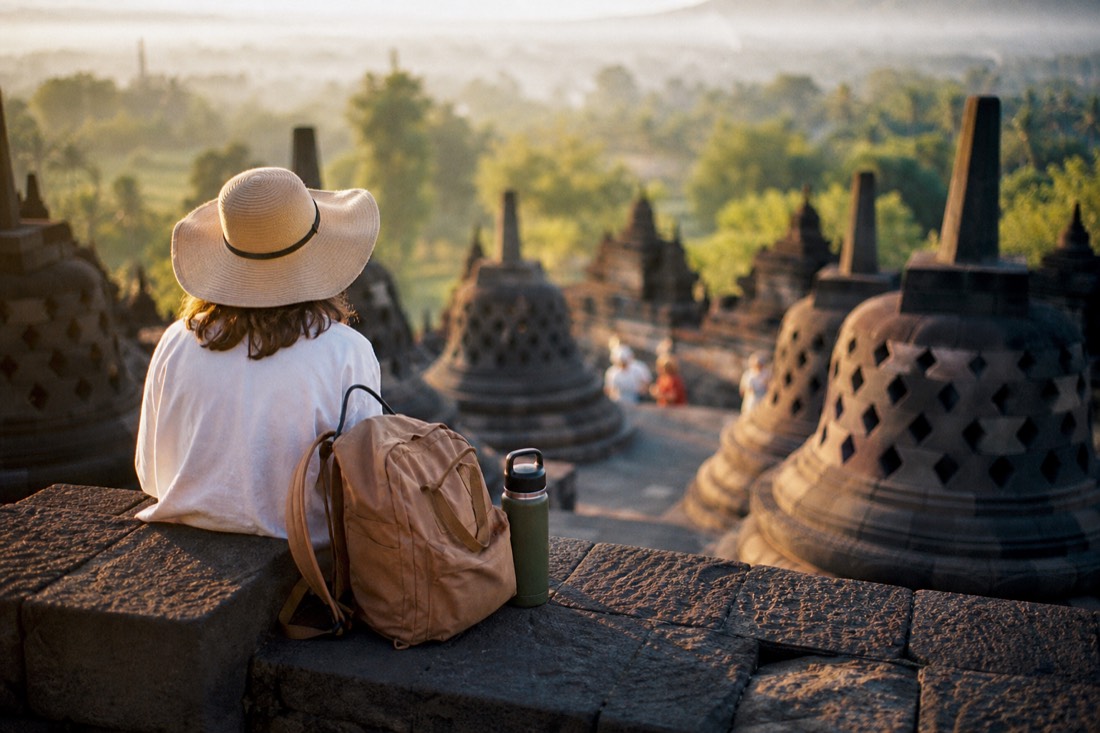
The sandals are woven from pandan leaf and coconut shell over a sponge sole, and they exist because the andesite stairs were wearing down under several thousand pairs of shoes a day. Made by roughly 45 craftspeople across 20 villages around the temple, they are also the rare heritage rule that pays the neighbourhood that lives with the heritage. Production capacity passed 4,000 pairs a day in early 2024, which tells you the scale of the footfall being managed.
Book the sunrise climb
Ready to book the sunrise climb?
Dawn from Punthuk Setumbu, then the Borobudur climb itself, with hotel pickup from Yogyakarta. Free cancellation up to 24 hours, reserve now and pay later: booking takes 2 minutes and costs nothing today.
Check live availability & prices →Why do people think Borobudur has a sarong rule? Blame Bali
Because Bali's temples genuinely do require a sarong and sash, and most travellers meet Bali first. Bali's are living Hindu temples in daily ceremonial use. Borobudur is an archaeological park and a heritage monument. The rules travel with the traveller, even when they should not.
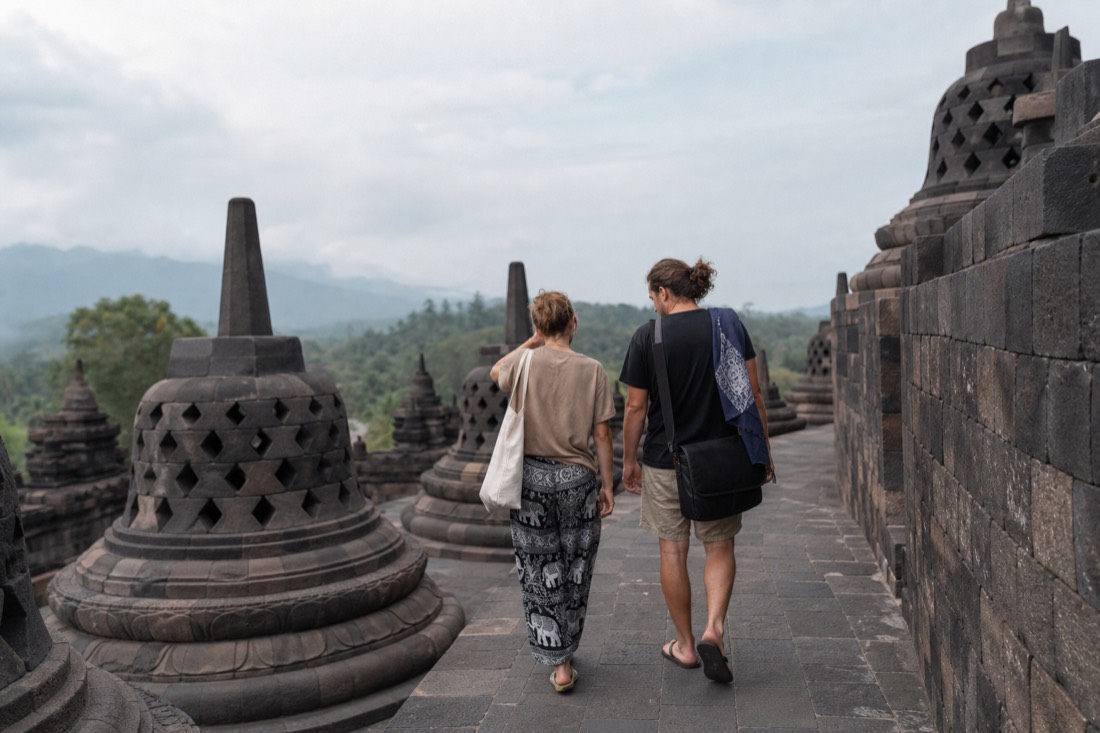
The confusion is understandable, and honestly it does the traveller credit. You arrive at Tanah Lot or Uluwatu, someone wraps a sarong around you before you go in, and you correctly file it as "Indonesian temples have dress rules". Then you fly to Java and expect the same gate.
| Bali's living temples | Borobudur | |
|---|---|---|
| Status | Active Hindu places of worship | Archaeological park, heritage monument |
| Dress requirement | Sarong and sash, genuinely required | None published |
| Provided at entry | Sarong loan is standard practice | Upanat sandals, for the stone |
| Worship on site | Daily, continuous | Pilgrimage at Waisak; not a daily working temple |
| Who sets the rule | The temple community | The heritage-park operator |
Borobudur is a ninth-century Mahayana Buddhist monument, the largest Buddhist temple in the world, inscribed by UNESCO in 1991 as part of the Borobudur Temple Compounds. It is sacred. It is not a parish. Those are different facts and they generate different rules.
When do clothing rules apply at Borobudur?
At events, not on ordinary days. Waisak, the Buddhist festival marking the Buddha's birth, enlightenment and death, brings monks and pilgrims to Borobudur and carries a white-clothing convention for participants. That is a rule for a ceremony you are joining, not a standing rule for the site.
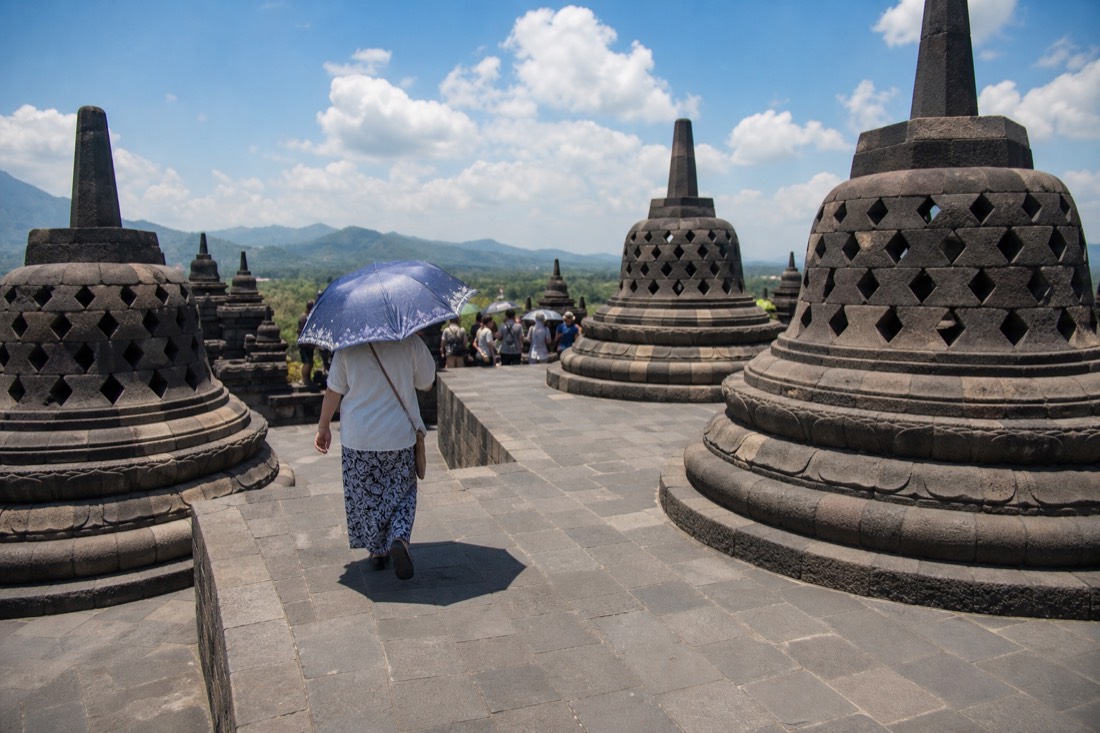
I point to Waisak because it proves the pattern rather than breaking it. When Borobudur wants something specific from what you wear, it says so, clearly, tied to a named occasion. The silence on every other day is not an oversight or a rule too obvious to print. It is the actual position.
If you visit during Waisak, you are a guest at someone's religious festival, and the etiquette bar rises accordingly. That is true at any faith's high holy day anywhere on earth.
What should you actually wear to climb Borobudur?
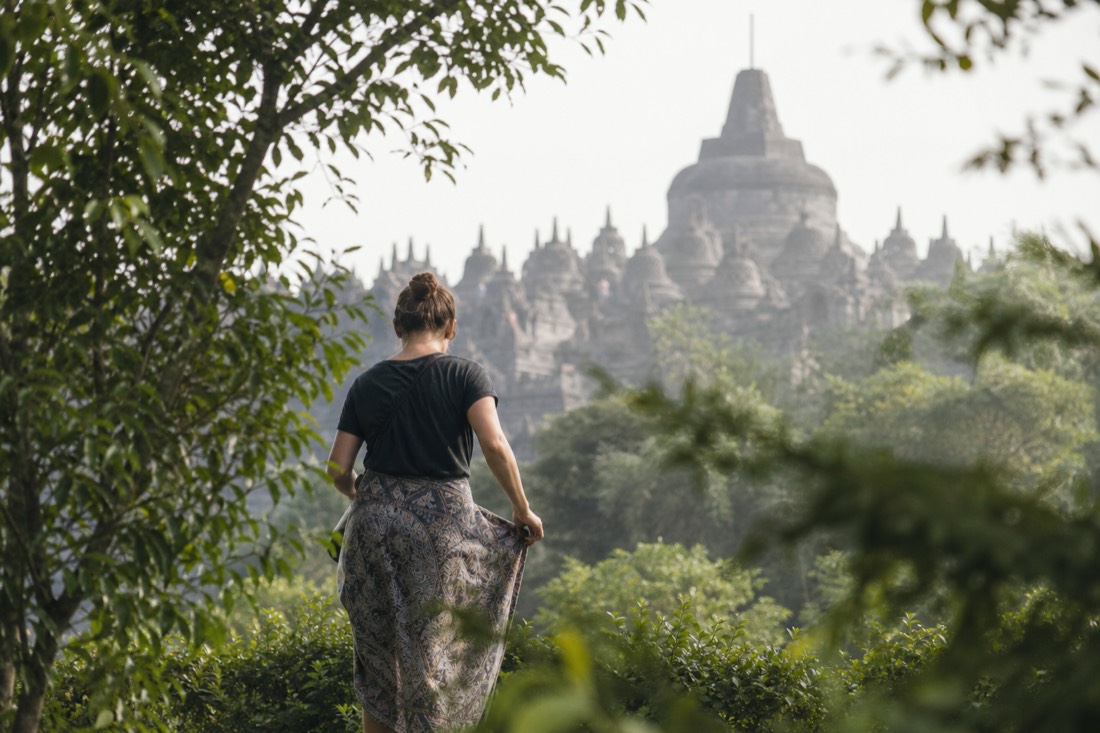
Dress for the sun, not for the rulebook. The terraces sit at seven degrees south with no shade and no shelter, and open stone reflects heat upward at you. Light long sleeves, long lightweight trousers, a hat and sunscreen beat shorts on comfort by mid-morning, every time.
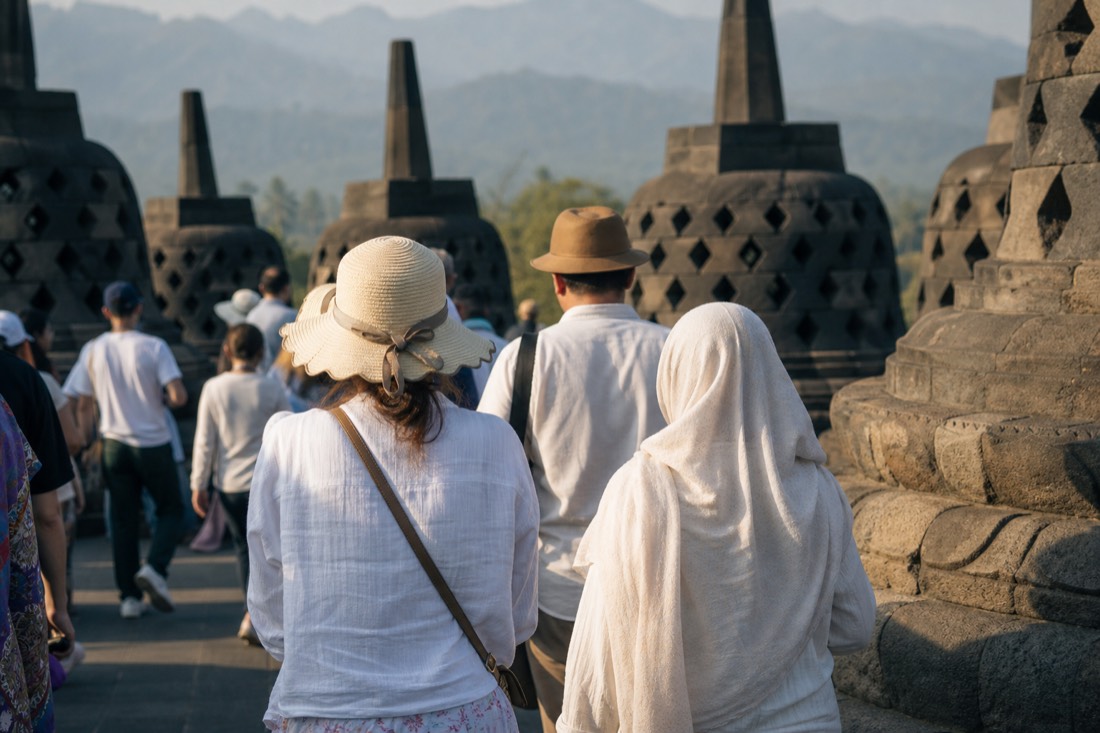
This is the argument that actually changes minds, and it has nothing to do with respect. It has to do with physics. You are on a stone platform, near the equator, in the open. The stone is hot. There is nowhere to hide.
| Item | Why it earns its place |
|---|---|
| Light long sleeves | Sun protection that beats sunscreen you forget to reapply |
| Loose long trousers or a long skirt | Covers the sun argument and the courtesy argument at once |
| Hat with a brim | There is no shade anywhere on the terraces |
| Sunscreen, applied before you arrive | Reapplying while holding a camera on a narrow terrace is miserable |
| Socks, if you want them | The Upanat sandals go over bare feet by default |
| A warm layer, dawn tours only | Punthuk Setumbu before sunrise is genuinely cold |
That last row surprises people. If you are on a dawn tour, you leave Yogyakarta around 03:30 and stand on a hill in the dark, and the same day that cooks you at ten o'clock will have you shivering at five. I have handed out my own jacket more times than I can count.
The courtesy argument still stands alongside the sun. This is one of Buddhism's great sites, monks do visit, and knee-length or longer costs you nothing and reads as respect in every culture standing next to you on that terrace. I am not going to dress it up as a regulation to make you do it. It is simply a decent instinct, and it happens to coincide with the smart one.
Do the tours have their own dress requirements?
No. Any licensed Borobudur climb tour works to the site's rules, which means the sandals and nothing else. What a good tour does is remove the decisions around the clothing: the ticket, the timing, the sandals and a guide are all handled before you arrive.
The climb runs every day, with the structure open 08:30 to 17:00 and the grounds from 06:30, and the climb ticket already includes the sandals, a wristband and a guide. There is no separate clothing checkpoint anywhere in that sequence.
If you want the dawn view first, the Borobudur Sunrise Climb & Prambanan is my most-booked trip, and you can check live availability & prices on GetYourGuide. If a 03:30 start sounds like a punishment, the Borobudur Climb & Prambanan Day Tour starts at a civilised hour and adds Candi Mendut. Either way, wear what you like, and bring the hat.
For the full breakdown, the what to wear guide is the reference version of everything above. If you are working out timing, is it rainy season in Indonesia right now covers the month-by-month pattern, and Borobudur in the rain answers what a wet-season visit actually looks like. The best time to visit guide handles the hours when the sun argument bites hardest.