2026-06-30
Borobudur in the Rain: Does It Still Run, and Is It Worth It?
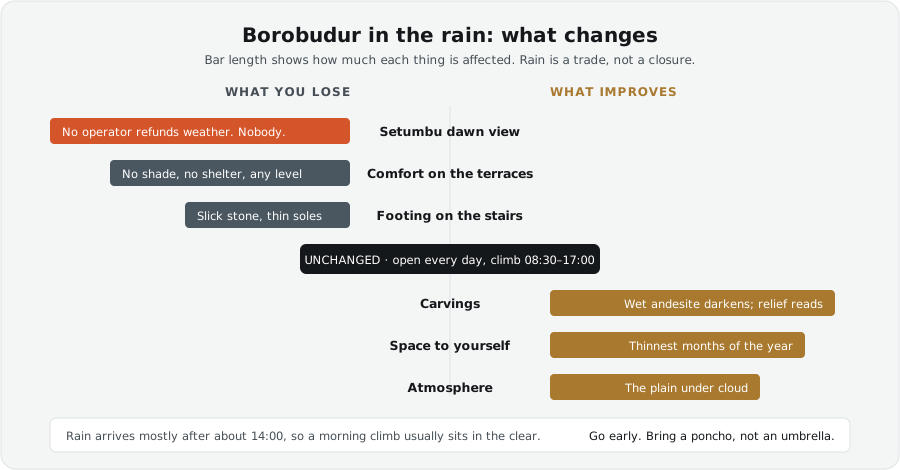
Borobudur opens every day and rain is not a closure. What a wet visit costs you is the Setumbu dawn view. What it gives you is darker stone, sharper carvings and far fewer people.
 By Dewi Lestari, Borobudur temple tour guide since 2022
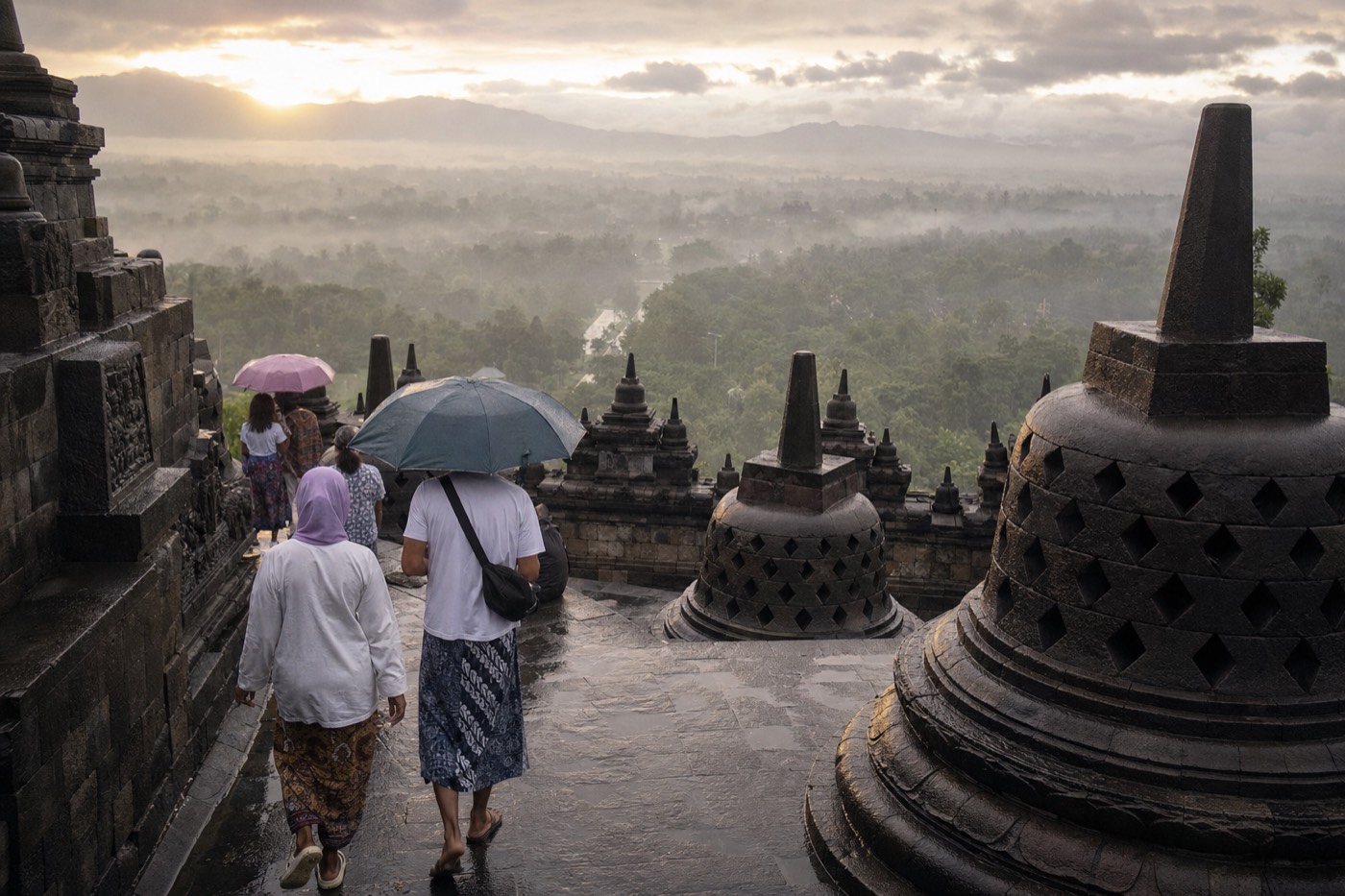
Wet andesite is a different colour. That is the thing I never manage to explain to people before they see it, and the thing they always mention afterwards. Dry stone in August glare goes flat and pale and the carvings sink into it. Add rain and the same panel turns nearly black in its hollows, the relief jumps forward, and a queue of ninth-century figures you would have walked straight past suddenly has faces. I have taken shelter under my own arms on that top terrace more times than I can count, and I have never once thought the day was wasted.
Does Borobudur close when it rains?
No. Borobudur opens every day of the year and rain is not a closure. The structure climb runs 08:30 to 17:00 and the grounds open at 06:30, in any weather. Tours run. What changes in the rain is comfort and visibility, not access.
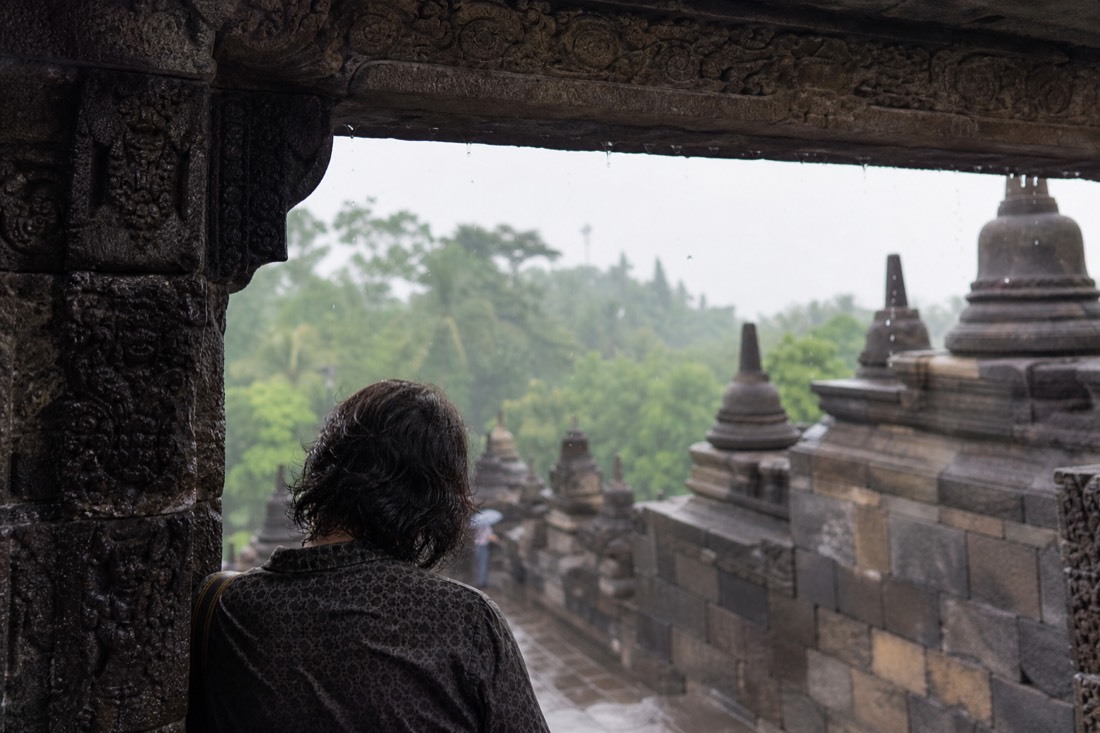
This is the first thing to settle, because a surprising number of travellers assume a wet forecast means a cancelled day and start rearranging a whole Java itinerary around it. The temple does not work that way. The operator's ticketing page lists the hours plainly and carries no weather clause, and since the operator removed the Monday climb restriction in the third week of July 2025, the climb has run every day of the week.
If the rain is violent enough that staff hold people off the terraces for a while, that is a pause, not a closure, and it passes with the squall. In practice you wait it out and go up.
What does the rain take away from a Borobudur visit?
One thing, mainly: the dawn view. Sunrise tours watch from Punthuk Setumbu, a hill about 2.5 km from the monument, and that view lives or dies on cloud. No operator refunds weather, including mine. The rest of what rain costs you is discomfort rather than loss.
I would rather say this bluntly than have you find out on a hill at half past five. Punthuk Setumbu in the wet season is a gamble. You leave Yogyakarta around 03:30, you climb the hill in the dark, and sunrise on the Kedu Plain lands near 05:30. Some wet-season mornings hand you the thing you came for: mist pooling on the plain, the stupa breaking through it, the whole postcard. Other mornings hand you a wall of grey and a wet bench. Nobody can tell you in advance which one you have booked, and nobody will give you your money back for the difference. That is standard across the industry and it is worth knowing before you book rather than after.
| What rain affects | How much it matters |
|---|---|
| Setumbu dawn view | High. The view is the product, and cloud can erase it |
| Access to the monument | None. Open every day, climb runs 08:30 to 17:00 |
| Shelter on the terraces | High for comfort. There is none, at any level |
| Footing on the stone | Moderate. Wet andesite in Upanat sandals is slick |
| Seeing the reliefs | Improves. Wet stone reads better than dry |
| Crowds | Improves. Notably thinner than July and August |
| Photography | Mixed. Worse light, better texture, better sky |
| Prambanan later in the day | Low. Rain is more tolerable there than on a terrace |
What does the rain give you?
Better carvings, fewer people, and a landscape that only exists in the wet season. Water darkens the andesite and pushes the relief forward, so the 1,460 narrative panels read more clearly than they do under flat dry-season glare. And the plain under moving cloud is genuinely one of the sights of Java.
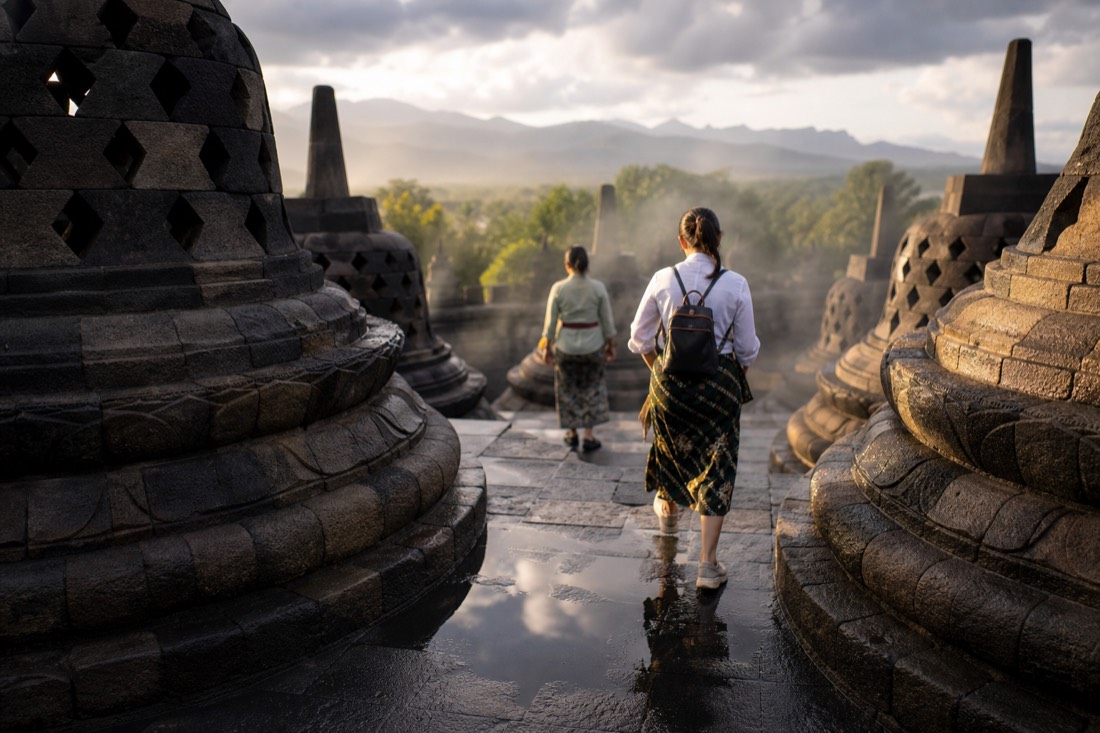
The relief point is not romantic filler, it is optics. Borobudur's panels are shallow carving in grey volcanic stone. In hard overhead sun the shadows that give them their legibility get washed out and the whole surface goes to a single tone. Wet the stone and the water collects in the cut lines, darkening them, so the figures separate from their background. Overcast light does the rest, being soft and even and forgiving in a way that noon in August absolutely is not.
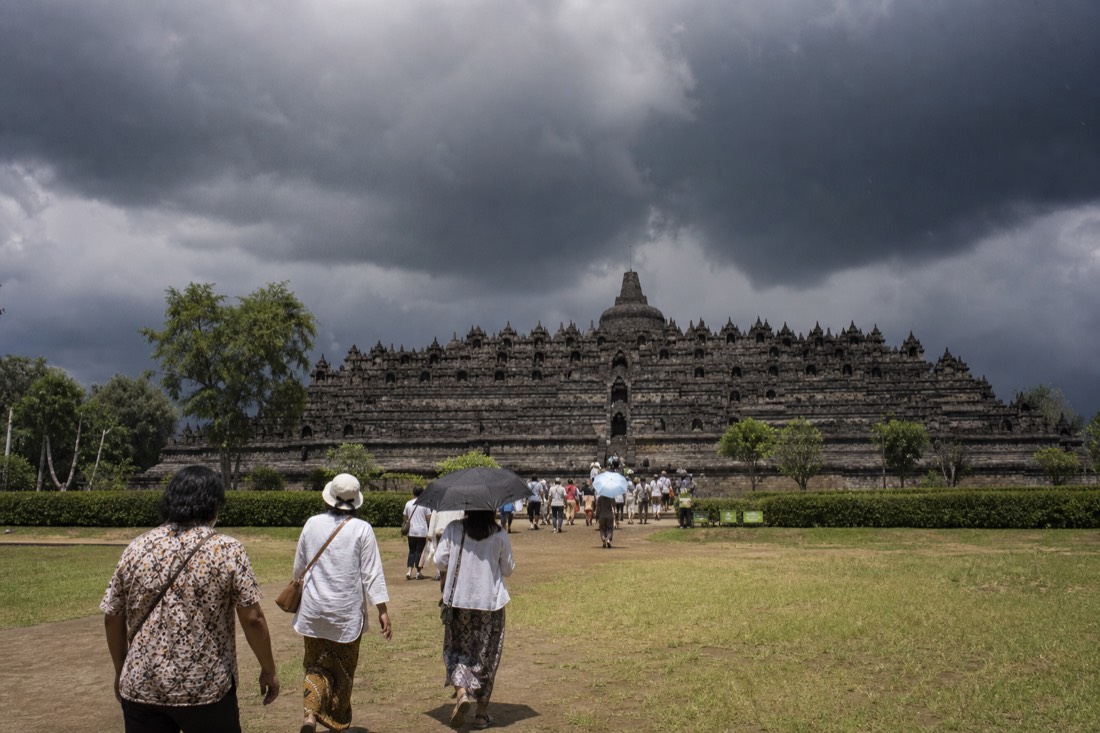
Then there is who else is there. Borobudur took roughly 1.3 million visitors in 2024, about 200,000 of them international, and they are heavily concentrated in the dry months. A wet-season weekday morning on those terraces is a different experience from an August one, and quieter is not a consolation prize at a Buddhist monument. It is closer to the point.
Book the day tour
Rather skip the 3am alarm?
The daytime Borobudur climb with Candi Mendut and Prambanan, no pre-dawn start, hotel pickup included. Free cancellation up to 24 hours, reserve now and pay later: booking takes 2 minutes and costs nothing today.
Check live availability & prices →When does it actually rain at Borobudur?
Mostly after about two in the afternoon. Central Java's wet season runs November to April and peaks December to February, but the rain is convective: it builds through the day and breaks in the afternoon or evening. Mornings are frequently clear, even in February.
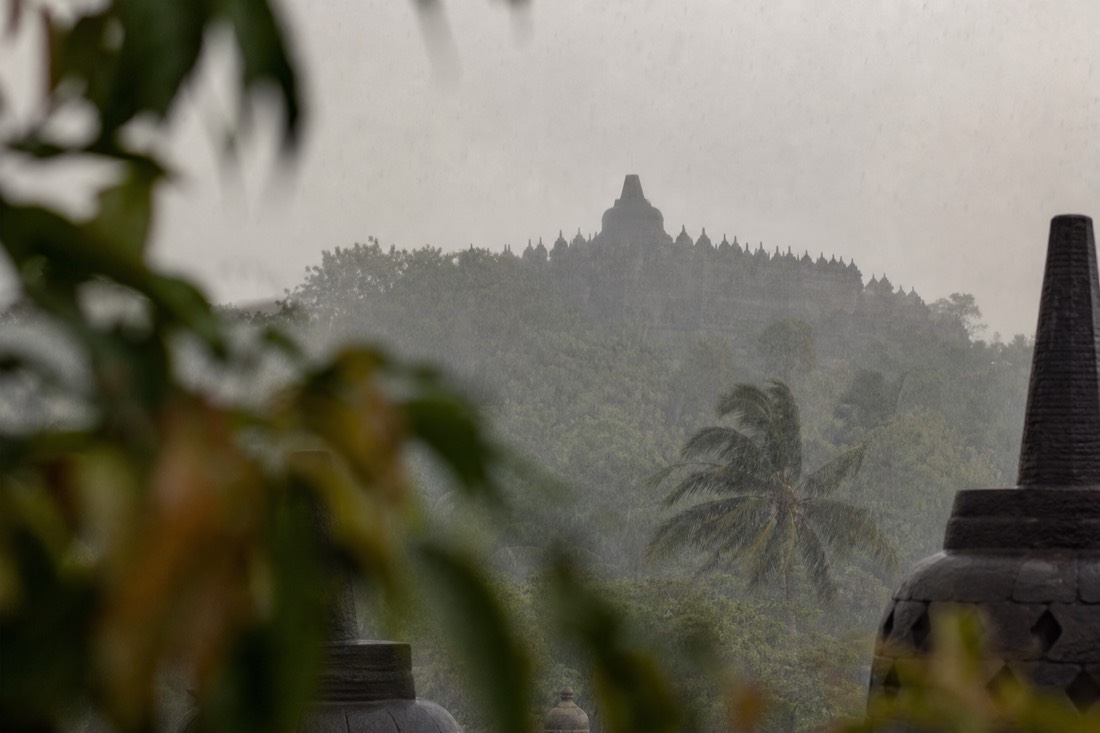
This is why the wet season is far less of a problem than the phrase suggests. You are not choosing between a dry holiday and a soaked one. You are choosing a start time.
| Window | Wet season, typical | What to do with it |
|---|---|---|
| 04:00 to 06:00 | Clear or clouded, no way to know | The Setumbu gamble |
| 06:30 to 08:30 | Often clear, plain still misty | Grounds open, best air of the day |
| 08:30 to 11:30 | Usually clear, cloud building | Climb. This is the window |
| 11:30 to 14:00 | Humid, thickening cloud | Get off the stone, eat |
| 14:00 onward | Downpour likely, often heavy | Prambanan, or a roof |
The pattern is reliable enough that I plan around it rather than around the forecast. Is it rainy season in Indonesia right now has the month-by-month version, and the best time to visit guide sets it against crowds and prices.
What should you bring for Borobudur in the rain?
A poncho rather than an umbrella, and the acceptance that you will be wet anyway. The terraces have no shade and no shelter at any level, so once you are up there, you are in whatever the sky is doing. Wet andesite in Upanat sandals is slippery, so take the stairs slowly.
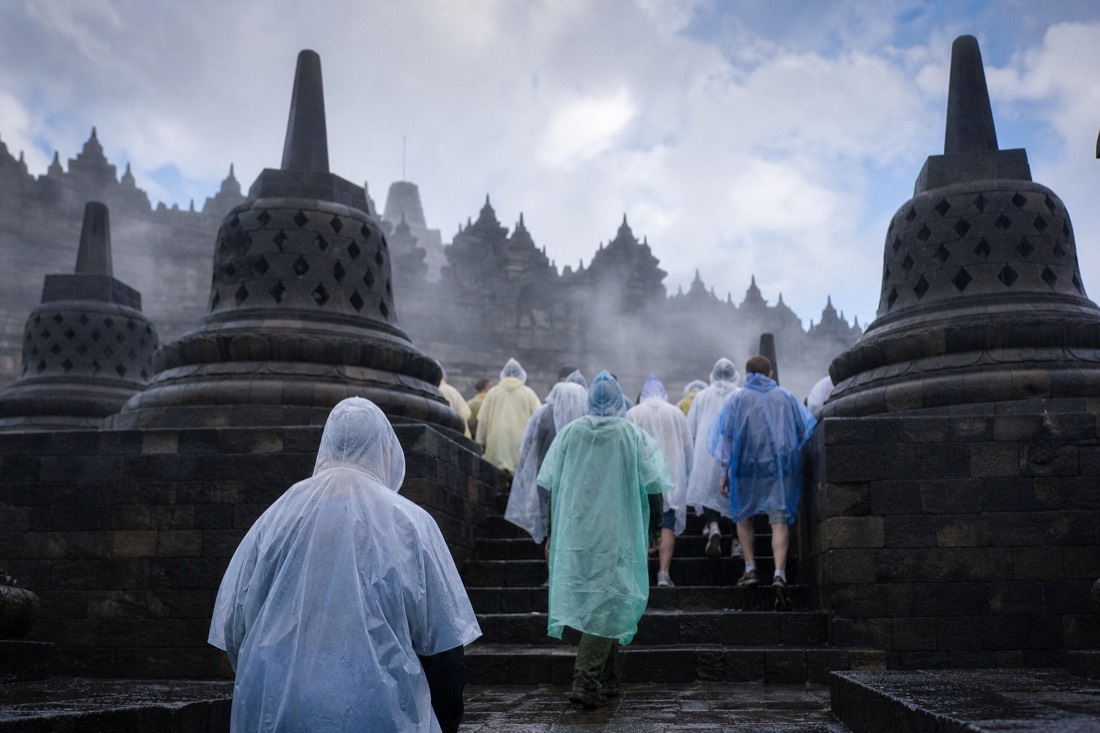
The no-shelter fact catches everyone. People picture a temple as somewhere you go inside. Borobudur has no inside: it is nine platforms of solid open stone, six square and three circular, rising to a main stupa about 35 metres above the base, and there is nowhere on it to get out of the weather. The nearest cover is back down at ground level.
An umbrella is a poor tool here for a practical reason. You are climbing steep narrow ninth-century stairs with one hand wanting the rail and the other wanting your camera. A poncho leaves both free. Ponchos are also sold everywhere around the site for very little.
| Item | Why | Priority |
|---|---|---|
| Poncho, not umbrella | Both hands free on steep wet stairs | Essential |
| Dry bag or zip bag for phone | Downpours here are not a drizzle | Essential |
| Quick-dry clothes | You will get wet; cotton stays wet | High |
| Grippy attitude on stairs | Wet andesite plus sandals plus slope | High |
| Microfibre cloth | Lens and phone screen, constantly | Useful |
| Spare socks | The Upanat sandals do not keep feet dry | Useful |
The sandals are not optional, by the way. They are the one genuine clothing rule at Borobudur, wet or dry, and they come with the climb ticket. What the dress rules actually say covers the rest, which is less than the internet claims.
Should you book a sunrise tour in the wet season?
Only if you can live with losing the view. A dawn tour in the wet season is a real gamble, because the Setumbu view is the thing you are buying and cloud can take it. A day tour is not a gamble in the same way, for a simple reason: it never promised you mist.
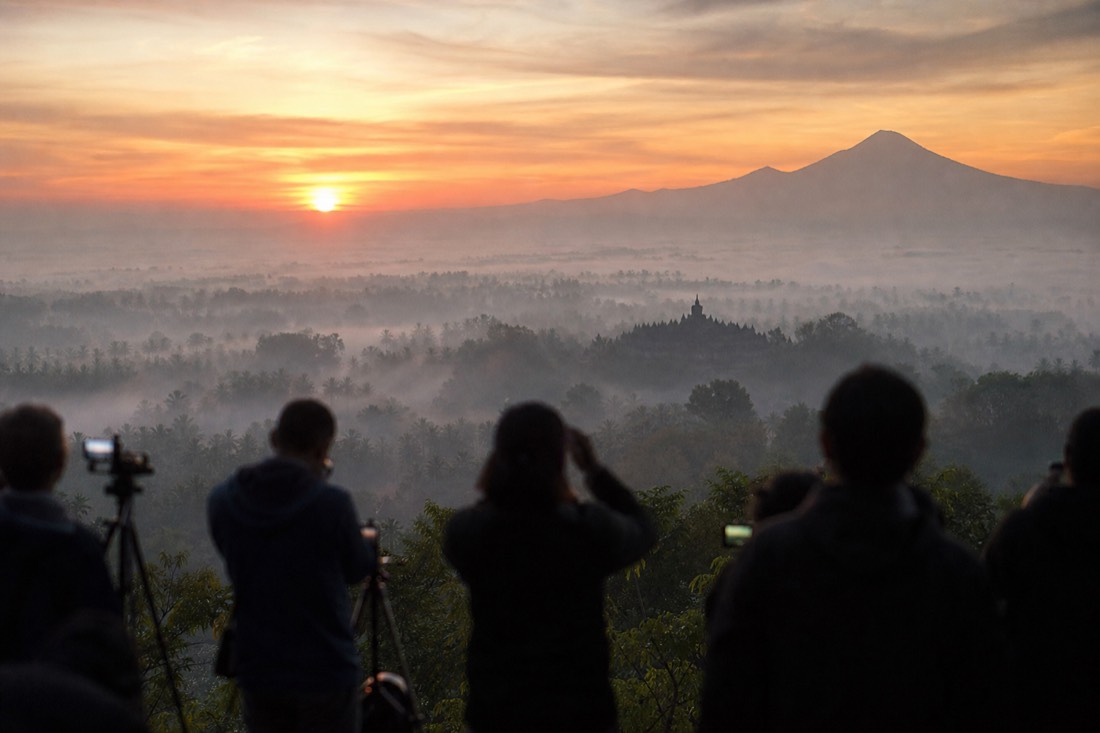
I would rather be straight about this than sell you the wrong trip. My Borobudur Sunrise Climb & Prambanan is the most-booked thing I run and it is a wonderful morning when the sky cooperates. In February, the sky cooperates sometimes. If you understand that going in, and the early start and the guaranteed climb still appeal, you can check live availability & prices on GetYourGuide. The sunrise guide explains exactly what the hill does and does not deliver.
If that gamble does not appeal in the wet months, take the Borobudur Climb & Prambanan Day Tour instead. About eight hours, a start you can face, Candi Mendut and its seated Buddha added, and Prambanan after. Nothing in it depends on a clear horizon at 05:30. That is not a lesser trip in December. It is the better-matched one.
Is Borobudur worth visiting in the rain?
Yes, and I would go further: a wet-season morning is one of the better ways to see it. You lose a view you were never guaranteed and gain a monument that looks the way it was carved to look, with a fraction of the crowd.
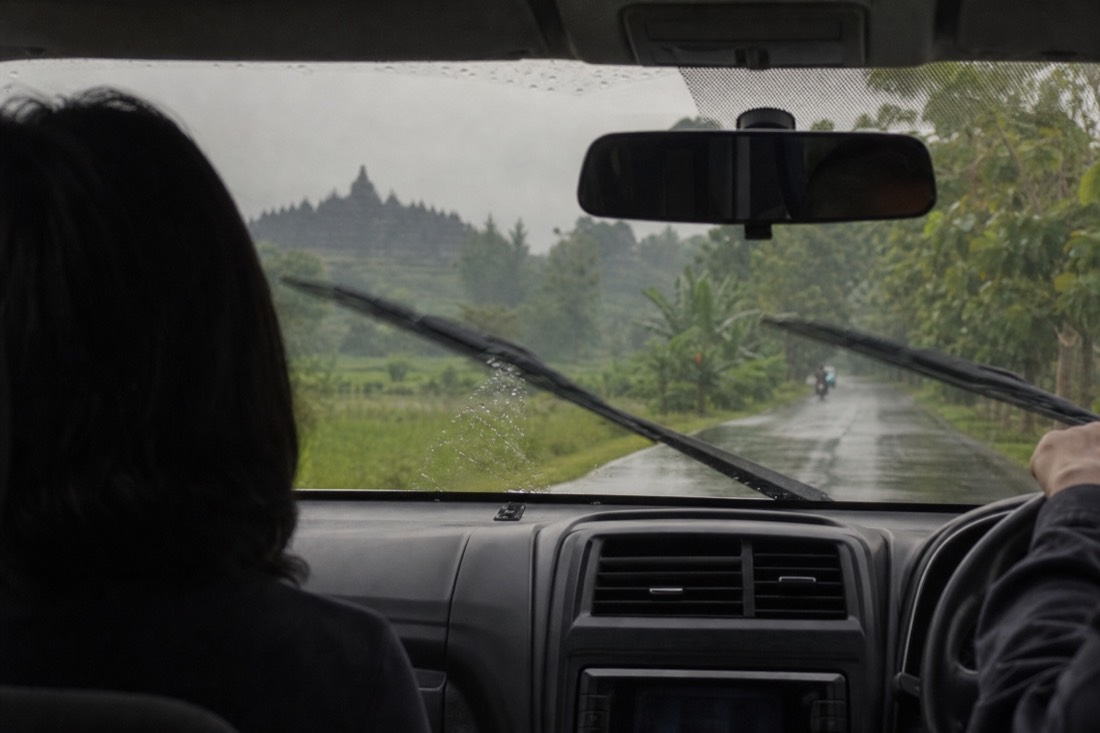
The temple is a ninth-century Mahayana Buddhist monument, the largest Buddhist temple in the world, built from around 778 to 825 AD and carrying 1,460 narrative relief panels. It has stood through roughly 1,200 wet seasons. Rain is not an interruption to Borobudur, it is the climate that made the plain it sits on.
What you are really deciding is which version you want. The dry-season one is bright, certain and crowded. The wet-season one is darker, quieter, riskier at dawn and better at the stone. The climbing guide covers the ascent itself in either. Bring the poncho, start early, and take the stairs like you mean it.